TL;DR
- Sales and production data go straight to billing, which makes sure that invoices are made automatically and correctly.
- You don’t have to take out expensive loans when payments are late. TReDS lets you turn unpaid bills into cash in less than 24 hours.
- AI finds problems like duplicate invoices, wrong prices, or unauthorized discounts before they go out so that customers don’t complain about them.
- Your payment history and external credit scores are used to automatically set the right credit limits and payment terms for each customer.
- The system checks purchase orders, receipts, and invoices all at once to find any mistakes in the number of items or the price before sending out an invoice.
For more than ten years, a shipping company and a manufacturing company in Mumbai had a good business relationship. The shipping company had a fleet that served Southeast Asia, and the manufacturer made capital goods and plastic industry machinery mostly for export.
The shipping company had built up ₹1,45,155 in accounts receivable from the manufacturer over time. The shipping company gave the manufacturer this claim along with supporting invoices and payment receipts, but the manufacturer disputed the amount and refused to accept it, even though there was proof.
After that, there were weeks of negotiations that went back and forth but never reached a conclusion. The shipping company had a tough choice to make: sue a customer who had been with them for ten years or find another way to solve the problem.
In the end, a third party had to step in to help with the case. The mediator put together all of the documentary evidence from both sides, such as ledger accounts, email conversations, purchase orders, unpaid bills, WhatsApp chats, and bank receipts. The process needed to fill in the gaps in understanding between the accounting teams before giving the results to the heads of each business.
The manufacturer could have faced an 18% penalty for not paying once the documentation showed that the claim was true. The shipping company, on the other hand, valued the business relationship more than punishment because they had been working together for a long time. The dispute was resolved peacefully through structured mediation.
This case shows the main problem with manufacturing billing: even with proof (invoices, purchase orders, delivery receipts), billing disputes can freeze working capital for weeks, hurt customer relationships, and need a lot of management time to fix.
For manufacturers with low profit margins and long payment terms, billing mistakes are technical failures that waste money and take up operational bandwidth.
The Billing Problem Nobody Talks About
You’re probably losing more money to billing problems than you realize.
Because billing in manufacturing is uniquely complex and most businesses are still running it like it’s 1995.
You’re managing:
- Multiple suppliers with different payment terms
- Dozens (or hundreds) of customers with varying credit limits
- Complex invoices with line items, batch numbers, GST calculations, discounts
- Purchase orders that don’t always match what was actually delivered
- Payments that arrive 30, 60, sometimes 90 days late (if they arrive at all)
And you’re doing most of this manually.
Someone is typing numbers from a delivery receipt into billing software.
Someone else is cross-checking invoices against purchase orders.
Another person is calling customers asking why they haven’t paid yet.
Every manual step is a point of failure. And those failures are bleeding your business dry.
Let me show you exactly how.
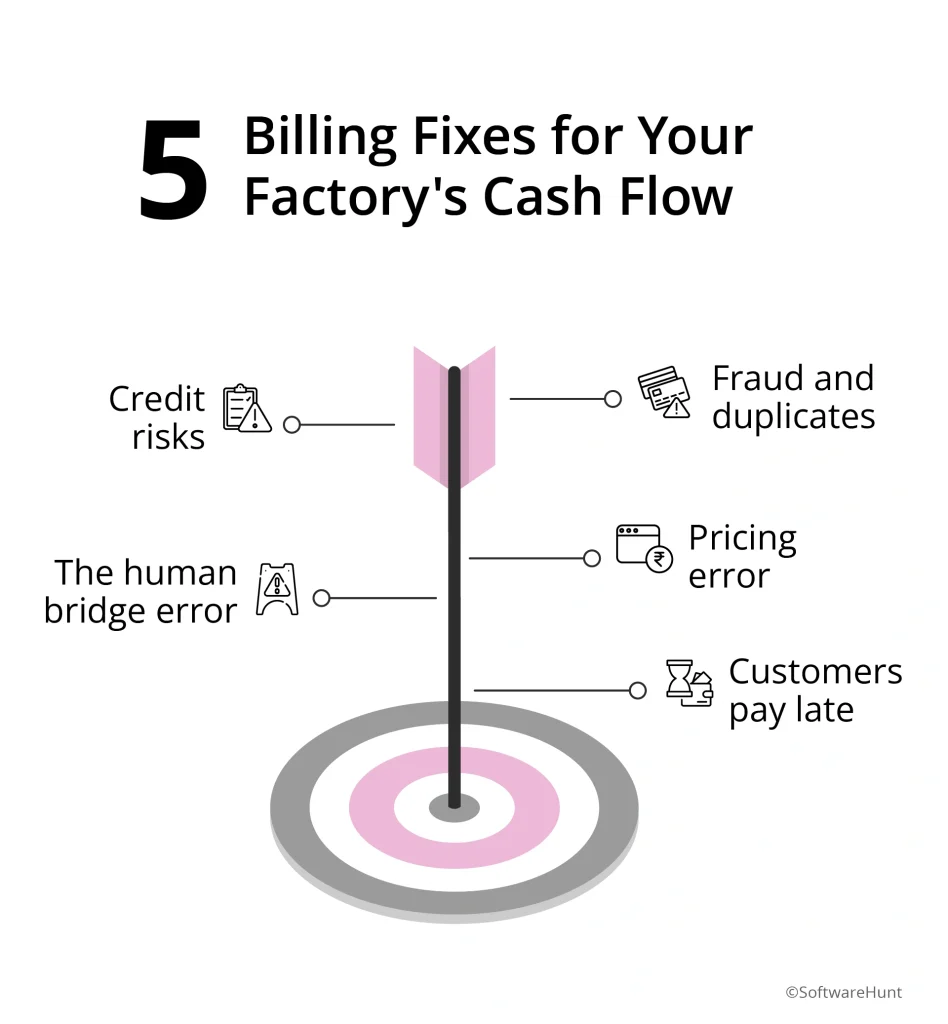
Problem 1: Your Invoices Are Wrong (And You Don’t Know It)
You shipped 500 units of Product A to a customer last week. Your delivery note says 500. The customer signed for 500.
Your billing team invoices 500 units at ₹350 per unit. Total: ₹1,75,000.
But here’s what actually happened:
The salesperson offered a 5% bulk discount during negotiations, mentioned in an email, not recorded anywhere formal. The customer is expecting ₹1,66,250 (after discount).
Your invoice says ₹1,75,000.
The customer receives the invoice. They don’t pay immediately (they’re on Net-30 terms anyway). 30 days pass. They finally look at it. “This is wrong. We negotiated a 5% discount.”
Now you’re 35 days into the cycle. You have to:
- Dig up the email chain proving the discount was offered
- Get approval to correct the invoice
- Generate a credit note
- Re-invoice the corrected amount
- Wait another 30 days for payment
You just turned a 30-day payment cycle into a 90-day nightmare.
And this wasn’t malicious. Nobody tried to cheat anyone. It was just a manual data entry gap between what was negotiated and what was billed.
What This Looks Like In Your Business:
- You discover invoice errors only after customers complain (not before you send them)
- Your billing team spends hours every week fixing “small mistakes” in invoices
- Customers regularly push back on invoices saying “this isn’t what we agreed to”
- You’ve had disputes over quantity, pricing, discounts, delivery charges, GST amounts
- Your accounts team is constantly issuing credit notes and re-invoicing
- You feel like you’re always apologizing to customers for billing errors
Why This Happens:
There’s a “human bridge” between your operations and your billing.
Your production floor tracks what was made. Your warehouse tracks what was shipped. Your sales team negotiates pricing. Your billing team generates invoices.
But these systems don’t talk to each other automatically. Someone has to manually transfer data from one system to another.
And every time a human touches data, there’s a chance for error.
Research shows that over 60% of invoice errorscome from manual data entry. You’re not alone in this.
A single typo – transposing two digits, forgetting a decimal point, missing a discount code – cascades into invoice disputes, delayed payments, and damaged relationships.
Problem 2: Your Customers Are Paying Late (And You’re Funding Them)
Your standard payment term is Net-30. The customer receives an invoice on January 1st. They should pay by January 31st.
It’s now March 15th. No payment.
You call. “Yeah, it’s in the queue. We’ll process it next week.”
Next week comes. No payment.
You call again. Different person. “Let me check… we received it, but there’s a small discrepancy. We’re holding payment until we verify.”
It’s now April 10th. You’ve been waiting 100 days for a 30-day payment.
Here’s what’s actually happening: Your customer is using your invoice as free working capital. They’re holding your money interest-free while they sort out their own cash flow problems.
And you? You’re stuck. You can’t stop doing business with them, they’re 30% of your revenue. But you also can’t keep funding their operations indefinitely.
Meanwhile, your own suppliers demand payment in 15 days. You have payroll due on the 25th of every month. You have rent, utilities, loan payments. All of it comes out of your pocket while your customers take their sweet time.
What This Looks Like In Your Business:
- Your largest customers consistently pay 40-70 days late, and you’ve accepted it as “just how they operate”
- You have ₹50 lakhs to ₹2 crores in outstanding receivables that’s been unpaid for 60+ days
- You’re borrowing from your bank just to cover the gap between customer payments and supplier obligations
- You spend hours every week calling customers: “Did you receive the invoice?” “Can you prioritize our payment?”
- You feel powerless—you need these customers, but they’re suffocating your cash flow
- You’ve started making business decisions based on when customers might pay rather than what the business needs
Why This Happens:
Power imbalance.
If a customer represents 25-40% of your revenue, they know they have leverage. They know you can’t afford to lose them. So they prioritize everyone else’s invoices and pay yours last.
It’s not personal. It’s just cash flow management on their side. Your late payment is their working capital strategy.
But here’s the kicker: You don’t have the same leverage with your suppliers. If you ask your raw material supplier to wait 60-70 days, they’ll either charge you a premium or cut you off entirely.
So you’re trapped in the middle. Funding your customers. Scrambling to pay your suppliers. Using your own working capital (or bank loans) to bridge a gap that shouldn’t exist.
The Hidden Cost:
Let’s do the math.
You have ₹1.2 crore in accounts receivable. Your annual credit sales are ₹8 crore.
Days Sales Outstanding (DSO) = (₹1.2 Cr ÷ ₹8 Cr) × 365 = 55 days
This means customers are taking 55 days on average to pay you. Industry benchmark for manufacturing in India? 45-55 days. So you’re “normal.”
But normal is expensive.
Your daily credit sales are ₹2.19 lakhs. If you could reduce your DSO from 55 days to 41 days (a 14-day improvement), you’d free up:
₹2.19L × 14 days = ₹30.7 lakhs
That’s ₹30.7 lakhs trapped in receivables that could be in your bank account. If you’re borrowing working capital at 12% interest, this delay costs you ₹3.68 lakhs per year in interest alone.
And that’s assuming everything goes smoothly. If customers stretch to 70, 80, 90 days? Multiply that cost.
Why SoftwareHunt?
We’re SoftwareHunt. We work with manufacturing owners running on Tally, Excel, and lean teams to understand your operational leaks and growth challenges. Our team is happy to connect with you, understand your personal pain points, operational leaks and growth challenges and go beyond platform listings/information to help find the right solution for you.
We’ll help you translate symptoms into clear financial insight and show you where to focus first – at no cost to you.
To email an advisor for a quick fit-check write to us at connect@softwarehunt.com.
Problem 3: Your Billing Disputes Are Destroying Customer Relationships
You send an invoice. The customer disputes it. You fix it. You send it again. They approve it. They pay 30 days later.
Sounds manageable, right?
In the US, 55% of invoices are overdue; India’s figure is even worse at 56-63%.
But the real cost isn’t the money. It’s the relationship.
Every disputed invoice is a micro-conflict. Even if you resolve it, the dynamic has changed. The customer now sees you as “the company that bills incorrectly.” You start from a defensive position instead of a collaborative one.
Research shows 60% of customers are highly likely to leave over poor service and billing is one of the top frustrations cited in B2B relationships.
What This Looks Like In Your Business:
- You dread billing cycles because you know disputes are coming
- Your best customers are frustrated with your invoicing process and have mentioned it multiple times
- You’ve lost customers not because of product quality but because “billing was always a headache”
- Your sales team spends time apologizing for billing errors instead of selling
- You feel embarrassed every time you have to issue a credit note or re-invoice
- You know your invoicing process is unprofessional, but you don’t know how to fix it while running the business
Why This Happens:
Most billing disputes stem from misalignment between what was agreed and what was documented.
The salesperson negotiates terms in a conversation or email. The operations team ships based on the purchase order. The billing team invoices based on a different document (or outdated pricing). Nobody’s deliberately trying to mess up—but the information isn’t flowing cleanly.
Add to this:
- Partial shipments that don’t match the original PO
- Price changes between order and delivery that weren’t communicated
- Discounts offered verbally but not recorded
- GST calculations that vary by state or product
- Delivery charges, handling fees, or other “miscellaneous” costs added without prior agreement
Each of these creates a point of friction. And over time, friction destroys trust.
Research shows that invoice disputes signal communication and service issues. Even when you resolve the dispute, the underlying problem (poor systems) remains. So it happens again. And again.
Eventually, the customer decides it’s easier to work with someone else.
Problem 4: You’re Shipping to Customers Who Can’t (Or Won’t) Pay
Here’s a nightmare scenario:
You get an order from a new distributor. Big order, ₹15 lakhs. They seem legitimate. They’ve been in business for 5 years. You agree to Net-45 terms. You ship the goods.
45 days pass. No payment.
You call. “We’re having some cash flow issues. Can you give us another 30 days?”
You agree. 30 days pass. No payment.
You call again. Voicemail. No response.
You’ve just lost not only the ₹3-lakh profit margin on that order—you’ve lost the ₹12 lakhs in cost of goods. Raw materials. Labor. Logistics. All gone.
And you have no recourse. You can hire a lawyer, send legal notices, maybe recover 20-30% after months of litigation. But the rest? Write-off.
What This Looks Like In Your Business:
- You’ve been burned by at least one customer who defaulted on payment
- You have “bad debt” written off on your books from customers who disappeared
- You’re nervous every time you ship to a new customer on credit
- You’ve tightened credit terms so much that you’re losing legitimate business opportunities
- You don’t have a systematic way to evaluate whether a customer is creditworthy before shipping
- You rely on “gut feel” or “they seem okay” when deciding who gets credit
Why This Happens:
You don’t know who’s creditworthy until after they’ve defaulted.
Most manufacturers don’t check customer credit scores before extending terms. They rely on reputation, referrals, or gut instinct. “They’ve been in business for 10 years, they’re probably fine.”
But here’s the reality: The average probability of default for Indian manufacturing firms is 0.45%. That might sound low, but when you’re dealing with hundreds of customers and crores in receivables, even a 0.5% default rate is devastating
And during economic downturns? Default rates spike. In FY 2020, corporate defaults hit 4.5%. Even large, established companies can default if their own customers stop paying them.
So when you ship ₹15 lakhs worth of goods to a “legitimate” customer without checking their financial health, you’re gambling. And sometimes, you lose.
Problem 5: Your Invoices Don’t Match Your Delivery (And Nobody Notices Until It’s Too Late)
You receive a purchase order from a customer for 1,000 units of Product B at ₹500 per unit. Total: ₹5,00,000.
Your warehouse ships 950 units (they were short 50 units, planned to ship the remaining later).
Your billing team invoices for 1,000 units. ₹5,00,000.
The customer receives 950 units. They check the invoice. It says 1,000.
They reject the invoice.
Now you have to:
- Verify what was actually shipped (check warehouse records, delivery receipts)
- Confirm the shortage with your operations team
- Re-invoice for 950 units
- Explain the shortage and provide a timeline for the remaining 50 units
- Wait for customer approval
- Wait another 30 days for payment
Meanwhile, the customer is frustrated. “Why didn’t you just invoice what you shipped?”
Good question.
What This Looks Like In Your Business:
- Your invoices frequently don’t match what was actually delivered
- Customers regularly push back saying “we only received X units, but you billed for Y”
- You have partial shipments that create invoice confusion
- Your warehouse, operations, and billing teams aren’t synchronized
- You spend hours every week reconciling delivery receipts, purchase orders, and invoices
- You’ve had situations where goods were returned but the invoice wasn’t adjusted
Why This Happens:
The problem is called three-way matching failure. Ideally, three documents should perfectly align:
- Purchase Order (PO): What the customer ordered
- Goods Receipt Note (GRN): What was actually delivered
- Invoice: What you’re billing for
When all three match – quantities, prices, descriptions – payment is smooth. But when they don’t match, everything grinds to a halt.
Common reasons for mismatch:
- Partial shipments: You shipped 950 units instead of 1,000, but billing wasn’t updated
- Price changes: The price changed between PO creation and delivery, but the PO wasn’t revised
- Missing PO numbers: The supplier (you) didn’t include the PO number on the invoice, making it nearly impossible for the customer to match
- Timing issues: Your billing team invoices as soon as goods ship, but the customer hasn’t received them yet
- Receiving errors: The customer’s receiving team logged 1,000 units when they actually received 950
Each mismatch requires manual investigation. The customer’s accounts payable team has to contact their warehouse. Your team has to dig through shipping records. Emails fly back and forth.
The average invoice exception takes 8.3 days to resolve. That’s 8.3 days your cash is frozen. Multiply that across dozens of invoices per month, and you’re looking at massive delays.
The Cascade Effect: How One Billing Problem Creates Five More
Here’s what most manufacturing owners don’t realize: These five problems compound each other.
You have a manual data entry error (Problem 1). So your invoice is wrong. The customer disputes it (Problem 3). Now payment is delayed by 30-60 days (Problem 2). Meanwhile, you shipped to another customer without checking their credit (Problem 4), and they default. Now you need cash urgently, so you’re chasing all your outstanding invoices aggressively, which damages more relationships (Problem 3 again). And because your invoices don’t match delivery records (Problem 5), every collection call turns into a 20-minute reconciliation nightmare.
Each problem makes the others worse.
And the most brutal part? You’re losing money in ways you can’t even measure.
A typical ₹50 crore manufacturing unit can save ₹40-65 lakhs annually by fixing billing problems. That breaks down to:
- ₹10-15 lakhs from eliminating manual data entry errors
- ₹20-30 lakhs from reducing DSO (freeing working capital)
- ₹10-20 lakhs from avoiding bad debt and capturing early payment opportunities
But most manufacturers never calculate this. They just know “cash is tight” and “customers pay late.” They don’t realize their billing process is costing them 8-13% of revenue every year.
What Actually Needs to Happen
You understand the problems now. You recognize at least three of them in your business.
But knowing the problem and fixing it are two different things.
Because here’s the real challenge: You can’t stop operations to fix billing. Customers need invoices. Suppliers need payments. Your team is already stretched thin.
You need to:
- Identify which billing problem is costing you the most money (Is it DSO? Bad debt? Invoice errors?)
- Quantify the financial impact (How much is this actually costing you per month?)
- Build a systematic fix (Not a one-time cleanup—a process that prevents the problem)
- Implement without disrupting operations (You can’t shut down billing for 3 months)
- Measure whether it’s working (Did DSO improve? Did dispute rates drop?)
This isn’t something you figure out alone in a spreadsheet. You need someone who’s seen this before. Someone who knows which billing leak to fix first, which systems to connect, and how to implement changes without creating new problems.
Stop Bleeding Cash Through Your Invoices
We’re SoftwareHunt. We work with manufacturing owners running on Tally, Excel, and lean teams to understand your operational leaks and growth challenges. Our team is happy to connect with you, understand your personal pain points, operational leaks and growth challenges and go beyond platform listings/information to help find the right solution for you.
We’ll help you translate symptoms into clear financial insight and show you where to focus first – at no cost to you.
To email an advisor for a quick fit-check write to us at connect@softwarehunt.com.