Key Takeaways
- Automation is about removing manual work.
- Use a 3-criteria framework to identify your first automation target, pilot test before purchasing, and follow the 3-Month Rule to ensure success.
- Most SMEs start with barcode systems or quotation templates, not complex ERP systems.
Industry association meeting, tea break, Nasik, Saturday afternoon
[Priya Menon slumps into a chair, tossing an Industry 4.0 seminar pamphlet onto the table. Sameer Kulkarni, sitting nearby with his chai, overhears her frustrated sigh.]
Priya: That seminar was completely useless for people like us, right?
Sameer: [Looking up] The one with the ₹2 crore robotic cell doing synchronized assembly?
Priya: Exactly! Beautiful demo, sure. But what does that have to do with my valve factory in Coimbatore? I have 42 people and mostly manual operations. That speaker might as well have been showing me how to build a spaceship.
Sameer: [Chuckling] I walked out of the same seminar three years ago feeling exactly like that. Then I spent ₹35,000 on my first automation. Changed everything.
Priya: [Leaning forward] ₹35,000? Wait, what did you automate for that?
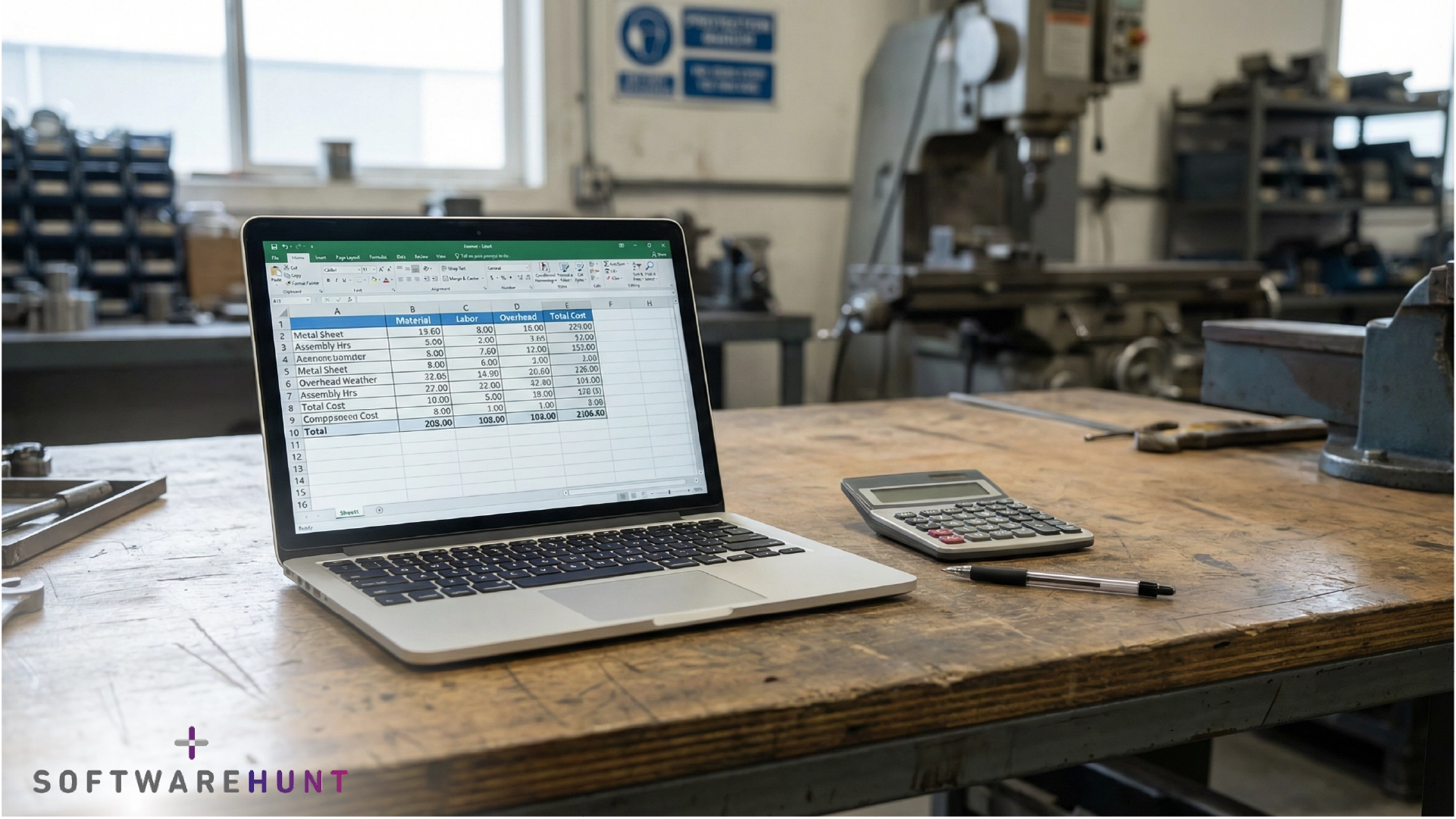
Sameer: A barcode system for tracking material. Not sexy, not impressive. But it eliminated 4 hours of daily Excel chaos and paid for itself in two months.
Priya: That’s… that’s not what I thought automation meant.
Sameer: [Smiling] Exactly. Want to hear what automation actually looks like for factories like ours?
What Does Manufacturing Automation Mean for Small Factories?
Priya: Okay, I’m confused. When I think automation, I picture robots, cobots, those Industry 4.0 smart factories. You’re saying that’s not what I need?
Sameer: Not for your first step. Look, automation isn’t about robots, it’s about removing manual, repetitive, error-prone work. That’s it. Robots are just one type of automation, and honestly, usually the wrong place to start.
Priya: So what did you actually automate in your factory?
Sameer: [Counting on fingers] Let me give you four examples from my place, Kulkarni Precision in Pune, automotive components, 65 people.
First: Barcode scanning for material movement, ₹35,000 total. Before this, my stores guy spent 4 hours daily updating Excel sheets every time material moved. Now? Scan, done. Four hours back in my day.
Second: Auto-calculation software for cutting parameters, ₹8,000. We were wasting 12% material because of manual calculation errors. Now it’s down to 7%. That 5% material savings paid for the software in three weeks.
Third: WhatsApp-to-system integration for customer orders, ₹15,000. Before, someone manually typed every order from WhatsApp into our system. We’d miss details, forget attachments. Now it auto-captures everything. Zero missed details.
Fourth: Automated job card printing, ₹12,000 for the setup. Eliminated handwriting errors that were causing rework. Clean printed cards every time.
Priya: So this is what affordable manufacturing automation actually looks like for businesses like ours?
Sameer: Exactly. Process automation in manufacturing doesn’t mean robots assembling cars. It means removing manual data entry, calculation errors, and repetitive tasks that waste 15-20 hours weekly.
Priya: [Taking notes] Those are all… software things. I thought that was just digitization?
Sameer: Arre, exactly! If it removes human repetition, it’s automation.
There’s a spectrum: Manual to Semi-automated to Fully automated.
For SMEs in India looking at manufacturing automation solutions, semi-automated is the sweet spot – human judgment plus machine precision. You’re not replacing people; you’re removing the boring, error-prone grunt work that frustrates them.
Priya: But my competitor installed robots. They’re producing 40% more with the same workforce. That’s what’s scaring me.
Sameer: Did they start with robots or end with robots? I bet if you ask, they automated material tracking, job flows, and quality checks first. Robots came after they built that foundation. You can’t jump to robots when you’re still tracking stock in Excel.
Priya: [Exhaling] Okay, smaller steps make sense. But here’s my problem: I look at my factory and see 50 things that could be automated. Dispatch delays. Material tracking chaos. Quotation errors that cost me three orders last quarter worth ₹1.2 lakh. Where do I even start?
Sameer: Bas, that’s the problem right there. You’re thinking about what to automate before understanding what’s actually broken.
How to Identify Which Manufacturing Processes to Automate First?
Priya: Isn’t it obvious? The slow stuff, the error-prone stuff, automate that, right?
Sameer: [Shaking head] Let me tell you about my ₹2.8 lakh mistake. Two years ago, I bought an automated inspection system. Top-of-the-line camera, AI defect detection, impressive demos. Ran it for two months. Now it sits in the corner collecting dust.
Priya: What went wrong?
Sameer: I automated the wrong problem. I thought inspection speed was our bottleneck. Turns out, the real issue was inconsistent raw material quality. Faster inspection of bad material doesn’t fix anything. I digitized a symptom, not the disease. ₹2.8 lakh lesson.
This is the most common mistake in factory automation for SMEs. Automating what looks impressive instead of what actually bleeds money. Before investing in any industrial automation for small businesses, diagnose the operational leak, not the symptom.
Priya: [Wincing] Ouch. So how do I avoid that?
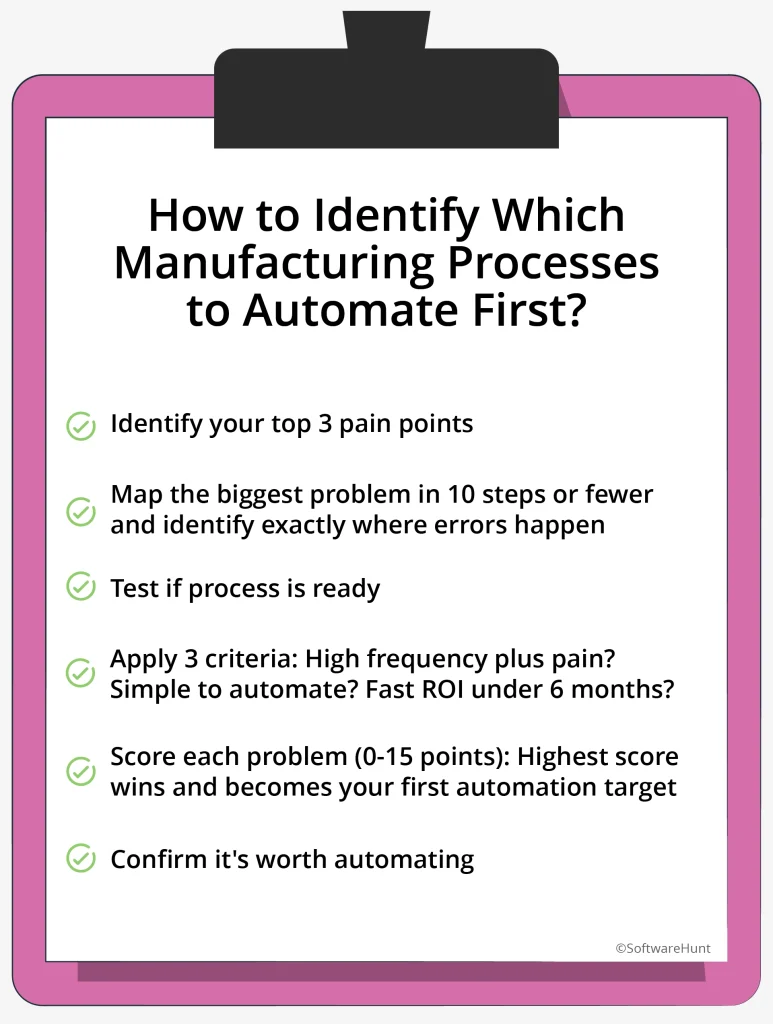
Sameer: Three questions. Where do your orders get delayed most? What causes the most rework or rejection? Where do you lose money due to errors? Not all 50 problems, just your top three pain points.
Priya: [Thinking] Dispatch delays – paperwork takes 2 hours per order. Material tracking is chaos, we can’t find stock, we order duplicates. And quotation errors… those manual calculations cost me those three jobs I mentioned.
Sameer: Perfect. Now pick your biggest pain point. Walk me through how it works today, step by step. Let’s do quotations since you mentioned lost orders.
Priya: Okay. Customer inquiry comes in email or call. I manually calculate material costs plus labor. Then I type everything in Word, send a PDF. Then… [Pausing embarrassed] …half the time I find a calculation error after the customer points it out.
Sameer: [Counting] So that’s eight manual steps. Customer contact, calculation, typing, sending, error discovery, recalculation, re-typing, re-sending. And I count three places where errors can happen – initial calculation, typing it in, and any updates. That’s what you automate. Not ‘quotations’ generally – those specific eight steps with those three error points.
Priya: So I need to map out my processes before I can automate them?
Sameer: Just the 2-3 that hurt most. Not everything. And here’s the test: Can you describe the process in 10 steps or fewer? Do you follow the same steps every time?
Priya: For quotations, yes. For production scheduling… no. Every order is different, lots of exceptions.
Sameer: Then don’t automate production scheduling yet. Fix that process first, standardize it, remove exceptions, make it consistent. Otherwise automation will just digitize your chaos. I’ve seen ₹4.5 lakh systems abandoned because companies automated messy processes.
Priya: [Nodding slowly] Okay. I’ve got my three problems clear now – material tracking, quotations, dispatch. Which one do I automate first?
Sameer: Whichever one meets three criteria. Let me show you the framework I use…
We’re SoftwareHunt. We work with manufacturing owners running on Tally, Excel, and lean teams to understand your operational leaks and growth challenges. Our team is happy to connect with you, understand your personal pain points, operational leaks and growth challenges and go beyond platform listings/information to help find the right solution for you.
We’ll help you translate symptoms into clear financial insight and show you where to focus first – at no cost to you.
To email an advisor for a quick fit-check write to us at connect@softwarehunt.com
What Are The 3 Criteria for Choosing Your First Manufacturing Process Automation?
Sameer: [Pulling out phone] I have this saved because I reference it every time. Three criteria: high frequency plus high pain, simple to automate, and fast ROI. Let me break it down.
Priya: Frequency and pain, you mean how often it happens?
Sameer: Exactly. How often does the problem occur – daily, weekly, monthly? And how much time or money does each occurrence cost? Let’s do the math for your material tracking.
Priya: Material tracking errors… probably 15 times a day. Each one takes about 20 minutes to sort out.
Sameer: So 15 errors times 20 minutes equals 5 hours daily waste. That’s 110 hours monthly. At even ₹500 per hour for your stores person’s time, that’s ₹55,000 monthly just in wasted time.
Priya: [Eyes widening] I never calculated it like that.
Sameer: Now compare that to your dispatch delays. You said those happen how often?
Priya: Maybe three times a week? Each delay is about 30 minutes of frantic paperwork.
Sameer: Three per week, 30 minutes each, that’s 1.5 hours weekly, maybe 6 hours monthly. Call it ₹3,000 monthly. See the difference? Material tracking happens every single day and costs 18 times more. Frequency times impact, that’s criterion one.
Priya: Okay, so material tracking wins on that. What’s criterion two?
Sameer: Simple to automate, low-hanging fruit. Can you solve it with existing tools like barcode systems, Excel macros, simple software? Or does it need custom development and ₹3 lakh ERP modules?
Priya: For quotations, I could probably use a spreadsheet with formulas and templates, right? That can’t be expensive.
Sameer: ₹8,000 to ₹12,000 to get a freelancer to build it properly. Compare that to production scheduling, which needs a custom ERP module – ₹3 lakh and up. Even though scheduling might save you more eventually, quotations are achievable right now. Success builds confidence.
Priya: And the third criterion – fast ROI?
Sameer: If automation costs ₹30,000, how quickly does it pay back? My barcode system was ₹35,000. Saved 4 hours daily, that’s 120 hours monthly. At ₹150 per hour, that’s ₹18,000 monthly savings. Paid back in two months.
Priya: [Calculating] My quotation automation would save… 6 hours weekly, that’s 24 hours monthly. Plus it would eliminate those ₹40,000 quarterly errors. So about ₹13,000 monthly savings against ₹12,000 cost. Paid back in… under a month?
Sameer: Bilkul. That’s the kind of ROI you want for your first automation. Under six months payback.
Priya: So based on these three criteria, material tracking wins – daily problem, simple barcode solution, clear ROI. But quotations are super low-hanging fruit.
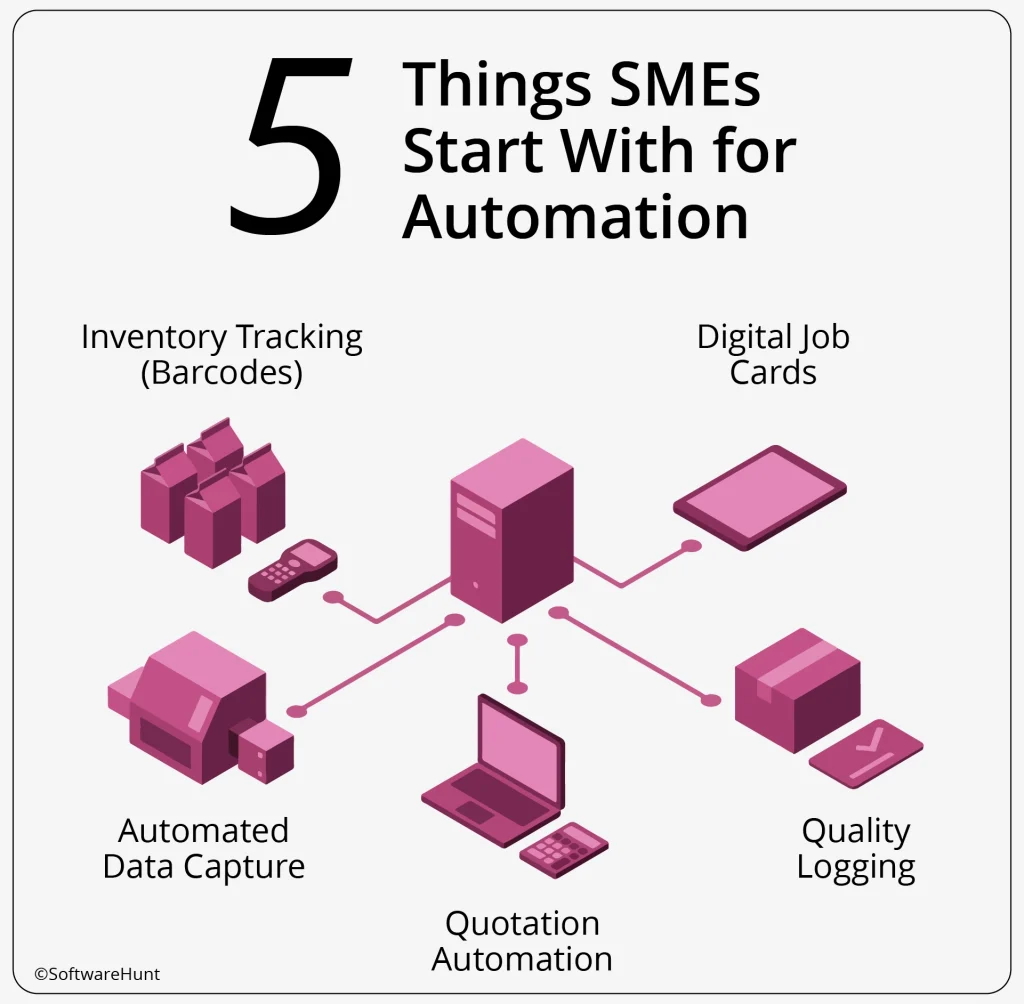
Sameer: Exactly. Most SMEs I know started with one of five things: inventory tracking like barcodes, digital job cards for order-to-production flow, automated data capture to replace Excel entry, quality logging with checklist apps, or quotation automation. Notice what’s not on that list?
Priya: Robots. Production scheduling. Anything over ₹5 lakh.
Sameer: Right. Those come later, after you’ve built automation muscle with simpler wins. Don’t automate production processes that still have quality issues. Don’t automate steps that need human judgment, like approvals or customer negotiations. And don’t automate rare problems, even if they’re painful when they happen.
Priya: [Decisive] Okay. Material tracking first – meets all three criteria. Quotations second. But Sameer, I’m worried. What if I buy some barcode system and it fails? My brother-in-law tried automation, spent ₹6 lakh, the team hated it, and they went back to paper within six months.
Sameer: Yeah, let me tell you the three ways SMEs screw up automation and how to avoid becoming one of those stories…
What Are The Common Manufacturing Automation Failures and How to Prevent Them?
Sameer: Mistake number one: Automating broken processes. My friend in Nashik – automotive parts guy – spent ₹4.5 lakh on production scheduling software. Abandoned it after six months.
Priya: Why? Was the software bad?
Sameer: The software was fine. His production process was chaos. No standard cycle times, no accurate BOMs, design changes happening mid-production. The automation just digitized that chaos made it faster and more visible, but didn’t fix anything. ₹4.5 lakh down the drain.
Priya: So how do I know if my process is clean enough to automate?
Sameer: Two questions: Can you document it in 10 steps or fewer? Do you follow the same steps every time? If the answer to either is no, fix your process first. Lean principles before digital tools. If it’s messy manually, automation makes it messier faster.
Priya: Okay, mistake one, don’t automate chaos. What’s mistake two?
Sameer: Buying software without testing the workflow first. You just said you’re worried about buying a barcode system and your workers hating it. That’s the right worry. Here’s what I did.
Priya: What, you returned it?
Sameer: [Laughing] No, I rented three scanners for one month, cost me ₹2,500. Tested with five workers on one product line. Good thing I did, because those scanners were too sensitive for our dusty shop floor. We needed ruggedized versions. I bought a better ₹35,000 system only after that pilot. That ₹2,500 pilot saved me from a ₹25,000 mistake
Priya: [Taking notes] So pilot before purchasing. Test with a few workers first, find what breaks.
Sameer: Exactly. Two to four weeks, small team, one area. You’ll discover issues, WiFi problems, scanner durability, workflow breaks, before you commit big money.
Priya: And mistake three?
Sameer: Over-automating too fast. SMEs get excited and try to automate five things simultaneously. Result? Implementation chaos, team overwhelmed, nothing works properly.
Priya: How long did it take you to automate your factory?
Sameer: I automated one thing, waited two months, then tackled the next thing. Took me 18 months to automate six processes, but all six are still working three years later. Meanwhile, my competitor tried to automate eight things in three months. Five of them were abandoned within a year.
Priya: So patience?
Sameer: Patience or permanent success. Pick one. I follow the 3-Month Rule, implement one automation, run it for three months minimum, get the team comfortable, fix issues, measure results. Only then start the next one.
Priya: [Looking relieved] Okay. Pilot testing, one at a time, fix the process first. That actually feels manageable. So if I want to start with material tracking, what’s my next step, like literally Monday morning?
Sameer: [Opening his phone] Let me show you how I planned this. I have it documented because I reference it every time we add something new…
How Should I Implement Manufacturing Automation in my SME?
Sameer: [Showing phone screen] This is my 90-day plan. Three months broken into three phases: Map + Pilot, Implement + Train, Stabilize + Measure. Week by week. Let’s use your material tracking as the example.
Priya: Week by week? Not just ‘Phase 1, Phase 2’?
Sameer: Vague phases don’t work. You need specific tasks for specific weeks. Okay, Month 1: Map + Pilot. Week 1, you document your current material flow, receiving to storage to issue to consumption. Count how many stock movements happen per day.
Priya: [Thinking] Probably 50 movements? Receiving, issuing to production, returning excess, moving between locations…
Sameer: Fifty movements is good data. Now identify: where do things go wrong? Can’t find stock? Duplicate orders? Week 1 deliverable: one-page process map.
Priya: Week 2?
Sameer: Research and start pilot. Talk to 2-3 vendors, barcode versus RFID, cost comparison. Rent or trial a system for two weeks. Test with 2-3 workers on one material category, not everything.
Priya: And Week 3?
Sameer: Continue pilot, log issues. Week 4, evaluate. Did it solve the problem? What broke, WiFi issues, scanner durability, data sync problems? Is the cost-benefit clear? Then you make your go or no-go decision.
Priya: If I go, then what, Month 2?
Sameer: Month 2: Implement + Train. Week 1, purchase the system if your pilot was successful. Week 2, setup and configure it for your specific items. Week 3 and 4, train your team in batches, 3 to 4 people per batch.
Priya: Why batches? Why not train everyone at once?
Sameer: Because training 20 people simultaneously overwhelms them and you. Start with your willing learners, your early adopters. Let them train the next batch. Peer training works better than vendor training. Builds ownership.
Priya: That’s smart. And Month 3?
Sameer: Month 3: Stabilize + Measure. This is critical, run your new system alongside the old process for two weeks. Parallel running. Cross-check results, build team confidence. They see it works without the pressure of ‘there’s no backup.’ Then you fix issues as they emerge.
Priya: When do I turn off the old system?
Sameer: End of Week 2 in Month 3. By end of Month 3, either your old process is retired completely, or you realize the system needs rethinking. That’s when you measure ROI, time saved, error reduction, actual cost savings.
Priya: [Pausing] This sounds doable, but… Sameer, my team is at 90% capacity right now. We’re slammed with orders through August. Can I still do this?
Sameer: No. Don’t. Automation during chaos is disaster. Here’s what I should have asked you first, before you even start Monday, answer five questions honestly.
Priya: Okay, go ahead.
Sameer: One: Do you have 4-5 hours per week to dedicate to this? Two: Is your team at less than 80% capacity? Three: Can you describe the current process in under 10 steps? Four: Do you have ₹25,000 to ₹50,000 you can invest without starving other operations? Five: Are you willing to iterate and fix things for three months, or are you expecting plug-and-play?
Priya: [Counting on fingers] Yes to one, three, four, and five. But no to two, we’re at 90% capacity, possibly higher during peak season.
Sameer: Then wait until after your busy season. June to August are your heavy months? Start in September. Cramming automation into an overloaded team adds stress, not efficiency. You’ll fail, blame automation, and never try again.
Priya: [Surprised] You’re telling me to wait? I thought you’d push me to start immediately.
Sameer: [Smiling] I’m telling you to start when you’ll succeed. September. Material tracking. 3-month pilot-implement-stabilize plan. By December, you’ll have one solid automation working. Then we have chai again and talk about quotation automation.
Priya: [Smiling back] One boring problem at a time.
Sameer: Bas, exactly. That’s the whole philosophy.
[Priya finishes her chai, pulls out her phone, and saves Sameer’s number. Not as Industry 4.0 Expert or Automation Consultant. As Automation Guru.]
We’re SoftwareHunt. We work with manufacturing owners running on Excel, Tally, and tight cash flows. Our advisors help you identify operational leaks like hidden setup costs and overhead allocation errors and translate symptoms into clear financial decisions. We show you where to focus first, at no cost to you.
Email us: connect@softwarehunt.com