Key Takeaways
- Seven invoice delays hide between dispatch and accounting.
- Most manufacturers identify wrong bottleneck and waste 8 weeks fixing symptoms.
- The 60-second diagnostic inside tells you which delay is costing you most.
The 60-Second Diagnostic
Don’t read further until you answer these three quick questions about your operation right now.
1. How many days after dispatch do you typically create invoices? (Check your last 5 orders. Day of dispatch = Day 0.)
2. Right now, how much value is sitting in “dispatched but not invoiced” orders? (Rough estimate: orders from past 2 weeks without invoices.)
3. Which of these seven delays do you think is YOUR bottleneck?
Incomplete dispatch documentation (missing LR, weight, etc.)
QC certificate taking time to reach accounts
Final quantity confirmation delays (packing adjustments)
Batch invoicing instead of daily
PO number retrieval from sales
Pricing/discount confirmation hold-ups
E-way bill / GST verification delays
If your answers are:
Days to invoice: >5 days
Stuck value: >₹8 lakh
You guessed on #3
…read this blog.
Most manufacturers guess wrong on #3. That guess costs them 8 weeks and ₹30K fixing the wrong delay first.
Background: We’re a mid-sized plastic components manufacturer in Rajkot. Good orders, decent margins, production running smoothly. But every month, same crisis: scrambling to pay salaries, delaying vendor payments, begging the bank for overdraft extensions. I blamed slow-paying customers. Turns out, I was the problem.
Time Period: February – April 2026 (8 weeks)
The Discovery: We invoice 12-18 days AFTER dispatch. That’s ₹18-25 lakh stuck in limbo monthly.
Day 1 – The Day Our Bank Manager Said No
February 18, 2026
[Bank manager leans back in his chair, steeples fingers.]
“Mr. Mehta, I’m not approving the ₹8 lakh overdraft extension.”
My stomach drops. We need this extension. Every month same story, good orders, good production, terrible cash position. “Why not? Our fundamentals are solid. Last quarter we had ₹42 lakh in orders.”
Bank manager: “You dispatched ₹42 lakh worth of goods last month. Show me the invoices.”
I pull up records on my phone, defensive. “We invoice after dispatch. Takes a few days. That’s normal.”
“How many days?”
I scroll through. Jan 28 dispatch, invoiced Feb 19. Feb 3 dispatch, invoiced Feb 15. Feb 10 dispatch, still waiting. My face gets hot.
“Average seems to be… 14 days.”
Bank manager: “Fourteen days. So you dispatch goods, then wait two weeks before asking for payment. Your 30-day payment terms become 44 days. You’re giving free extended credit before your official credit even starts.”
This is what poor invoice management in manufacturing looks like, ₹18-25 lakh stuck between dispatch and payment request. For manufacturers struggling with working capital management, the first leak to fix isn’t customer payment terms. It’s your own invoicing process.
The words hit differently when someone else says them out loud.
He continues: “You dispatched ₹42 lakh last month. At 14-day lag, how much is currently dispatched but not invoiced?”
I do the math. Five to six dispatches weekly, average ₹3.5 lakh per dispatch. 14-day gap.
₹18 to 25 lakh.
That’s our entire monthly salary obligation.
Anil (my brother, co-owner) sits beside me, defensive. “But we’re busy. Invoicing takes time. We get to it when we can.”
Bank manager: “That ‘when we can’ is costing you ₹18 lakh in working capital every single month. Fix it, then come back for overdraft.”
Driving back to Rajkot, neither of us speaks for an hour.
WHAT I LEARNED: We don’t have a customer payment problem. We have an invoicing problem. We’re starving ourselves.
MONEY STUCK: ₹18-25L at any given time between dispatch and invoice
EMOTIONAL STATE: Embarrassed. How did I not see this for 11 years?
Week 1 – Why Does Invoicing Take So Long?
Day 3, February 21
I decide to follow one order from dispatch to invoice. Order #IMP-1847 (automotive dashboard clips, ₹4.2 lakh to Pune).
9:30 AM: Goods loaded on truck, transport receipt signed.
11:00 AM: Ramesh (dispatch coordinator) creates manual dispatch register entry in notebook.
2:00 PM: Ramesh hands physical delivery challan to Kavita (accounts manager) when he remembers to stop by.
Kavita has 8 other challans from past 3 days piling on her desk.
“When will you invoice this?” I ask.
Kavita: “After month-end reconciliation. Waiting for quality clearance certificate, final weight confirmation, and transport LR number. Takes 2-3 days to collect everything.”
This information lag is the core problem in manufacturing invoicing systems. When businesses search for how to reduce invoice delays, the answer isn’t faster typing, it’s faster information flow from dispatch to QC to accounts. Automated invoice processing solves this, but process fixes come first.
The invoice delay isn’t laziness. It’s information stuck in seven different places.
WHAT I LEARNED: Invoicing delay isn’t accounting’s fault. Information flows slowly from dispatch/QC/sales to accounts.
MONEY STUCK: Still ₹22L (based on this week’s dispatches)
EMOTIONAL STATE: Less angry, more curious. This is solvable.
Week 1, February 28
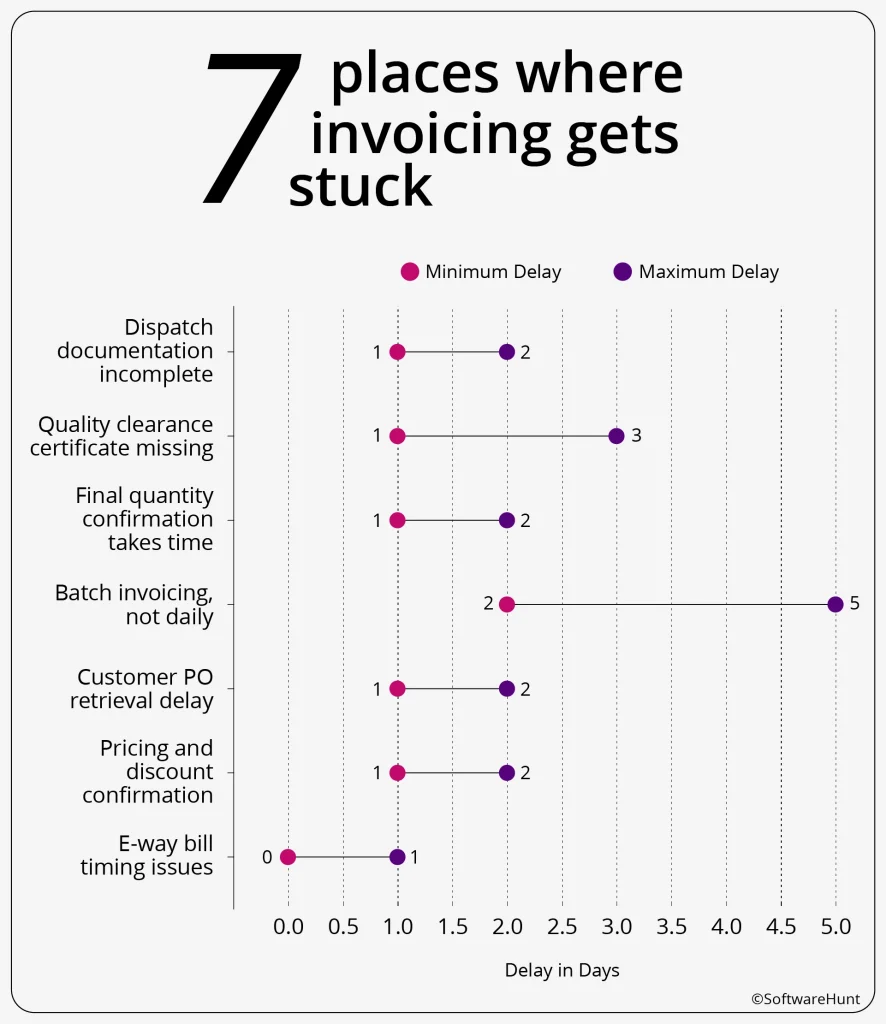
I spend the next five days shadowing Kavita and Ramesh. Not to blame them, to understand. By Friday, I’ve tracked 12 dispatches, and the picture gets real clear. There’s not one bottleneck. There are seven.
Dispatch documentation incomplete (1-2 days)
Ramesh loads the truck. Goods leave at 10 AM. But the transport company’s LR number doesn’t come until evening. Sometimes next day. Kavita can’t invoice without it.
Quality clearance certificate missing (1-3 days)
Quality signs off on goods before they ship. But the actual certificate? It stays on the QC manager’s desk. Someone needs to physically walk it over to accounts. That doesn’t happen same day. Usually takes 2-3 days before Kavita even sees it.
Final quantity confirmation takes time (1-2 days)
Packing always has small adjustments. Customer asked for 1,020 pieces, but after packing they count 1,025. Or there’s a quality reject, so it goes down to 995. Production notes it somewhere. Accounts doesn’t know. Takes a day or two for the number to actually reach Kavita’s desk.
Batch invoicing, not daily (2-5 days)
This one surprised me. Kavita doesn’t invoice each dispatch as it happens. She batches them. Every four or five days, she sits down and processes all the pending invoices at once. “More efficient,” she tells me. I understand the logic. It’s also why we’re drowning.
Customer PO retrieval delay (1-2 days)
Every invoice needs the PO number. Sounds simple. But the PO email is somewhere in the sales inbox. Nobody has a system. So Kavita spends time digging through email threads, asking sales “which PO was this for?” Sales is busy. They get back to her when they can.
Pricing and discount confirmation (1-2 days)
This one’s frustrating. Sales negotiates a last-minute price. They email it to me, maybe Kavita. But it’s not documented anywhere formal. The sales guy goes on leave. Now nobody knows if the order was actually at the negotiated price or the original quote. Invoicing waits until someone figures it out.
E-way bill timing issues (0-1 day)
The e-way bill generates at dispatch. Mostly. But if GSTIN verification fails in the system, it gets delayed. Hold-up in invoicing.
I add it all up. Seven different friction points. Each one innocent on its own. Together they create a 7 to 14 day gap between dispatch and invoice.
And here’s the kicker: nobody owns it. Ramesh thinks accounts should push. Kavita thinks dispatch should prepare better. QC thinks someone should collect their certificate. Sales thinks it’s not their problem. So everyone waits for someone else to move first.
WHAT I LEARNED: Seven different delays, averaging 7-14 days total. Batch processing “efficiency” is equal cash flow disaster.
MONEY STUCK: ₹23.5L (18 dispatches awaiting invoices, ranging 2-19 days old)
EMOTIONAL STATE: Determined. This stops now.
Week 2
I pull out a calculator and sit down with Anil. He thinks I’m overreacting. Let me show him the numbers.
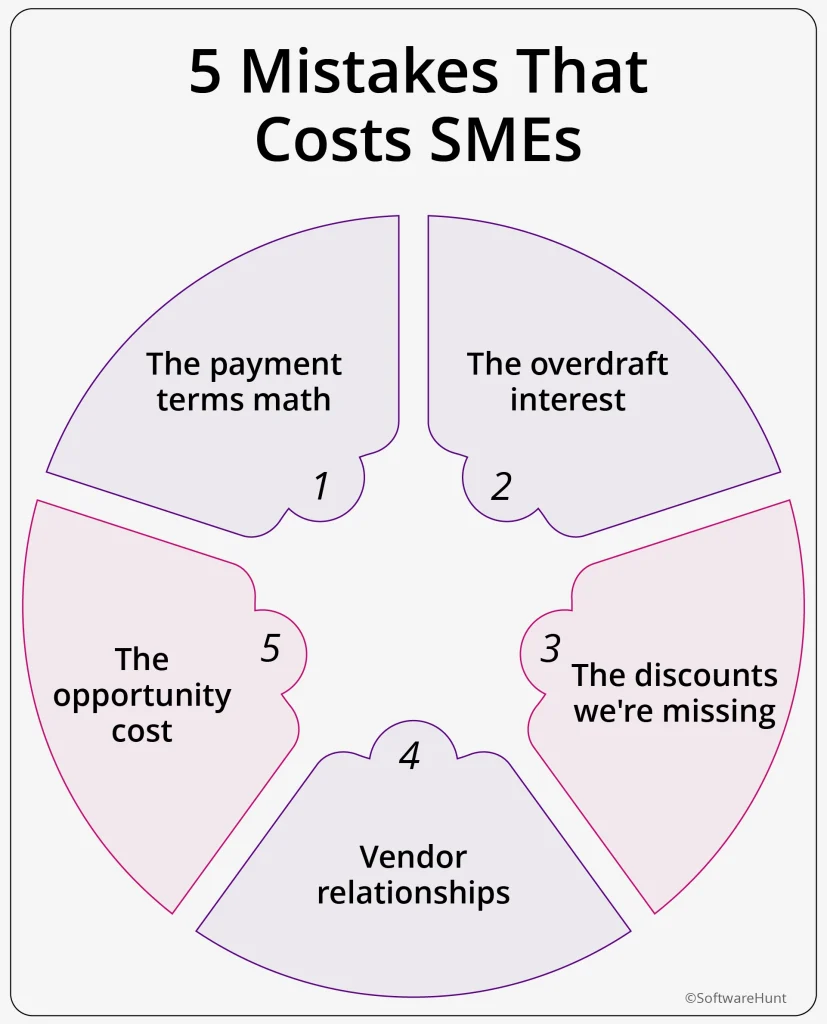
First, the payment terms math.
We tell customers: pay in 30 days from invoice date. Sounds reasonable. But if we invoice 14 days after dispatch, customers aren’t actually paying in 30 days from dispatch. They’re paying in 44 days. Our competitor who invoices within 2 days of dispatch? They get paid in 32 days. We’re giving 12 extra days of free credit to every customer without realizing it.
On our annual revenue, that’s ₹40 lakh in working capital we’re giving away unnecessarily. Just sitting there. Not ours to use.
Second, the overdraft interest.
We currently have ₹12 lakh in overdraft at 11.5% interest. That costs us ₹1.38 lakh every year. If faster invoicing freed up ₹20 lakh in working capital, we could drop that overdraft to ₹4 lakh. Interest would be ₹46K. We’d save ₹92K annually. Just from invoicing faster.
Third, the discounts we’re missing.
Last month alone, two suppliers offered 2% discount if we paid early. We couldn’t. We didn’t have the cash. Cost us ₹16K right there. And now our key raw material supplier is tired of waiting. He stopped giving us 15-day credit. Now he wants advance payment. That changes our entire cash flow equation.
Fourth, vendor relationships.
We’re late paying suppliers. They know we have cash flow problems. They’re losing trust. When you’re late with payment, you lose negotiating power. You lose the relationship cushion that usually saves you in tough times.
Fifth, the opportunity cost.
A customer in Ahmedabad wanted to place a rush order for ₹6.5 lakh. They needed an invoice within 2 days because of their accounting deadline. We couldn’t promise it. Our invoicing takes 14 days. They went to a competitor. That margin would have been ₹1.8 lakh for us. Gone.
I show Anil the total. He stares at the numbers for a long time.
“Wait,” he says finally. “We’re losing ₹92K a year in interest alone? That’s more than we spend on tea and snacks for the whole factory combined.”
He gets it now.
WHAT I LEARNED: I kept thinking this was a small operational issue. It’s not. Every 14 days we don’t invoice, we’re bleeding money in five different directions at once.
MONEY STUCK: Checked the records this morning. We have 21.8 lakh sitting in invoices that should’ve gone out days ago.
EMOTIONAL STATE: I’m frustrated with myself for letting this go on for 11 years. But I’m calm about fixing it. The math is clear. There’s no arguing with it.
Week 3 – Why I Couldn’t Fix It Alone
March 5, the implementation begins.
I meet with Anil, Ramesh, Kavita, and the QC head. Whiteboard full of the seven delays. I’ve got my five fixes written out. Everyone’s nodding.
“Let’s start with the batch invoicing problem,” I say. “That’s eating the most time.”
Kavita agrees immediately. “Yes, daily invoicing will fix this.”
By Wednesday, we’ve changed the system. Kavita invoices everything daily instead of once per week. We create WhatsApp alerts. Dispatch sends message when truck leaves. Accounts replies with invoice number within 24 hours.
Sounds good. Isn’t.
By Thursday morning, Kavita has 18 pending invoices stacking up. She’s trying to process them all. Making errors. Missing dates. Wrong quantities.
“This is impossible,” she tells me Friday afternoon, nearly in tears. “You’ve tripled my workload.”
I try to add an assistant. But I’m patching symptoms, not fixing root cause.
Then Anil asks the question I should’ve asked myself: “Which delay is actually the worst one for us?”
I look at my notes. Seven delays. I’ve been assuming batch processing (Delay #4) is the bottleneck. But what if it’s not?
What if it’s Delay #2 (QC certificate) or Delay #1 (documentation)?
Honestly, I have no idea.
And neither does Anil.
The problem is: we’re inside the system. We can see the problems, but we can’t see which problem is CAUSING the other problems.
Fixing Delay #4 first made Delay #1 and #2 worse, because they were already slow. Now Kavita is trying to invoice faster when her information isn’t even there yet.
I’m fixing the wrong thing.
Anil and I sit in silence for a few minutes.
Then he says: “We need someone who’s done this before. Someone who can tell us which delay to fix FIRST, in what order.”
I think about the consultant I know – ₹12K fee for one day. I’m embarrassed. I’ve been doing this for 11 years. Shouldn’t I know this?
But the math is simple. Wrong sequence = 8 weeks wasted + ₹30K unnecessary expenses. One consultant = ₹12K.
Monday morning, I call him.
Week 4 – The Diagnosis Changed Everything
The consultant (let’s call him Amit) spends Friday morning in our shop. 90 minutes. He walks the flow:
- Dispatch to QC
- QC to production
- Production to accounts
- Accounts to customer
He takes notes. Asks 15 questions. Watches Kavita trying to process invoices on Monday morning.
By noon, he’s got his diagnosis.
“Your biggest bottleneck isn’t Delay #4,” he says.
I knew it wasn’t.
“It’s Delay #2. QC certificate. Seventy percent of your invoice delay is waiting for the QC certificate to reach accounts. You’re trying to invoice faster when you don’t even have the information you need.”
He’s right. I can see it now that someone’s pointed it out. QC sits in a different building. They sign off on goods. But the certificate? It gets filed. Nobody sends it to Kavita. She has to ask. Then it sits. Then she gets it.
Amit shows me the sequence:
1. Fix Delay #2 first (QC certificate to accounts same day) – ₹0, just process change
2. Then fix Delay #1 (documentation checklist at dispatch) – ₹0
3. Then fix Delay #4 (daily invoicing, not batch) – ₹0
4. Only if those three don’t work, add assistant help – ₹12K
“Your natural instinct was right,” Amit says. “But the sequence was wrong. Fix #4 first and you overwhelm yourself. Fix #2 first and everything else becomes easier.”
He stays another two hours. Works with Ramesh, QC head, and Kavita to:
- Create a daily QC certificate email (same day dispatch)
- Pre-fill invoices with all data except LR + dispatch time
- Establish daily invoicing rule (not weekly batch)
Implementation takes exactly one week.
Results by Week 5:
- QC certificate now reaches accounts same day (Delay #2: 2 days to 0.5 days)
- Documentation mostly complete at dispatch (Delay #1: 1.5 days to 0.5 days)
- Daily invoicing happens without Kavita breaking down (Delay #4: 3 days to 0 days)
- Average dispatch to invoice: 14 days to 2.8 days in Week 1, 1.5 days by Week 4
Cost: ₹12K consultant fee + ₹0 process changes.
Payback: ₹12K investment to ₹20L working capital freed + ₹92K annual interest savings = 5-week payback.
What I Learned: I couldn’t see my own system. Fixing the wrong delay first would’ve cost me 8 weeks and ₹30K. One external diagnosis saved me that time and money, and showed me the exact sequence.
The GST/E-Way Bill Complexity We Almost Missed
By Week 5, we’re hitting a new wall: GST compliance.
Our business crosses ₹5 crore threshold. We’re supposed to use e-invoicing now. E-way bills automatically generate in GSTN. Except when they don’t.
GSTN portal downtime. IRN generation failures. State reconciliations.
Amit (the consultant) had warned us: “Don’t assume e-way bill timing is 0 delay. It’s variable. Sometimes instant. Sometimes 2-3 hours. When it fails, you’re stuck.”
This is where manual checklists and WhatsApp break. Because you can’t WhatsApp the GST portal.
Amit recommended: “You need software integration with Tally. Not for invoicing itself but for e-way bill automation and GST reconciliation.”
That’s when we realized: Process alone won’t solve this forever. We’re at the size where compliance complexity requires system support.
This wasn’t in my original five fixes. But it’s real.
This is also where we brought Amit back for Phase 2 implementation: Tally integration for e-invoicing and GST workflow.
Cost: ₹40-45K software setup. But it saved us from future GST compliance disasters and ₹500/day penalties for late e-way bills.
What This Means For You: If you’re ₹5-15 crore revenue, don’t assume WhatsApp + checklist solves everything forever. You’ll hit this wall too.
Month 2 – The Results & Self-Check
April 1
Verdict:
Total time invested: 20 hours (me: 8 hours on process redesign, team: 12 hours learning/adjustment)
Total money spent: ₹24K (part-time assistant for 2 months)
Unexpected benefits:
Customers are paying faster. Clearer, timely invoices = fewer disputes. One customer specifically thanked us for “finally invoicing properly.”
Bank approved overdraft extension (impressed by the process fix, not just because we asked again).
Accounts team morale improved. No monthly fire drill.
Five Self-Assessment Questions (for you):
Q1: How many days after dispatch do you typically invoice?
Check your last 10 dispatches. Count days until invoice date. I didn’t realize mine was 14 days until I checked. If your average is less than 3 days, you’re giving free extended credit.
Q2: How much money is sitting in “dispatched but not invoiced” right now?
List all dispatches from past 30 days without invoices. Add up the value. Mine was ₹18-25 lakh (monthly salary equivalent). That’s your stuck working capital.
Q3: Can you invoice 90% of orders within 24 hours of dispatch?
If not, why not? Missing information? Batch processing? No ownership? Mine couldn’t because of seven delay points – all fixable.
Q4: Do your customers complain about invoice errors or delays?
If yes, you’re damaging relationships AND delaying payment. I had two customers who specifically requested “faster invoicing,”I hadn’t prioritized it.
Q5: Have you lost vendor credit terms due to delayed payments from cash squeeze?
If this happened, root cause might be invoicing lag, not customer payment delays.
Who should fix this immediately:
Manufacturers with dispatch-to-invoice gap less than 5 days. Businesses using 70%+ of overdraft limits regularly. Anyone who delayed vendor payments in past 3 months due to cash shortage. SMEs with DSO >45 days despite 30-day terms.
What’s next for us:
Exploring automated e-invoicing to cut 1.5 days to same-day. Evaluating accounting software integration (₹45K investment). Training a backup person for Kavita’s role.
Closing narrative:
It’s March 28, month-end. Last year this day meant panic scrambling to pay salaries, calling customers begging for early payments, watching overdraft limit like a hawk. This month? Calm. Because invoices sent 1-2 days after dispatch, customers paid on time, and we have ₹8 lakh sitting in the bank, not in the “dispatched but not invoiced” black hole.
Fixing invoicing didn’t solve all our cash flow problems. But it solved the ones we were creating ourselves.
If you’re always cash-tight despite good orders, check your dispatch-to-invoice gap. The problem might not be your customers. It might be you.
WHAT I LEARNED: We were choking our own cash flow. Simple process fix is equal to ₹20L working capital freed plus ₹80K annual interest saved.
WOULD I DO IT AGAIN? Yes. Should’ve done it 10 years ago.
WHO SHOULD DO THIS: Anyone invoicing >3 days after dispatch. You’re starving yourself.