TL;DR
- You’re profitable. But you can’t pay salaries. Here’s why
- You pay suppliers: Day 30
- You collect from customers: Day 90
- The gap: ₹3-4 crore locked up, costing ₹4-5L annually in interest alone
- In 3 minutes, diagnose which one is bleeding you most: inventory, collections, production cycles, or the payment gap. Then fix that ONE thing. Cash improves in 90 days.
Log9 Materials was a ₹200+ crore company. Venture-backed. Building the future of EV batteries. Then, in 2024, it ran out of cash. The company spiraled into a “borrow-to-repay cycle,” taking loans to repay previous loans at increasingly higher interest rates. By September, they laid off 180 employees out of 220. Employees went unpaid for three months. The company started asset repossession. All while the balance sheet showed thousands of crores in “assets.”
The irony? The business wasn’t broken. The working capital management was.
The Real Reason Cash Gets Stuck
You’ve heard it before: “Cash is king.” But that’s not the whole truth. The real issue is deeper. It’s not about having cash. It’s about when you have it compared to when you need it.
In manufacturing, three things fight each other constantly.
You pay suppliers on Day 30.
our production ties up cash for 20 days.
You collect from customers on Day 90.
The math creates a gap. That gap is what destroys businesses.
The gap between when money leaves and when it returns.
82% of Indian SMEs fail due to cash flow mismanagement.
This blog is about understanding that gap and closing it.
Diagnose Your Leak in 3 Minutes: Which One Is Costing You Most?
Not all cash leaks equal. Find yours:
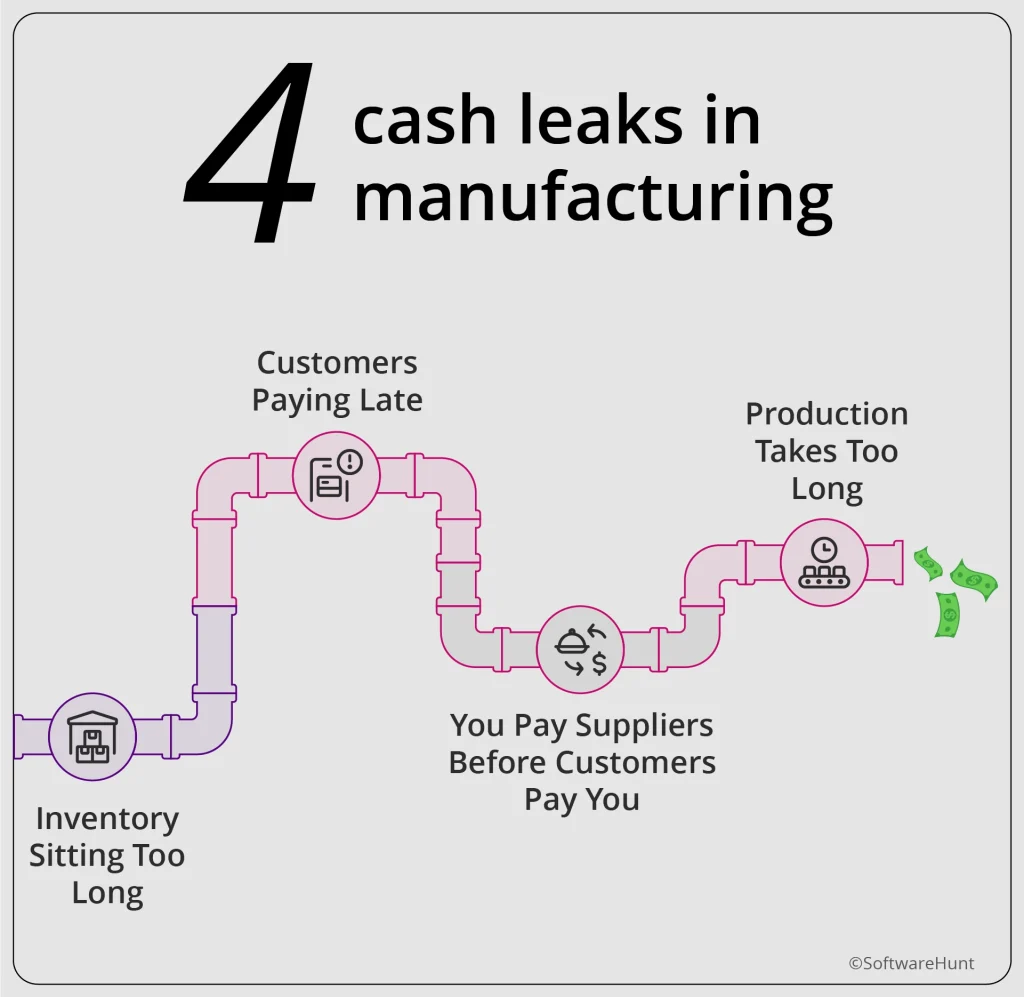
Leak #1: Inventory Sitting Too Long
- What % of your inventory is older than 90 days?
- Are you seeing 10%+ obsolete inventory?
- Last 3 months: How much inventory liquidated at loss?
If YES to 2+: This is your leak.
Cost if unfixed: ₹50-100L annually
Quick fix: Demand forecasting accuracy (50% to 65% frees ₹20-40L)
Leak #2: Customers Paying Late
Calculate: (Accounts Receivable ÷ Annual Revenue) × 365 = Your DSO
Compare: Stated terms (Net-30) vs. Actual (_____ days)
If gap is 10+ days: This is your leak.
Cost if unfixed: ₹50L per 15 days on ₹1Cr revenue
Quick fix: Same-day invoicing (reduce DSO by 15 days)
Leak #3: You Pay Suppliers Before Customers Pay You
You pay suppliers: Day _____
Customers pay you: Day _____
Gap: _____ days
If gap is 30+ days: This is your leak.
Cost if unfixed: ₹18L annually (on ₹12Cr revenue)
Hard truth: Structural. Harder to fix.
Leak #4: Production Takes Too Long
Raw material days + Production days + Warehouse days = Total _____ days
If total is 90+ days: This is your leak.
Cost if unfixed: ₹4-5L locked per day of delay
Quick fix: Reduce cycle time (every day = ₹20-30L freed)
Which costs you most? That’s where you focus. ONE leak, not all five.
The Three Components That Lock Your Cash
Every manufacturing business has three invisible enemies. They don’t show up on your profit statement. But they determine whether you survive.
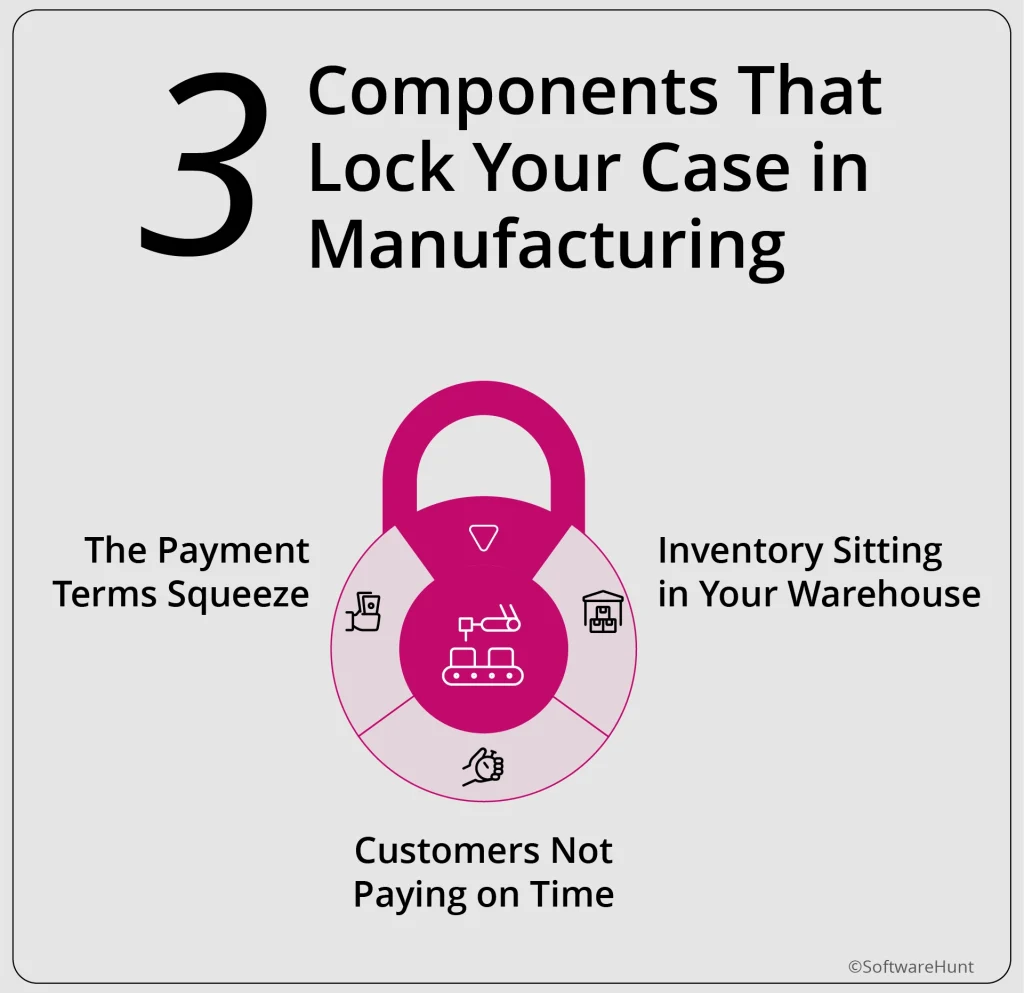
Component 1: Inventory Sitting in Your Warehouse (DIO — Days Inventory Outstanding)
Cash gets locked the moment you buy raw materials. It stays locked through production. It stays locked after the product is finished. It only comes free when the customer pays.
Let’s break down where your cash is sitting.
Raw materials: You buy them. They sit in the warehouse. On average, this takes 30-60 days before they enter production.
Work-in-progress (WIP): The material is now being worked on. It’s not raw material anymore. But it’s also not a finished product. No revenue is being generated. Cash is spent, but no money is coming in. This typically takes 15-30 days.
Finished goods: The product is complete. But the customer hasn’t bought it yet. It sits in your warehouse waiting for a purchase order or for the customer to take delivery. This takes another 30-60 days.
Add these up: You have 90-150 days of inventory sitting in your facility at any given time.
On a business doing ₹1 crore in monthly revenue, that’s ₹2-4 crore tied up in inventory alone.
Most manufacturers don’t even realize this. They think inventory is cheap. It’s not. Every rupee sitting in inventory is a rupee you can’t use for growth, debt repayment, or emergency reserves.
The biggest culprit is demand forecasting error.
You forecast demand using a spreadsheet. You forecast 1,000 units needed next month. The actual demand? 600 units. You’ve now overstock by 400 units worth ₹20 lakhs. That inventory sits. It gathers dust. It becomes obsolete. Six months later, you sell it at a 40% discount. You’ve lost ₹8 lakhs permanently.
Traditional demand forecasting is only 50-60% accurate. Advanced AI forecasting can reach 85%+. But it costs ₹50-100 lakhs to implement. Most mid-sized manufacturers can’t afford it. So they stay with spreadsheet forecasting. And they stay stuck with excess inventory.
That excess inventory? It costs you 5-10% of its value in annual obsolescence and carrying costs.
On ₹10 crore in inventory, that’s ₹50-100 lakhs annually. Just gone.
Component 2: Customers Not Paying on Time (DSO — Days Sales Outstanding)
Your customer receives the product. You send an invoice. Your payment terms say Net-30. So payment should come by Day 30.
In reality? It rarely does.
Here’s why.
First, invoicing delays. You deliver the product on Day 10. But you don’t create the invoice until Day 15. That’s a five-day delay before the payment clock even starts. On ₹1 crore in revenue, that five-day delay means ₹17 lakhs unnecessarily tied up.
Second, invoice errors. Your team re-keys the invoice from the sales system into the billing system. A typo happens. Wrong amount sent. Customer notices. They hold payment. You send a correction. The customer re-processes. Another 20 days gone. ₹66 lakhs locked.
Third, customer approval bottlenecks. Your customer isn’t a person. It’s a company. The invoice lands in their AP department. But the purchase order was handled by procurement. And the delivery was received by warehouse. It takes 20-30 days for all three departments to align and approve payment.
Fourth, customer payment system lags. Most large companies process payments weekly or monthly. Your invoice arrives on Thursday. It goes into the next batch processing on Monday. Suddenly there’s a 4-day administrative delay built into every transaction.
Research from accounts receivable analysis firms shows this reality: Intended DSO is 30 days. Actual DSO is 40-50 days. Why? Because 37% of invoices slip into overdue buckets due to these delays.
That’s not your customer being slow. That’s your system being manual.
80% of invoices in low-maturity manufacturing companies need manual intervention.
What does that mean? Someone has to look at the invoice. Check it against the PO. Check it against the delivery receipt. If anything doesn’t match, the invoice sits. Someone has to send an email asking for clarification. The customer responds three days later. Back-and-forth ensues. Eventually it gets resolved. By then, 20-30 days have passed.
On 100 invoices per month, if 5-10 have errors, you’re losing ₹50-100 lakhs in collection delays annually.
Component 3: The Payment Terms Squeeze (DPO vs. DSO Gap)
Here’s the uncomfortable math.
You pay your suppliers in 30 days. Your customers pay you in 60-90 days. That’s a 30-60 day gap where you’re financing the difference.
On ₹1 crore monthly revenue, that gap means ₹33-66 lakhs must come from somewhere.
Where?
Option 1: Borrow from a credit line. Interest cost: 12-15% annually. On ₹3 crore working capital need, that’s ₹4-5 lakhs per year just to bridge the timing gap. That’s pure cost. It doesn’t create value. It just keeps your business alive.
Option 2: Extend your payment terms with suppliers. Ask suppliers to go from Net-30 to Net-45 or Net-60. Sounds smart. But here’s the reality: You lose early payment discounts. Most suppliers offer 2-3% discount for paying early. By extending terms, you’re giving up that discount. That’s ₹20-30 lakhs annually on ₹1 crore COGS. Plus, suppliers will deprioritize your orders. You’ll get longer lead times. You might face supply shortages. Your customer delivery will slip.
Option 3: Negotiate higher prices with customers. Ask for Net-30 instead of Net-60. But your customer has already committed to Net-60 in the purchase order. You push back, they find another supplier. You lose the deal.
This squeeze is structural. It’s not something you can optimize away. It’s built into the supply chain. Large customers demand Net-60 or Net-90. Suppliers demand Net-30 or Net-15. You’re in the middle. You lose money either way.
These Three Components Create the Cash Conversion Cycle
The industry calls this the “Cash Conversion Cycle” or CCC. It’s the number of days between when you pay for raw materials and when you collect cash from customers.

For a typical Tier 2/3 manufacturer:
- DIO: 90 days (raw materials + WIP + finished goods)
- DSO: 60 days (actual customer collection, not stated terms)
- DPO: 30 days (what you pay suppliers)
- CCC = 90 + 60 – 30 = 120 days
What does 120 days mean? It means you need to finance 120 days of operations out of pocket. On ₹1 crore monthly revenue, that’s ₹4 crore in working capital you must fund—either through borrowing, owner’s money, or retained earnings.
Compare that to best-in-class manufacturers: CCC of 45 days = ₹1.5 crore working capital needed.
The gap: ₹2.5 crore in unnecessary working capital. That’s cash that could be used for growth, R&D, debt repayment, or emergency reserves. Instead, it’s trapped financing the timing mismatch.
We’re SoftwareHunt. Our team sits with manufacturing owners to understand your operational leaks and growth challenges. We go beyond platform listings to help you find the right solution at no cost to you.
Email an advisor for a quick fit-check write to us at connect@softwarehunt.com
The Diagnostic Questions: Which One is Costing You Most?
Not all six stuck points cost you equally. One or two are probably eating your cash flow more than the others. If you can identify which one, you can prioritize fixing it.
Ask yourself:
On inventory: What %age of your inventory is older than 90 days? Are you seeing 10%+ of inventory as slow-moving or obsolete? If yes, your demand forecasting is the bottleneck.
On collections: What’s your actual DSO? Not what you think it is. Actually calculate it: (Accounts Receivable / Annual Revenue) × 365. If it’s 45-50+ days when your terms are 30, you have a collection problem.
On payment terms: Are you paying suppliers in 30 days while collecting from customers in 60-90 days? If yes, you’re financing the gap with credit line interest or discount forgiveness.
On invoicing: What %age of your invoices require follow-up or correction? If it’s more than 2-3%, you have a process problem that’s costing you ₹50+ lakhs annually.
On WIP: How long does material spend in your facility from raw material to finished goods? Add up raw material days + production days + warehouse days. If it’s more than 90 days, you have either a production efficiency problem or a demand visibility problem.
On seasonality: What %age of your annual revenue happens in your peak season? If it’s 40%+, you’re forced to build inventory. If demand forecasting is off, you’re stuck with dead stock.
Here’s Your Fix Without Breaking the Bank
You can’t afford ₹50-100L systems. Good news: You don’t need to.
The fix starts small. Proves ROI. Then scales.
If Your Leak Is Inventory
Stage 1 (This month)
Audit 12 months of demand. Which months overforecasted by 10%+?
Time: 1 day | Cost: ₹0 | Result: 10-15% more accuracy next month
Stage 2 (Next quarter)
Rule for top 20% SKUs (by value): “3 months without reorder = don’t produce more”
Time: 1 week | Cost: ₹0 | Result: ₹20-40L freed, 60-90 days
Stage 3 (Next 6 months)
If Stage 2 works, basic inventory management software (₹10-20L)
ROI: ₹20-40L freed pays for this
If Your Leak Is Collections
Stage 1 (This week)
Stop manual invoicing. Export from Tally same day as delivery (not 5 days later)
Time: 2 hours | Cost: ₹0 | Result: ₹25-35L freed in 5-7 days
Stage 2 (Next month)
Create follow-up rule: Invoice then Day 3 reminder then Day 5 reminder then Day 7 owner call
Time: 1 week | Cost: ₹0 | Result: ₹50L freed, total ₹75L
Stage 3 (Next quarter)
Basic AR automation (₹5-10L)
ROI: ₹75L freed pays for this in 2 months
If Your Leak Is Payment Terms Gap
Honest truth: Structural. Can’t fix, but can manage.
Stage 1
Track exact cost. Interest paid annually? Front this to your founder monthly. Awareness changes behavior.
Stage 2
Negotiate 1-2 key suppliers (Net-45). Try Net-45 with 1-2 key customers. Wins offset gap by 20-30%.
Stage 3
Document wins. Use for credit line negotiation. Move 15% interest then 12%. That’s ₹9L annual savings.
If Your Leak Is Production Cycles
Stage 1 (This month)
Pick ONE product line. Track: Raw → Finished = _____ days. Document every wait point.
Time: 3 days | Cost: ₹0 | Result: Find 2-3 bottlenecks
Stage 2 (Next month)
Fix bottlenecks from Stage 1 (usually process, not money)
Time: 2-3 weeks | Cost: ₹0-5L | Result: ₹60-100L freed in WIP
Stage 3 (Next quarter)
Production scheduling software (₹15-30L)
ROI: ₹60-100L freed covers this
The Pattern:
- Stage 1: Audit + manual fix (₹0)
- Stage 2: Process change (₹0-5L)
- Stage 3: Technology (₹5-30L only if Stage 2 proves ROI)
Each stage frees cash. That cash pays for next stage.
The Path Forward: Diagnosis Before Implementation
Here’s what separates manufacturers who improve their cash flow from those who don’t: They start with diagnosis, not implementation.
They identify which of the six stuck points costs them the most. Not all six equally. The one that bleeds the most.
Then they fix that one.
They don’t try to implement JIT manufacturing when their problem is invoice errors. They don’t invest in AI forecasting when their customer approval bottleneck is the real issue. They don’t automate everything. They fix the bottleneck.
If your bottleneck is inventory: Focus on demand forecasting accuracy. Even improving from 50% to 65% accuracy can reduce excess inventory by 20%. That’s ₹20-40 lakhs freed up.
If your bottleneck is collections: Focus on invoicing automation and AR follow-up. Reducing DSO by 15 days releases ₹50 lakhs on ₹1Cr revenue.
If your bottleneck is the payment terms gap: The fix is harder. It requires renegotiating with customers or suppliers. Or accepting the cost. But at least knowing where the bleed is lets you make conscious decisions instead of running in circles.
If your bottleneck is production efficiency: Focus on reducing cycle time. Every day you reduce production cycle saves ₹20-30 lakhs in WIP on a ₹1Cr-scale business.
You don’t fix everything. You fix the thing that costs you the most.
The Core Insight
Your business isn’t broken. Your timing is broken.
You’re profitable. You’re operationally solid. Your customers love you. But money flows in and out at different speeds. That timing gap is what creates the cash crisis.
The gap isn’t new. It’s not unique to you. It’s structural to manufacturing. The question is: Do you manage it consciously or do you let it suffocate you?
We’re SoftwareHunt. We work with manufacturing owners running on Tally, Excel, and lean teams to understand your operational leaks and growth challenges. Our team is happy to connect with you, understand your personal pain points, operational leaks and growth challenges and go beyond platform listings/information to help find the right solution for you.
We’ll help you translate symptoms into clear financial insight and show you where to focus first – at no cost to you.
To email an advisor for a quick fit-check write to us at connect@softwarehunt.com.