TL;DR
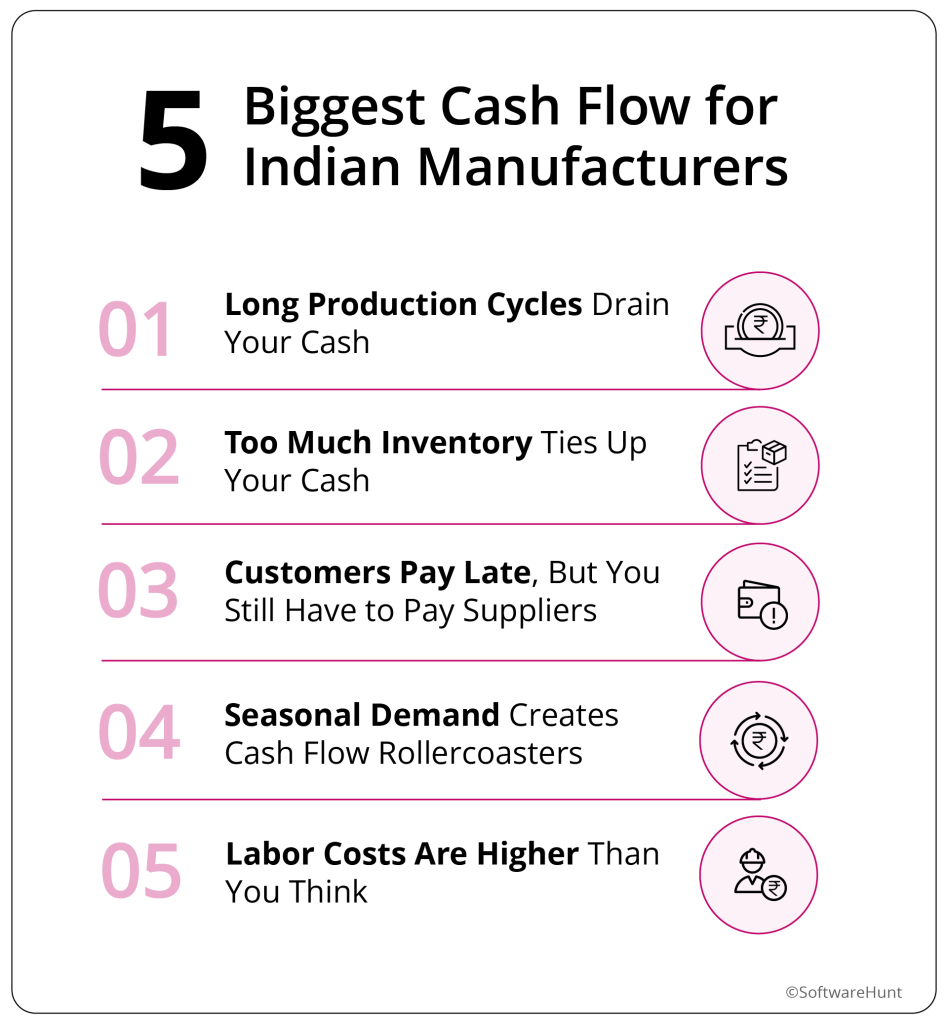
- Long production cycles drain cash. Use progress billing, supplier financing, and AI forecasting to align inflows with outflows.
- Inventory ties up cash. Implement Just-in-Time, demand-sensing AI, and consignment to reduce carrying costs.
- Delayed payments hurt. Offer early-payment discounts, use supply chain financing, and automate AR.
- Seasonal demand creates volatility. Build rolling forecasts, secure a line of credit, and diversify revenue streams.
- Labor costs add up. Use AI scheduling, cross-training, and contractor negotiations to control payroll.
Let’s talk about “The Winner’s Curse.”
In February 2018, a UK manufacturing company sought to integrate a pre-existing business to drive revenues. On paper, it was a masterstroke: they secured a diverse customer base with specialist requirements and projected massive cost synergies.
Within six months, the company faced a severe cash flow crisis despite growing sales.
Why?
The new mix of customers required smaller, varied orders. This forced the factory into frequent machine changeovers and longer running times. Manufacturing costs skyrocketed, but the pricing model wasn’t adjusted to match this new operational reality.
Sales were up. Direct costs were up. Margins were squeezed.
The crisis reached a breaking point where no headroom existed in funding facilities, monthly wages were due, and contractual deadlines loomed. The business faced collapse. Administrators had to step in to secure interim funding of £80k per week just to keep the lights on.
This case illustrates the core manufacturing cash flow paradox: the company had customers, orders, and revenue, but cash moved too slowly relative to operational demands.
60% of small businesses struggle with cash flow management.
Here are the 5 biggest cash flow traps killing Indian manufacturing SMEs, and the exact fixes to survive them.
The Cash Flow Paradox No One Talks About
A manufacturing business is a cash-conversion machine. Money comes in (from customers), but only after it’s gone out (to suppliers, labor, equipment). The longer the gap between “money out” and “money in,” the more working capital you need to survive.
And most manufacturers don’t have it.
You likely started this business with some savings or a loan, you bootstrapped, proved the concept, got customers and grew.
But growth created a problem: The bigger the orders, the more cash you need to fund them before you get paid back. Your profitability kept growing, but your cash account kept shrinking.
You might have ₹2 crore in annual revenue and ₹20 lakhs in the bank. On paper, that looks healthy. In reality, you’re one bad month away from not making payroll.
Five Places Your Cash is Disappearing
The problem isn’t one thing. It’s five separate, overlapping cash drains that compound each other. Let’s walk through each one, and I guarantee you’ll recognize your business.
Problem 1: Your Production Cycle is a Cash Trap
You took a ₹1 crore order last month, the customer gave you 60 days to deliver. You’re 30 days into production. You’ve already spent ₹70 lakhs on materials, labor, and processing. Your customer hasn’t paid you a single rupee yet.
In fact, they won’t pay you until 30 days after delivery. So that ₹1 crore is locked away for 120 days minimum before it reaches your account.
But here’s what most manufacturing owners don’t calculate: During those 120 days, you’re funding the entire operation from your own pocket.
You’ve already paid:
- ₹70 lakhs to suppliers for raw materials
- ₹15 lakhs in labor costs (wages, overtime, benefits)
- ₹8 lakhs in power, fuel, and utilities
- ₹5 lakhs in equipment maintenance
- ₹2 lakhs in miscellaneous costs
You’re ₹1 crore deep. Your customer owes you ₹1 crore. But you have ₹20 lakhs in the bank. Where does the remaining ₹80 lakhs come from?
You borrow it. You use credit from suppliers you’ve built relationships with. You ask vendors to wait. You negotiate with your bank for a short-term overdraft. You hope nothing else breaks during this period.
This is the manufacturing reality: You must fund your customer’s order before they fund you.
What This Looks Like In Your Business:
- You’re constantly juggling payment dates, moving money from one supplier to another to stay afloat
- You’re adding emergency overdraft to your loan portfolio
- You’re negotiating endlessly with suppliers to “wait one more week” for payment
- You’re terrified of big orders because they require big cash upfront
- Your payroll is your worst stress point—you know it’s coming, and you’re always scrambling to cover it
- You’ve skipped your own salary three times in the last year to keep the business alive
Why This Happens:
Manufacturing is inherently slow. Unlike retail (where you sell what you buy), manufacturing is a transformation process.
Materials → Labor → Processing → Quality Check → Packaging → Shipping.
This takes time. And during all that time, capital is tied up.
Then, after delivery, the customer takes their own sweet time to pay. Net-30, Net-45, Net-60 – they’re in no rush. Your pain is not their problem. They’re using your extended payment terms as free financing.
So you’re left funding both your operation AND your customer’s working capital. And you’re doing it with money you don’t have.
What You Can Do About It:
Stop waiting for delivery to start collecting money. The moment you incur a cost, start invoicing.
Simple checklist:
- Review your largest 5 contracts, write down the total project cost and the payment timeline
- Calculate how many days between your first cost and final payment (this is your cash trap length)
- For new projects, structure your contract so you collect money as you spend it: 20% upfront (when you order materials), 30% at halfway point, 50% on delivery
- Write this explicitly into contracts: Specify what “completion” means for each milestone (materials ordered, production starts, half-finished, final inspection passed, delivery)
- Set a reminder system so invoices go out the same day the milestone is achieved—no delays
- For existing customers, propose a modified payment structure for future orders (position it as “helping them plan their budget too”)
Problem 2: Your Warehouse Is a Money Pit
Last month, you looked at your inventory. You had ₹50 lakhs sitting in the warehouse.
Your immediate thought: “Good, we have stock. No stockouts.”
But here’s what you didn’t think about: That ₹50 lakhs in inventory is costing you ₹7.5 to 17.5 lakhs just to hold it there every single year.
Let’s do the math:
You’re paying 15-35% of your inventory value annually just to keep it.
- 8-12%: Interest on the money you borrowed to buy that inventory (it’s your working capital, funded by a bank loan)
- 5-10%: Storage, racking, warehouse rent, electricity, warehouse staff
- 5-10%: Inventory that goes obsolete, gets damaged, expires, or is written off as scrap
- 1-3%: Insurance and taxes on that sitting inventory
So if you’re holding ₹50 lakhs in stock, it’s costing you ₹7.5 to 17.5 lakhs per year. That’s like paying someone a full salary just to have inventory sitting there.
What This Looks Like In Your Business:
- You make products “just in case” demand spikes (but demand rarely spikes)
- You have dead stock, products from 12 months ago that still haven’t sold
- Your warehouse is overcrowded; you’ve had to rent additional space
- You’re not sure what’s actually in your warehouse without checking physically
- You bought materials in bulk “because we got a good price” but they’re still sitting
- You feel anxious about how much money is trapped in inventory but you’re not sure how to reduce it without risking stockouts
Why This Happens:
Most manufacturing owners overproduce because they’re afraid. Afraid of missing sales due to stockouts. Afraid of disappointing customers with long lead times. So they make extra. “Just in case.”
But “just in case” never happens the way you think it will. You end up with inventory that doesn’t match actual demand. It sits. It becomes outdated. It ties up capital that could be used for payroll, supplier payments, or emergencies.
The second reason: You don’t have clear visibility into what sells. You’re making decisions on gut feel, not data. “We always sell 500 units of Product A,” but you haven’t actually checked the last 12 months of sales history. Maybe it was 500 units in 2023, but only 350 last year. You’re still making 500 based on a guess.
What You Can Do About It:
Stop making products to fill a warehouse. Make products because someone ordered them.
Simple checklist:
- Pull 12 months of actual sales data (by product, by month)—be honest about what actually sells
- Identify your top 20 products (they probably represent 80% of your sales)
- For each of these products, calculate the average monthly demand (total annual sales ÷ 12)
- Calculate your production lead time (how long does it take you to produce one batch?)
- Set a simple rule: Only produce a new batch when inventory drops to 1.5x your monthly demand
- If you sell 100 units of Product A per month, and it takes 20 days to produce a batch of 200 units, you make a new batch when inventory hits 150 units
- If you sell 100 units of Product A per month, and it takes 20 days to produce a batch of 200 units, you make a new batch when inventory hits 150 units
- Track your inventory value weekly (not monthly), watch it trend downward over 90 days
- Calculate your inventory turnover: (Annual Cost of Goods Sold) ÷ (Average Inventory Value) = how many times you “turn over” your inventory per year
- Healthy manufacturing: Turnover of 4-8x per year (meaning inventory sits 6-12 weeks on average)
- Most manufacturers: Turnover of 1-3x (inventory sits 3-12 months)
- Your goal: Increase this by 25-50% in the first year
- Healthy manufacturing: Turnover of 4-8x per year (meaning inventory sits 6-12 weeks on average)
Why SoftwareHunt?
We replace guesswork with clarity.
We’re SoftwareHunt. We work with manufacturing owners running on Tally, Excel, and lean teams to understand your operational leaks and growth challenges. Our team is happy to connect with you, understand your personal pain points, operational leaks and growth challenges and go beyond platform listings/information to help find the right solution for you.
We’ll help you translate symptoms into clear financial insight and show you where to focus first – at no cost to you.
To email an advisor for a quick fit-check write to us at connect@softwarehunt.com
Problem 3: Your Customers Are Using You as a Bank
You invoice a customer on January 15th.
Your contract says Net-30. They should pay by February 15th.
It’s now March 10th and still no payment.
They say: “Yeah, it’s in the queue. We’ll pay next week.”
Next week comes. No payment.
You call again. Different person answers. They say: “Let me check… we received it on January 18th, but there’s a small discrepancy in the quantity. We’re holding payment until we confirm with our warehouse.”
It’s now April 2nd. You’ve been waiting 78 days for a 30-day payment.
Here’s what’s happened: Your customer is using your ₹20-lakh invoice as free working capital. They’re holding your money interest-free while they sort out their own cash flow problems.
And you’re stuck. You can’t stop doing business with them, they’re your biggest customer, 30% of your revenue. But you also can’t fund their operations indefinitely.
What This Looks Like In Your Business:
- Your largest customers consistently pay 30-50 days late, and you’ve given up trying to change it
- You have ₹1+ crore in outstanding receivables that’s been unpaid for 60+ days
- You’re constantly calling customers asking, “Did you receive this invoice?” “Can you prioritize our payment?”
- You’re paying suppliers on time to maintain relationships, but customers take their time and there’s nothing you can do
- You feel helpless—you need these customers but they’re bleeding your cash
- You’ve started borrowing money from banks specifically to cover the gap between customer receivables and supplier payables
Why This Happens:
Power imbalance. If a customer is 30% of your revenue, they know they have leverage. They know you can’t afford to lose them. So they take their time paying. If you complain, they might take their business elsewhere. So you don’t complain. You just… wait.
It’s not personal. It’s just how big companies operate. They manage their cash by extending payables. Your invoice is their float.
But it’s devastating for you. Because you don’t have the same leverage with your suppliers. If you ask your raw material supplier to wait 60 days, they’ll either charge you more or cut you off.
What You Can Do About It:
You can’t force customers to pay on time. But you can stop funding them.
Simple checklist:
- Pull your last 3 months of invoices, identify which ones are unpaid and by how many days
- Calculate your total outstanding receivables and the average number of days they’re outstanding
- List your top 5 customers by unpaid amount
- For each of these customers, set an internal target date for collection (call them, escalate if needed, offer to help with any issues)
- For new customers, implement a simple payment incentive structure:
- Pay within 7 days: No surcharge (baseline pricing)
- Pay within 15 days: No surcharge (baseline)
- Pay within 30 days: Add 1% surcharge to invoice
- Pay after 30 days: 2% monthly interest on overdue amount
- This is transparent—it’s on the invoice
- Pay within 7 days: No surcharge (baseline pricing)
- Set up an automated payment reminder sequence:
- Day 1: Invoice sent
- Day 10: Friendly reminder email (subject: “Friendly reminder: Invoice due on XYZ date”)
- Day 20: Second reminder (cc’ing their finance manager if you have it)
- Day 30: Escalation notice (cc’ing both finance AND operations contact)
- Day 40: Final notice (cc’ing their C-level contact if needed)
- Day 1: Invoice sent
- For existing customers paying late, have a conversation: “We love working with you. But to continue at current volume, we need to discuss payment terms. Can we talk?”
- Option A: They agree to pay faster (great)
- Option B: They need extended terms (50+ days)—in which case, you might need to add a small surcharge or reduce volume with them
- Either way, you’ve made it explicit and professional, not confrontational
- Option A: They agree to pay faster (great)
Problem 4: Your Revenue Swings Wildly, But Your Costs Stay Constant
You make Diwali lights. Or winter wear. Or agricultural equipment.
Here’s your revenue and expense pattern:
September-December: You’re exploding. ₹3 crore in revenue. You’re running double shifts. You’ve hired 20 temporary workers. You’re maxed out. Every rupee that comes in goes right back out to operations. You’re running on fumes.
January-August: Your revenue drops to ₹50-60 lakhs per month. But your fixed costs (rent, salaries for permanent staff, loan payments, insurance, machinery maintenance) don’t drop. They’re still ₹25-30 lakhs per month minimum.
So for 8 months, you’re burning ₹15-20 lakhs per month. By August, you’re running on whatever cash you built up during Q4.
The question that keeps you up at night: What if Diwali demand is weak this year?
What if, instead of ₹3 crore in Q4, you only do ₹2 crore? That’s ₹1 crore less cash coming in. Your cash reserves would evaporate. You wouldn’t have money for November payroll. You’d be asking your landlord for an extension. You’d be negotiating with your bank.
What This Looks Like In Your Business:
- You have two versions of yourself: Crazy-busy and terrified-of-running-out-of-money
- Around August, you’re anxious about whether the season will be strong
- You’ve been forced to build a “cash buffer” (3-4 months of expenses) but that tied-up capital isn’t earning anything
- You’re constantly doing math in your head: “If revenue is X, can we make it to the next season?”
- You can’t plan hiring or expansions because the next 8 months are unpredictable
- You over-stock before the season “just in case,” which creates inventory problems (Problem 2)
- You feel trapped, you can’t grow year-round because you’re seasonal, but you also can’t stop being seasonal
Why This Happens:
Market demand is genuinely seasonal. That’s not your fault. Winter wear sells in winter. Diwali lights sell in Diwali season. That’s just the reality of your industry.
But because demand is unpredictable, you’re trying to hedge by over-producing and building inventory. The problem: This ties up capital that should be freed up for non-seasonal periods.
You’re essentially trying to solve a forecasting problem (you don’t know exactly how much you’ll sell) by over-investing in inventory (buying extra just in case). But this is backwards. Over-investing in inventory makes the forecasting problem worse because now you have dead stock.
What You Can Do About It:
Accept that you’re seasonal. But plan for it systematically.
Simple checklist:
- Pull 3 years of monthly revenue and monthly expenses (break fixed vs. variable)
- Calculate your minimum monthly cash burn (fixed costs you can’t avoid)
- Identify the months when you’re cash-positive and the months when you’re cash-negative
- Calculate how much cash buffer you need to survive your leanest months (e.g., if you burn ₹20 lakhs/month for 8 months, you need ₹1.6 crore in reserves by August)
- Now calculate realistically: Do you have this buffer? If not, where’s the shortfall?
- Make a decision:
- Option A: Build the buffer by end of this season (set aside ₹1.6 crore from this year’s profits)
- Option B: Secure a line of credit with your bank (borrow only what you need during lean months, repay during high season)
- Option C: Reduce fixed costs during low season (negotiate lower rent, let go temporary workers, etc.)
- Option D: Find counter-seasonal products to sell (something that sells in Jan-Aug while your main product is slow)
- Option A: Build the buffer by end of this season (set aside ₹1.6 crore from this year’s profits)
- Create a 12-month cash flow forecast (project revenue and expenses month-by-month)
- Update this forecast every month with actual data, compare projected vs. actual
Problem 5: Your Labor Costs Are Sneaking Up On You
You have 15 permanent employees. You pay them ₹80,000-2,00,000 per month each. That’s ₹20-25 lakhs in monthly payroll alone.
But here’s what you’re actually paying for:
The ₹80,000 salary includes:
- Time when they’re waiting for work (production is slow that day)
- Time when machines are down (they’re paid but can’t work)
- Changeovers between product batches (30 minutes of downtime that isn’t billable)
- Quality rework (fixing mistakes takes time and cost)
- Training new people (your experienced workers lose 20% of their productivity for a month)
- Absenteeism (on days when someone doesn’t show up, either you lose production or you pay overtime to cover)
So the actual cost of that ₹80,000 salary is closer to ₹95,000-1,10,000 when you account for all the hidden inefficiency.
That’s a 20-30% cost overhead you’re not accounting for.
Most manufacturing owners estimate labor at 10-15% of revenue. The actual cost (when you include inefficiency) is 20-25%.
What This Looks Like In Your Business:
- You have one or two specialists that everyone depends on (if they don’t show up, production stops)
- You pay overtime constantly because you’re not efficient at planning shifts
- Training new people is brutal, they slow down experienced workers for weeks
- You feel like you’re over-staffed but you can’t afford to lay people off
- You have high turnover, good people leave for better-paying jobs
- You’re stuck in a pattern: Lose experienced people, hire new people, lose productivity for a month, repeat
- Your payroll is your biggest fixed cost and you feel helpless to control it
Why This Happens:
You’re running lean. You don’t have extra people to absorb inefficiency. So one person being absent means the whole operation breaks. You can’t afford to cross-train because you’re already stretched.
The irony: Your leanness is making you more expensive, not less. Because you’re paying overtime, you’re using temporary labor (which costs more), and you’re losing productivity due to absenteeism.
What You Can Do About It:
You can’t reduce labor (you need people to make products). But you can dramatically improve how efficiently those people work.
Simple checklist:
- Map your 5 most critical roles – who does what? Who’s irreplaceable?
- For each critical role, identify 2-3 people on your team who could learn this job
- Create a simple training plan for each (even just 2 hours per week for 3-4 months)
- Track your absenteeism rate (days absent ÷ total working days) for each person, which roles have the highest absence?
- For roles with high absence, make them “cross-trainable” (so absence doesn’t paralyze you)
- Calculate your overtime hours for the last 3 months – is it chronic or occasional?
- If chronic, redesign your shift schedule to match demand better:
- Identify which hours are bottlenecks (when do you need the most people?)
- Shift people to those hours instead of running uniform shifts
- This alone can reduce overtime by 20-30%
- Identify which hours are bottlenecks (when do you need the most people?)
- Separate payroll into fixed (salary) and variable (bonus/incentive) components
- Example: ₹70,000 base salary + ₹10,000-15,000 monthly bonus based on output
- This aligns incentives: More efficient work = more money
- Example: ₹70,000 base salary + ₹10,000-15,000 monthly bonus based on output
The Pattern Behind All Five Problems
Here’s what’s insane: These five problems compound each other.
You have a 90-day production cycle (Problem 1). So you need to hold 90 days of inventory (Problem 2). But that inventory ties up ₹50 lakhs, which you need to borrow from the bank at interest. Meanwhile, customers pay you 60 days late (Problem 3), so you’re funding them too. Come Q4, if you’re seasonal, you’re panicked about having enough cash (Problem 4). So you over-staff and over-work your team (Problem 5), which burns money even faster.
Each problem creates pressure that forces you to make the next problem worse.
Most manufacturing owners try to fix all five at once. That’s overwhelming and impossible while running the business.
But here’s the thing: You don’t need to fix all five. You just need to fix your biggest one.
If your biggest leak is inventory, fix that first. It’ll free up ₹20-30 lakhs immediately. That extra cash solves some of your other problems automatically.
If your biggest leak is customer payment delays, accelerate collections. That ₹50-lakh receivable sitting on the books? Get it paid faster. That’s real cash.
If your biggest leak is your production cycle, shift to milestone-based invoicing. You’ll stop waiting 120 days to get paid.
Each fix is localized. Each one solves 2-3 of the other problems as a side effect.
The Real Question: Where Is Your Cash Actually Stuck?
Before you try to fix anything, you need to know exactly where the problem is.
Most manufacturing owners can’t answer this question:
“Of every rupee I invest in this business, how many days does it take to come back to me?”
The answer is: Add up three numbers.
- Days your money is trapped in inventory (how long do raw materials sit before becoming finished products?)
- Days you wait for customers to pay (from invoice to cash in account)
- Minus the days your suppliers let you wait (from purchase to payment)
For most manufacturers, this number is 60-120 days. That means every rupee you spend takes 60-120 days to return. During that time, you’re funding everything from working capital.
This is the number you need to obsess over. Not profitability. Not revenue. This number.
Because this number determines whether you survive or go bankrupt.
What Needs to Happen Now
You understand the five problems. You recognize at least three of them in your business.
But knowing the problem isn’t solving it. Implementing the solution while running day-to-day operations is the hard part.
You need to:
- Diagnose which problem is bleeding the most cash (inventory? receivables? production cycle?)
- Build a specific action plan (not generic—for your business, your customers, your operations)
- Know the sequence (what to fix first, second, third)
- Measure whether it’s actually working (cash flow should improve within 90 days)
- Have accountability (because you’ll be tempted to abandon the plan when things get busy)
This isn’t something you figure out alone in a spreadsheet at 11 PM on Sunday.
You need someone who’s seen this before. Someone who’s worked with 50+ manufacturers and knows which problems compound which. Someone who can look at your specific numbers and say: “Your biggest leak is here. Fix this first. Here’s exactly what to do.”
Let’s Get Specific About Your Situation
That’s what we do at SoftwareHunt.
We diagnose your specific cash flow bottleneck. We look at your production cycles, your inventory, your receivables, your payables, your seasonality. We identify which one is costing you the most cash. We build a specific 90-day plan to fix it. We measure results.
We’ll help you translate symptoms into clear financial insight and show you where to focus first – at no cost to you.
To email an advisor for a quick fit-check write to us at connect@softwarehunt.com