TL;DR
- Pharma cash conversion cycles stretch 90-150+ days because batches take weeks to produce and clear QC while customers pay in 60-120 days but suppliers demand payment in 15-45 days.
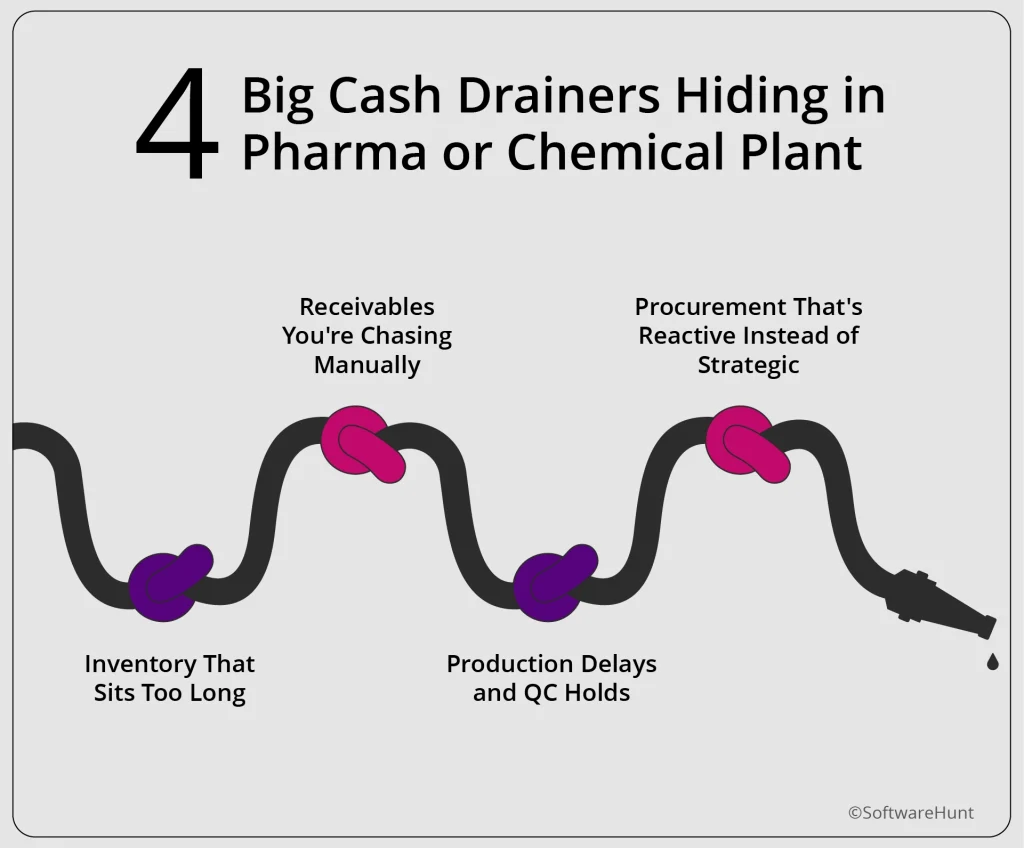
- Cash is trapped in four places: aging inventory, late-paying receivables, WIP and QC holds, and reactive procurement bleeding money through emergency orders.
- Most pharma plants can’t calculate their Days Inventory Outstanding, Days Sales Outstanding, or Cash Conversion Cycle so they can’t identify which drain costs the most.
- Start with a cash audit: measure how many days cash sits locked at each stage, pick one lever per function, and make cash visibility a weekly standing agenda item.
In 2016, Bengal Chemicals and Pharmaceuticals, India’s first pharmaceutical company, was dying. The135-year-old institution had been bleeding money for over six decades. Raw materials piled up in warehouses. Finished goods sat waiting for dispatch. Bills went unpaid. Employees wondered if their next salary would arrive on time.
From the outside, production looked busy. Batches were running. Machines were operating. People were working.
But inside the finance department, the cash flow was a nightmare.
Then something changed.
A new finance head walked in, took one look at the scattered Excel sheets and manual payment vouchers, and said something unexpected: “We have a cash visibility problem.”
Within 18 months, the company turned a ₹37 crore loss into a ₹4.5 crore profit without adding a single new product line. They didn’t launch a blockbuster drug. They didn’t expand capacity. They simply fixed how cash moved through the business.
If you run a pharma manufacturing business, you know the pain: Cash feels tight even when orders are full.
Here’s where your cash is actually stuck and what’s really happening behind the scenes.
Why Cash Flow Feels Like Quicksand in Pharma Manufacturing
Most manufacturing businesses deal with working capital challenges but pharma and chemical companies face a uniquely brutal combination that makes cash flow problems exponentially worse.
Long production and quality cycles lock cash for weeks.
A typical batch takes 10-15 days to manufacture, then sits for another 5-10 days in QC holds before it can even be dispatched. That’s three weeks where your raw material investment earns you nothing.
Every day a batch sits waiting for QC approval, your working capital is frozen. And in pharma, those delays multiply. A hold at formulation delays filling. A delay in filling pushes back QC. A QC backlog delays dispatch.
In India, QC delays are compounded by manual documentation, unclear SOPs, and reactive issue resolution. A small deviation in one parameter can hold up an entire batch for days while teams figure out whether to release, rework, or scrap.The pharmaceutical industry loses approximately $50 billion annually due to the shortcomings of batch processing – time constraints, delivery issues, damage, and review cycles.
Regulatory compliance demands capital upfront.
GMP upgrades, Schedule M compliance, batch documentation, stability testing, and audit readiness all require immediate investment. Miss a compliance deadline or fail an inspection, and you’re looking at production halts, rework, or worse.
Credit cycles stretch receivables out to 60-90 days or more
Distributors and institutional buyers expect extended payment terms, especially in tier 2 and 3 markets.
By the time your invoice gets paid, you’ve already had to fund the next two production runs out of pocket.
Raw material prices fluctuate, and you can’t always pass costs downstream
Pharma pricing in India is tightly controlled. When API costs spike due to import dependencies, geopolitical instability, or supply chain disruptions, your margins get squeezed but your prices stay frozen.
Financial and political issues create limitations for supplying APIs, especially for imported materials. The US-China trade war, tariffs, and changing geopolitical situations dramatically raise costs beyond planned schedules.
Add it all up, and you get a cash conversion cycle that can easily stretch to 100-150 days or longer. That means every rupee you invest in raw materials takes three to five months to come back to you.
And if any link in that chain breaks – billing delays, QC rejections, overdue receivables, surprise compliance costs – the whole system seizes up.
The Four Places Your Cash Is Actually Trapped
Walk through any mid-sized pharma plant and you’ll see cash disappearing in four distinct places. Each one drains more working capital than everything else combined.
1. Inventory That Sits Too Long (And Eventually Expires)
Walk your warehouse right now. You’ll find:
- Raw materials bought three months ago because the supplier offered a bulk discount
- Half-finished batches waiting for the next production slot
- Finished goods aging on shelves because dispatch coordination is manual and reactive
- Dead stock from discontinued SKUs nobody bothered to write off
Inventory represents cash in disguise. And when it doesn’t move, neither does your money.
But here’s what makes pharma uniquely brutal: Your inventory has an expiration date.
The ₹2 Lakh Write-Off That Should Never Have Happened
A pharmacy in India ran a routine month-end audit. The store manager noticed unusually large disposal entries, entries labeled “Stock write-off” totaling ₹2,00,000 for expired medicines.
No one on the counter team had flagged these items. It wasn’t a one-off SKU. It was dozens of products across painkillers, antibiotics, and chronic-care drugs.
What went wrong?
The logs revealed the pattern:
- Last sale: Many items hadn’t sold since December or January. No movement for 2 months.
- Shelf life: Batches had 4-6 months of shelf life when received. Under normal turnover, they should have sold. But low demand and poor visibility kept them hidden.
- No system: Staff used random picking. Newer stock got sold first, leaving older, expiring batches at the back.
- No alerts: Nobody knew which batches were 30 or 60 days from expiry.
- No action: No clearance promotions. No discounts. No urgency until it was too late.
At a 25% margin, that ₹2 lakh write-off represented ₹50,000 in lost profit. Money tied up in expired goods couldn’t restock faster-moving items.
Why This Happens in Pharma
Pharma and chemical companies face uniquely tight expiry windows compared to other industries. APIs, excipients, and finished formulations all have shelf lives. Batch-level traceability is mandatory, so you can’t just mix old and new stock to move things faster.
Research shows that for items with short shelf life, targeting very high service levels actively generates waste. If your average shelf time exceeds the product’s shelf life, waste will consistently be generated.
Products approaching or surpassing their expiration must be written off, leading to higher wastage rates that inflate your cost of goods sold (COGS).
Long lead times and large batch sizes reduce supply chain agility, making it hard to respond to changing market conditions.
What This Looks Like In Your Business:
- You have stock sitting for 90+ days that nobody’s touched
- Your stores team is still eyeballing labels to figure out which batch to issue first
- You discover expired batches only during month-end audits, never before
- You’ve written off ₹3-5 lakhs in the last year due to expiry
- You don’t track expiry windows systematically, it’s all reactive
- Half your warehouse is “safety stock” that you can’t actually justify with a formula
The Real Cost:
If you’re currently holding 75 days of inventory but industry-efficient plants operate at 60 days, reducing your Days Inventory Outstanding (DIO) by 15 days frees up approximately 4% of your annual COGS as working capital. For a plant with ₹3 crore annual COGS, that’s ₹12 lakh freed up immediately.
DIO currently: 75 days. Target: 60 days. Reduction: 15 days. Annual COGS: ₹3 Cr. Working capital freed: (15 days ÷ 365 days) × ₹3 Cr = ₹12.3 L. That’s 4.1% of COGS immediately available for operations, payroll, or growth.
2. Receivables You’re Chasing Manually (While Distributors Use You as a Bank)
Your normal payment term is 60 days. You send out bills on January 1st. The distributor needs to pay by March 2nd.
Today is April 25. 115 days. No payment.
You call. “It’s in line.” “Next week, we’ll take care of it.”
Next week comes. No payment.
You call again. Another person: “Let me check… we got it, but there is a problem with the paperwork.” We are holding off on payment until we check.
This is what really is going on: Your distributor is using your invoice as free cash flow. They are keeping your money without charging you interest while they fix their own cash flow issues.
The Power Imbalance That No One Talks About
Pharmaceutical MSMEs have a lot of trouble when payments are late. They mess up cash flow, which makes it hard to pay for operations, pay employees, and put money into growth projects.
Pharma MSMEs have less power when it comes to negotiating than bigger companies. Buyers can take advantage of this power imbalance by delaying payments without facing serious consequences.
Many buyers, both private and public, pay late because of problems with administration, bureaucracy, a desire to improve margins, or a lack of understanding of how late payments affect pharma MSMEs.
Pharma MSMEs use costly alternative financing options to make up for the money they lose when payments are late. This makes debt and interest costs go up, which hurts financial health even more.
How This Affects Your Business:
Your biggest distributors are always late with payments by 90 to 120 days, and you’ve accepted that as “just how they do business.”
You have ₹1 crore or more in unpaid bills that have been due for more than 60 days.
Your AR team spends half of their week calling customers and asking, “When will you pay?”
You’re getting a loan from your bank to cover the difference between what customers owe you and what you owe your suppliers.
Payment is late because invoicing is slow, there are mistakes on the bill, the paperwork isn’t complete, or no one is following up on a regular basis.
You feel like you can’t do anything, but you need these customers because they’re hurting your cash flow.
The Hidden Math: Studies show that you should stay away from a DSO of more than 90 or 120 days as much as possible because it makes it more likely that payments will be missed.
If your DSO is currently 90 days and you cut it down to 75 days, you will have 15 days of extra revenue as
3. Production Delays and QC Holds (Your Cash Sitting Idle)
Work-in-progress inventory is the sneakiest cash trap because it looks like productivity. Batches are moving. Machines are running. People are busy.
But if those batches sit half-finished for days waiting for the next step, your working capital remains stuck in limbo.
Every day a batch sits in QC limbo represents a day your working capital is frozen. Batch processing delays, quality rejections, and rework cycles tie up working capital and extend cash conversion cycles by preventing finished goods from reaching customers.
Why QC Becomes a Bottleneck
The biggest QC delays are administrative rather than technical:
- Batches waiting for someone to review documentation
- Test results sitting in an inbox
- Approval workflows that require five signatures and three of those people are out of the office
- Manual logs and email approvals where nothing gets tracked systematically
These are process problems, not quality problems.
In pharma, WIP delays multiply. A hold at formulation delays filling. A delay in filling pushes back QC. A QC backlog delays dispatch. Every extra day adds carrying cost and risk.
What This Looks Like In Your Business:
- Batches routinely sit 5-7 days in QC even though the actual testing takes 48 hours
- You don’t have clear SLAs for QC turnaround time
- Approvals depend on one person being at their desk, if they’re on leave, everything stops
- You’re discovering quality issues after the batch is finished, not during production
- Your QC team is overwhelmed with manual documentation
- Production schedules change constantly to accommodate “urgent corrections”
The Changeover Tax:
Time wasted changing over between batches and setting up for new batches results in longer lead times and significant production delays. Every hour your line is down for cleaning and setup represents an hour your WIP isn’t moving.
Batch production often necessitates the storage of intermediate products between different stages, leading to higher inventory costs as storage and handling expenses increase.
4. Procurement That’s Reactive Instead of Strategic
Procurement is where cash leaves your business, so it demands the most discipline. Yet in most mid-sized pharma companies, procurement remains chaotic:
- Orders placed over WhatsApp
- Invoices verified manually
- Payments made based on whoever’s shouting the loudest
- Emergency purchases at premium prices because someone forgot to reorder
Cash bleeds out faster than it should.
The Real Procurement Problems in Pharma
Research on pharmaceutical supply chains identified the most important problems:
- Inaccuracy in forecasting
- Long lead times
- Lack of optimum target inventory
- High supply chain costs
- Lack of integration and collaboration between different supply chain echelons
- Lack of information visibility, transparency, and sharing
- Long cash-to-cash cycle time
- Uncertainty in supplying qualified raw materials in required quantity and at the right time
- Lack of effective supplier relationship management
Financial and political issues cause some limitations for supplying APIs, especially for imported materials. A lack of collaborative relationship strategies with suppliers creates harder conditions: deviation of forecasts, drastic inventory oscillations, and stock-out episodes.
Therefore, companies buffer large amounts of materials and products inventory. Although this strategy enhances responsiveness and increases customer satisfaction, it causes other problems: need for more warehouse space, increasing inventory costs, and the risk of material or product expiration.
What This Looks Like In Your Business:
- Every department orders independently, you lose visibility and pay different prices for the same materials
- You can’t negotiate volume discounts because your spend is fragmented
- You often pay invoices without verifying that goods were actually received, or received in the right quantity and quality
- Your payment terms don’t match your cash conversion cycle, you pay suppliers in 15-30 days but customers pay you in 60-120 days
- You’re dealing with 50 small suppliers for similar materials, creating administrative overhead and weak negotiating power
- Raw material costs are volatile due to inflation, geopolitical instability, and supply chain disruptions but you have no hedging strategy
Why SoftwareHunt?
We’re SoftwareHunt. We work with manufacturing owners running on Tally, Excel, and lean teams to understand your operational leaks and growth challenges. Our team is happy to connect with you, understand your personal pain points, operational leaks and growth challenges and go beyond platform listings/information to help find the right solution for you.
We’ll help you translate symptoms into clear financial insight and show you where to focus first – at no cost to you.
To email an advisor for a quick fit-check write to us at connect@softwarehunt.com
How to Start Fixing This (Without Overhauling Everything)
You don’t need a transformation project. You need clarity about your biggest leak and a way to attack it without disrupting everything else.
Step 1: Run a Brutally Honest Cash Audit
Block half a day with your finance and operations heads. Answer five questions:
- How many days of RM, WIP, and FG do we really hold today?
- How many days does it take, on average, to get paid after dispatch?
- How many days of credit are we giving suppliers versus getting from customers?
- How much stock is older than 90 days, and what is it worth?
- How many days do batches sit in QC or WIP beyond plan?
Write the numbers down. This becomes your baseline.
Calculate your Cash Conversion Cycle (CCC):
CCC = DIO + DSO − DPO
Where:
- DIO (Days Inventory Outstanding) = (Average Inventory ÷ Cost of Goods Sold) × 365
- DSO (Days Sales Outstanding) = (Accounts Receivable ÷ Net Credit Sales) × 365
- DPO (Days Payable Outstanding) = (Accounts Payable ÷ Cost of Goods Sold) × 365
If your CCC is 120+ days, you’re bleeding working capital.
Step 2: Pick One “Money Lever” Per Function
Instead of trying to transform everything, assign one clear, cash-linked priority to each team for the next quarter:
- Inventory / Stores: “Reduce inventory days by 15% without stockouts.”
- Production / QC: “Cut average WIP + QC time by 10 days.”
- Finance / AR: “Reduce DSO by 15 days for top 20 customers.”
- Procurement: “Align top 10 suppliers’ payment terms closer to our customer payment terms.”
This keeps the whole company pointed at cash flow instead of isolated KPIs.
Step 3: Attack Inventory First
Inventory is often the single biggest cash drain and the one you have the most control over.
Pull an aging report today.
Show every SKU in your warehouse, how long it has been sitting there, and its current value. Anything over 90 days old needs a decision: Use it in production, discount it and move it out, or write it off. Don’t let it sit for another quarter pretending it’s an asset.
Set reorder levels based on real consumption.
Track actual consumption over the last 6-12 months, adjust for seasonality and growth, and set reorder triggers at that level. Stop reordering based on “what we usually buy” or supplier minimum order quantities.
Enforce FIFO discipline systematically.
Label stock clearly with manufacturing dates and expiry dates. Train your stores team to issue oldest batches first, every single time. Make this a non-negotiable rule.
Track expiry windows at every stage.
Raw materials have shelf lives. Intermediates have hold times. Finished goods have expiry dates. Each of those windows should trigger alerts so you have time to act before the product becomes unsellable.
Reduce batch sizes if you’re overproducing.
Larger batches feel efficient because you maximize equipment utilization. But if half that batch is still sitting in your warehouse six months later approaching expiry, you’ve locked up capital unnecessarily.
Step 4: Accelerate Receivables
Receivables represent revenue you’ve earned but can’t spend yet.
Invoice faster.
The clock on payment doesn’t start until the invoice goes out. If your billing team takes 5-7 days after dispatch to generate and send an invoice, you’ve already lost a week. Make invoicing happen the same day goods leave your warehouse.
Make invoices clean and complete.
Errors in GST details, wrong HSN codes, mismatched PO numbers, or missing delivery proof all give customers an excuse to delay payment while they “clarify.” Get it right the first time.
Set up systematic payment reminders.
Don’t rely on manual follow-up emails or phone calls. Create a structured reminder sequence at 30, 45, 60 days, and escalations for anything overdue beyond 75 days.
Track aging and act on it.
Pull a receivables aging report every week. Anything over 60 days needs immediate attention. Anything over 90 days needs escalation to senior management or a hold on future shipments until payment clears.
Offer early payment discounts selectively.
For high-value customers with good track records, offering a 1-2% discount for payment within 15 days can improve your cash flow dramatically. You trade a small margin hit for much faster liquidity.
Step 5: Cut QC Delays
Quality control is a must in the pharmaceutical industry. But QC delays that aren’t needed cost a lot of money.
Set clear SLAs for how long it will take to finish QC.
- How long should a normal test take?
- How long does it take to look over the results?
- How long does it take to get approval for batch release?
Set goals, keep an eye on them, and make sure teams are responsible. If your QC SLA is 48 hours and batches sit for 6 days all the time, you have a problem with your system.
Find deviations early.
Quality checks during production let you find problems before the whole batch is done. That saves time, cuts down on waste, and keeps money flowing.
Make approval processes the same for everyone.
Don’t let approvals depend on one person being at their desk. Set up escalation procedures so that if someone is on leave, the next person in line is automatically told.
Step 6: Tighten Procurement
Make all buying decisions in one place.
You can’t see what’s going on, pay different prices for the same materials, or get volume discounts when each department orders on its own. Centralized procurement gives you power and control.
Use three-way matching: PO-GRN-invoice.
You’d be surprised at how often businesses pay bills without checking to see if they actually got the goods or if they were the right amount and quality. This easy check makes sure you only pay for what you got and lets you know if there are any problems before the money leaves the building.
Set up payment terms that work with your cash conversion cycle.
Instead of paying your suppliers in 15 to 30 days, try to get them to agree to 45 to 60 days, especially for materials that aren’t critical.
Keep an eye on how well your suppliers are doing and combine them.
When you have to deal with 50 small suppliers for the same materials, it takes more time and makes it harder to negotiate. If you cut down on the number of vendors you work with and only work with the best ones, you’ll get better terms, faster service, and cleaner workflows.
Step 7: Trim Operational Costs Without Cutting Corners
After raw materials, energy costs are usually the second most expensive part of running a business. Simple changes, like better HVAC schedules and heat recovery, can cut down on energy use without slowing down production.
You can save a lot of money by recovering and reusing solvents. A chemical plant in Vapi that was buying solvents for ₹18 lakh a year could have saved 60% of that money with a simple recovery and reuse system. They also changed the terms of their packaging contracts and cut their energy use by 12% by upgrading their equipment, which paid for itself in 14 months.
Less scrap and rework. Every time you reject a batch or have to redo something, you lose time, money, and materials. Every month, keep track of your scrap and rework rates, find the main problems, and fix them. Even a 1–2% drop in scrap can save tens of lakhs every year.
Preventive maintenance is better than fixing things after they break. Unplanned downtime costs a lot of money. It stops production, makes batches take longer, and costs a lot of money to fix things that go wrong. A simple schedule for preventive maintenance keeps lines running and costs under control.
The Weekly Discipline That Changes Everything
Bengal Chemicals didn’t turn around overnight. They built a weekly cash discipline.
Every week, without fail:
- Review inventory and receivables aging
- Review upcoming payables
- Review WIP and QC backlogs
- Take three concrete decisions that impact cash in the next 30 days
Treat cash visibility with the same seriousness you treat regulatory audits.
Two pharma plants can look identical from the outside – same lines running, same products shipping, same teams under pressure. The difference shows in the numbers leadership reviews every week, and in the discipline that ensures every batch, invoice, and payment moves without friction.
What Actually Needs to Happen
If you boil this entire playbook down, three themes drive working capital optimization in a pharma or chemical plant:
- Move inventory faster and more intelligently
- Shorten the time between dispatch and cash in bank
- Make cash visible so you can steer, not react
If you cannot calculate your current cash conversion cycle, Days Sales Outstanding, or Days Inventory Outstanding, you can’t identify which drain is costing you the most.
Calculate your CCC this week. Identify which component drains the most cash. Then pick one lever – inventory, receivables, QC delays, or procurement – and attack it systematically for the next 90 days.
The best cash flow improvement is the one your finance and operations teams adopt next month and measure improvement within 90 days, not the comprehensive overhaul that sits in planning for a year while working capital continues bleeding.
Ready to Stop the Bleeding?
Why SoftwareHunt?
We’re SoftwareHunt. We work with manufacturing owners running on Tally, Excel, and lean teams to understand your operational leaks and growth challenges. Our team is happy to connect with you, understand your personal pain points, operational leaks and growth challenges and go beyond platform listings/information to help find the right solution for you.
We’ll help you translate symptoms into clear financial insight and show you where to focus first – at no cost to you.
To email an advisor for a quick fit-check write to us at connect@softwarehunt.com