TL;DR
- Every rupee locked in dead stock is cash from your personal guarantee. Every ₹5 lakh overstocked is equal to ₹70,000/year in wasted interest on your working capital loan.
- When inventory turnover drops below 6x, your bank stops trusting you. Your loan renewal gets delayed. That ₹50 lakh export order you wanted to take? You can’t because your cash is locked in dead stock.
- The 4 Dead Stock Types You Have Right Now: MOQ murder (ordered for bulk discount), trend trap (finished goods nobody wants), specification ghost (custom RM from cancelled job), and safety surplus (ordered “just in case”)
- Simple Fixes You Can Start This Week: Weekly godown walk with phone camera. PO vs. Customer PO rule (no large PO without customer justification).
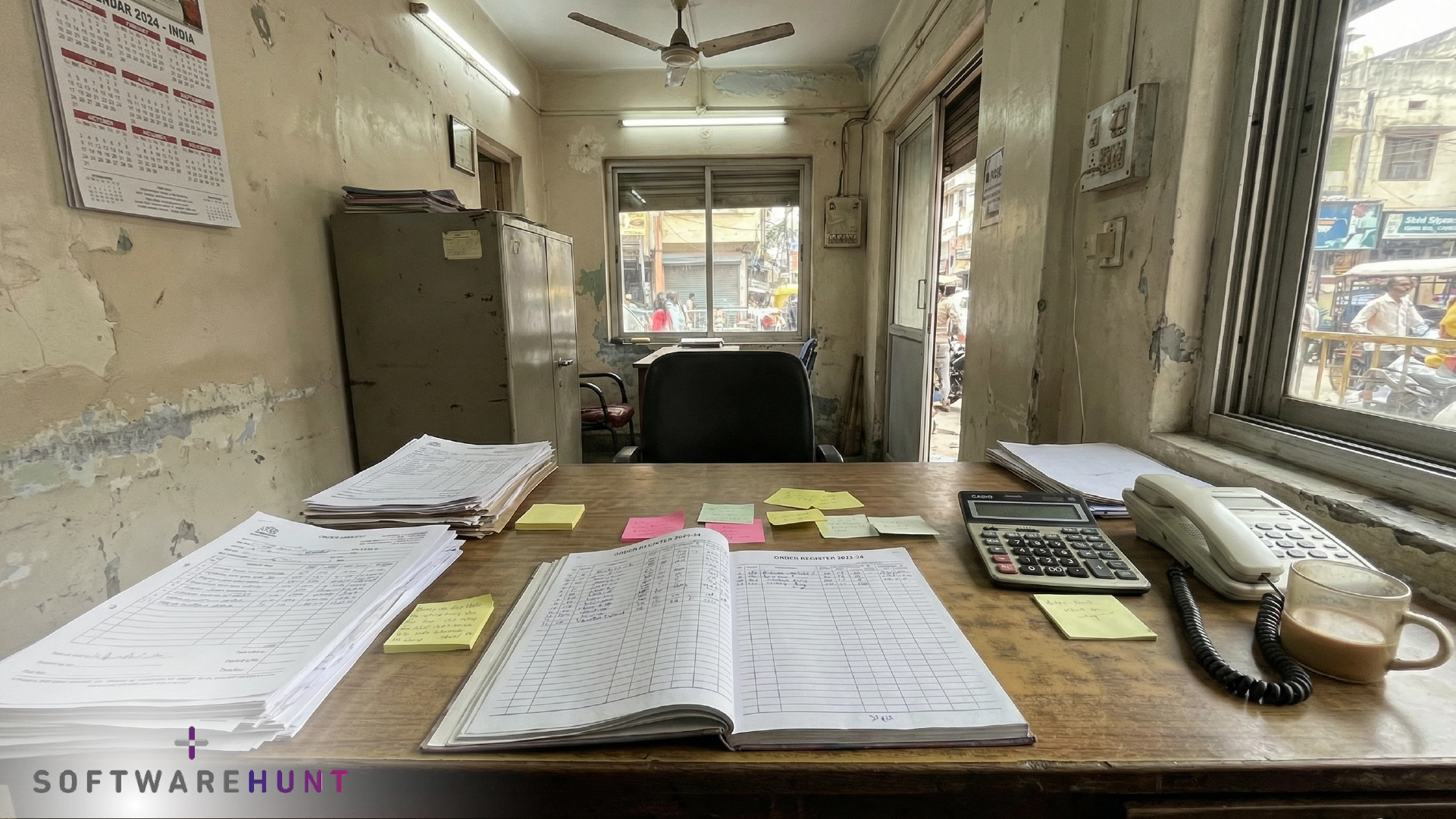
Jaipur, 10:47 PM. Anil Mehta is staring at a WhatsApp message from his auditor that he cannot unsee. Attached is a photo of rusted ball bearings, covered in dust, stacked in the far corner of his godown. The caption reads: “₹4.2 lakh, zero movement in 11 months, write-off is recommended.”
This is Anil’s money he had personally guaranteed to the bank. Money he could have used for his daughter’s school fees, money that was supposed to be his family’s safety net. Instead, it’s a monument to a mistake he calls “playing it safe.”
For SME Founder-Owners like Anil, overstocking isn’t just an accounting problem, it’s a personal financial crisis dressed up as “inventory management.” Every rupee trapped in dead stock is a rupee that isn’t in his daughter’s education fund. Every dead bearing is a personal guarantee he now has to explain to his wife.
The inventory in your godown isn’t company property. It’s your personal wealth that you haven’t lost yet.
Research shows that even well-run manufacturing companies hold 20-30% of their inventory as dead or slow-moving stock, and for poorly managed SMEs, this figure can be even higher.
In a typical Tier 2/3 manufacturing unit with ₹15-30 lakh in total inventory, this means ₹3-9 lakh is trapped in stock that isn’t moving. A 2025 study across 300 MSMEs in Tier 2 cities (Zirakpur, Mohali, Chandigarh) found that 81% reported stockouts on fast-moving goods indicating severe cash flow and inventory management problems.
That “Safe” Stockpile Is Actually Stealing Your Home Loan EMI Money
Let’s stop calling it “overstocking.” Let’s call it what it really is: cash you can’t use.
The personal guarantee trap you didn’t see coming
When you sign that ₹25 lakh working capital loan, you put your personal assets on the line. Every quarter, your bank manager reviews your inventory turnover. When he sees ₹6 lakh in slow-moving stock, his Excel sheet turns red. Your debt-to-asset ratio worsens, collateral value drops. Suddenly, that “safe” stockpile is the reason your home loan application gets rejected.
The math that hurts:
If you have ₹5 lakh in dead stock and your working capital loan interest is 16-22% per annum (typical for Tier 2/3 SME manufacturers), you’re paying ₹80,000-1.1 lakh per year in interest on inventory that isn’t generating any revenue. Public sector banks like SBI offer rates starting from 8-10.75% for top-rated borrowers, but most MSMEs face 14-24% from NBFCs and private lenders depending on credit profile. This doesn’t include the additional 20-30% annual inventory carrying cost (warehousing, insurance, obsolescence, opportunity cost), which adds another ₹1-1.5 lakh to the total cost of holding that dead stock.
The auditor’s red flag that becomes your personal headache
Every 90 days, your auditor visits. He walks through your godown with his phone camera. He finds items you ordered “just in case” that haven’t moved. He says, “We need to write off ₹3.2 lakh.” That write-off doesn’t just hit your company P&L. It hits your personal income. It reduces your ability to draw a salary. It means you skip the family vacation this year.
The 4 Signs Your Auditor Is About to Red-Flag Your Inventory
Sign 1: The “₹50,000 minimum order” items you can’t remember ordering
Walk your godown. Find items you ordered because the supplier had a “bulk discount” but you can’t remember the last time they moved. If you touch an item and your fingers come back dusty, it’s dead. If you don’t remember ordering it, it’s likely a “MOQ trap” you fell into.
Sign 2: Your Tally shows “stock” but your shopfloor says “shortage”
Your Tally says you have 500 kg of steel. Your supervisor says production stopped because “steel is finished.” This isn’t a Tally error. This is overstocking of the wrong items. You have inventory, but it’s the inventory you can’t use. The mismatch is the smoke alarm.
The daily check: Compare Tally’s stock summary with supervisor’s end-of-shift consumption log. If they don’t match for your top 10 SKUs, you’re overstocking the wrong things.
Sign 3: Your auditor’s phone camera is your worst enemy
When your auditor walks the godown, he isn’t trying to find fault. He’s trying to find value. If his phone camera shows more than 30% of your inventory covered in dust, he’ll send you a “management letter” that your bank manager will read. That letter becomes the reason your loan renewal gets delayed.
Sign 4: Your purchase orders are bigger than your confirmed orders
If you’re ordering raw material worth ₹2 lakh but you only have confirmed customer orders for ₹80,000, that ₹1.2 lakh is a personal gamble. You’re betting your family’s money on “hope.” Hope isn’t a strategy. It’s how you end up with ₹4.2 lakh of rusted bearings.
The ledger check: Before signing any PO over ₹50,000, Anil now asks: “Show me the customer PO that justifies this.” If there isn’t one, he asks the sales head to confirm it verbally. If the sales head hesitates, the PO is cancelled.
Why Your “Just in Case” Ordering Is a ₹10 Lakh Personal Guarantee Risk
Every founder says “Order extra. We can’t afford a stockout.” But stockouts cost you orders. Overstocking costs you your house. Let’s understand the real root causes.
The bank manager’s inventory turnover trap
Under RBI guidelines for working capital assessment, banks typically evaluate 25% of your projected annual turnover as total working capital requirement. Of this, you (the borrower) must contribute 5% as margin/net working capital, while banks finance the remaining 20% minimum.
The supplier MOQ trap that feels like a discount
Suppliers in Tier 2/3 cities offer bulk discounts because they have MOQs (Minimum Order Quantities). You order ₹50,000 worth to get a 12% discount. But you only need ₹15,000. The ₹35,000 extra sits for 8 months. The 12% discount cost you more in interest than you saved.
The founder’s fear tax
You’re afraid of stockouts because one stockout cost you a ₹20 lakh order last year. So you overstock. But now you’re losing ₹5 lakh in working capital interest annually. The fear of losing ₹20 lakh is costing you ₹5 lakh every year. That’s a tax you pay on your own fear.
The math of fear: ₹5 lakh dead stock costs you ₹70K-1.1L in interest + ₹1-1.5L in carrying costs = ₹1.7-2.6L per year. That’s 34-52% of the dead stock’s value, annually.
The ₹1.8 Lakh Graveyard: 3 Types of Dead Stock Hiding in Your Godown
Not all dead stock is the same. Each type requires a different burial strategy.
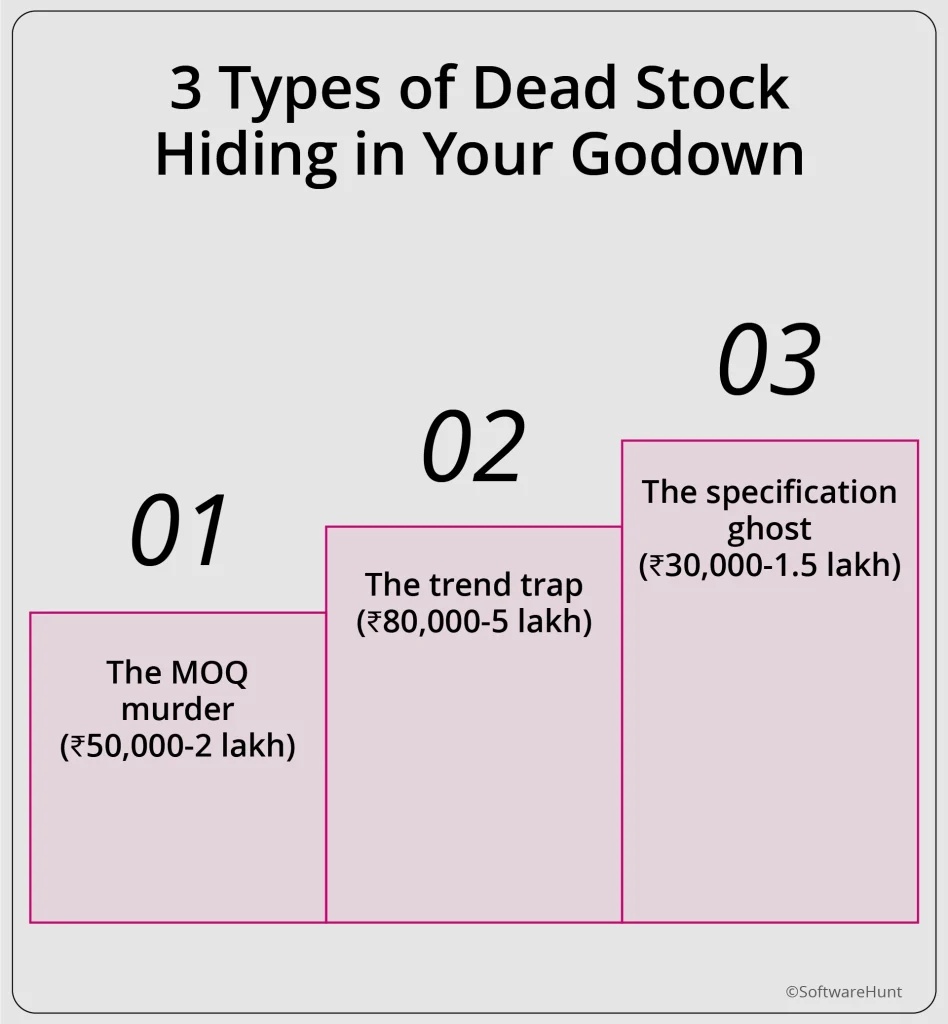
Type 1: The MOQ murder (₹50,000-2 lakh)
This is the inventory you ordered because of supplier MOQ. Bearings, fasteners, specialty chemicals, you have 500 pieces, you need 50, the remaining 450 are dead the day they arrive.
How to spot: Run a Tally report: Items ordered in the last 6 months where consumption < 20% of purchase quantity. That’s your MOQ murder list.
How to prevent: Negotiate “phased delivery” instead of bulk. Commit to ₹2 lakh annually, but take ₹50,000 monthly deliveries. Most suppliers agree if you’re reliable.
Type 2: The trend trap (₹80,000-5 lakh)
This is the finished goods you produced because “last season this sold well” but customer tastes changed. Now you have ₹3 lakh of finished garments in last year’s color that nobody wants.
How to spot: Tally’s “Stock Ageing” report. Items in FG godown >90 days = trend trap.
How to prevent: Produce FG only against confirmed POs. The “Inventory forecast” for FG should be 70% confirmed orders + 30% historical baseline. Not the other way around.
Type 3: The specification ghost (₹30,000-1.5 lakh)**
This is raw material bought for a specific customer job that got cancelled. Custom-sized steel, special-grade chemicals, branded packaging. It can’t be used for any other customer. It’s dead the moment the PO is cancelled.
How to spot: Tally items with “customer name” in description and zero consumption for 60 days.
How to prevent: Get 50% advance payment for custom RM orders. If a customer cancels, you keep the advance to cover the dead stock cost. Include this clause in your quotation terms.
Type 4: The Safety Stock Illusion (₹1-3 lakh)
This is inventory you think is safety stock but is actually dead stock in disguise.
Anil’s ₹4.2L bearings? He called it ‘safety stock for peak season.’ But peak season was 8 months ago. And the order quantity was 10x what any peak actually needed.
Real safety stock has a formula:
(Max daily usage × Max lead time) – (Avg daily usage × Avg lead time)
For Anil’s bearings:
– Max daily: 12 kg | Max lead time: 21 days = 252 kg
– Avg daily: 8 kg | Avg lead time: 12 days = 96 kg
– Real safety stock = 252 – 96 = 156 kg
He had 420 kg. The extra 264 kg wasn’t safety. It was hope.
Remember: If you don’t know exactly why you’re holding inventory, it’s probably overstock.
How to spot: Run Tally report for all items tagged “safety stock” in your system. Calculate actual safety stock using the formula above. The gap is dead stock pretending to be safe.
How to prevent: Set reorder points based on MAX lead time, not average. Update the formula quarterly based on actual supplier performance from the last 6 months. Review every item tagged as “safety stock” with your auditor annually.
The BOM blindspot trap
You order 100 kg ‘extra’ steel. Feels safe. But your BOM (Bill of Materials) says each finished unit needs 4 different materials in specific ratios.
Steel arrives. Bearings are delayed. You can’t start production anyway. The steel becomes dead stock because the BOM wasn’t considered.
Real example: Anil ordered extra steel shafts for “safety” – 200 pieces. But his gear assembly BOM requires:
– 1 steel shaft
– 4 bearings
– 8 bolts
– 1 housing
The bearings supplier was delayed by 3 weeks. The 200 steel shafts sat idle. By the time bearings arrived, the customer had moved the order to another vendor. The steel became dead stock – not because he didn’t need it, but because he couldn’t use it without the other 3 BOM components.
For manufacturers, safety stock isn’t one number. It’s 15-20 numbers that must arrive together. That’s why ‘just in case’ ordering creates more dead stock, not less.
The fix: Never order safety stock for one BOM component without checking supplier lead time for ALL components. If one has 3-week lead time, either order all components with 3-week lead time buffer, or negotiate phased delivery for all or nothing.
How ₹3 Lakh in Dead Stock Cost You That ₹50 Lakh Order (And Your Bank Manager’s Trust)
The real cost of overstocking isn’t the money locked in your godown. It’s the opportunities you miss because your cash is trapped there.
The ₹50 lakh order you couldn’t take
Last month, a customer offered Anil a ₹50 lakh export order. Delivery: 45 days. He needed ₹12 lakh for raw material. But he had ₹8 lakh locked in dead stock. His bank refused to increase his working capital because his inventory turnover was already stressed. He lost the order. The dead stock didn’t just cost him ₹8 lakh. It cost him ₹50 lakh in revenue and a customer who won’t call him again.
The math of opportunity cost: If your dead stock is ₹8 lakh and your gross margin is 20%, you need ₹40 lakh in new sales to replace the cash you lost. That’s one big order you can’t afford to miss.
The bank manager’s trust you can’t rebuild
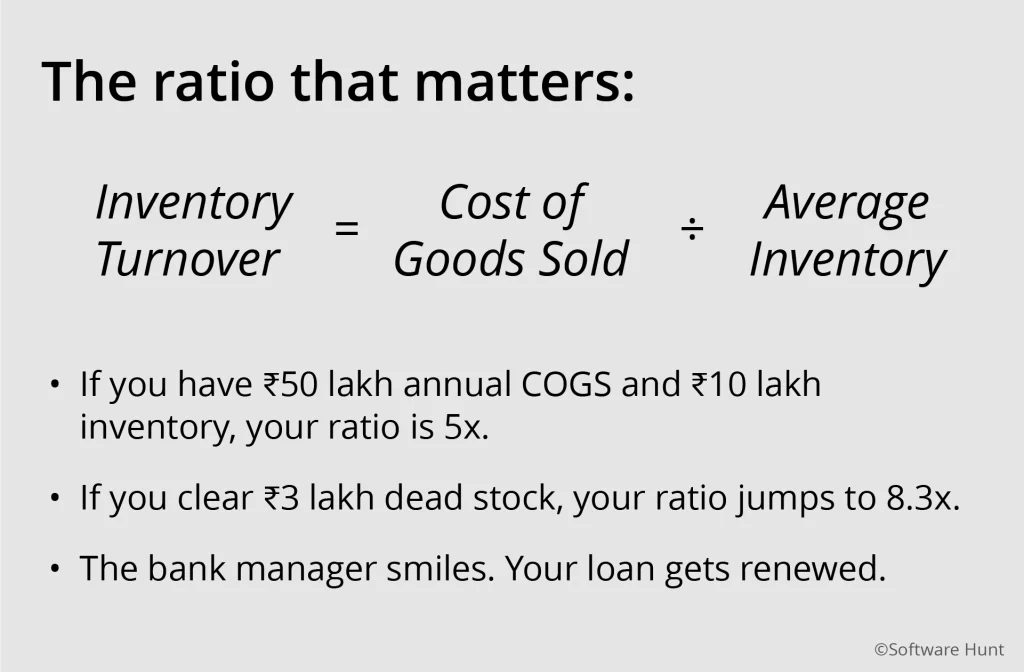
Your bank manager looks at your inventory turnover ratio every quarter. When it’s below 6x, he doesn’t just see bad inventory management. He sees a founder who can’t manage risk. Who can’t make hard decisions. Who isn’t bankable. Your personal guarantee becomes a topic of discussion in the bank’s credit committee.
The trust metric: Inventory Turnover > 8x = Bank manager smiles. Between 6-8x = He asks questions. Below 6x = He stops returning your calls.
The family conversation you dread
Every month, your wife asks, “How is the business?” You say, “Good, but cash is tight.” She asks, “Why? We have so much inventory.” You have no good answer. Because you know that inventory is dead. It’s not an asset. It’s a liability you haven’t confessed yet.
The truth: Dead stock is a secret loan you took from your family. You’re paying interest on it. You’re protecting it. And it’s not giving anything back.
5 Fixes You Can Start This Week (Without Asking Your Bank for More Money)
You don’t need a big budget. You need a weekly rhythm.
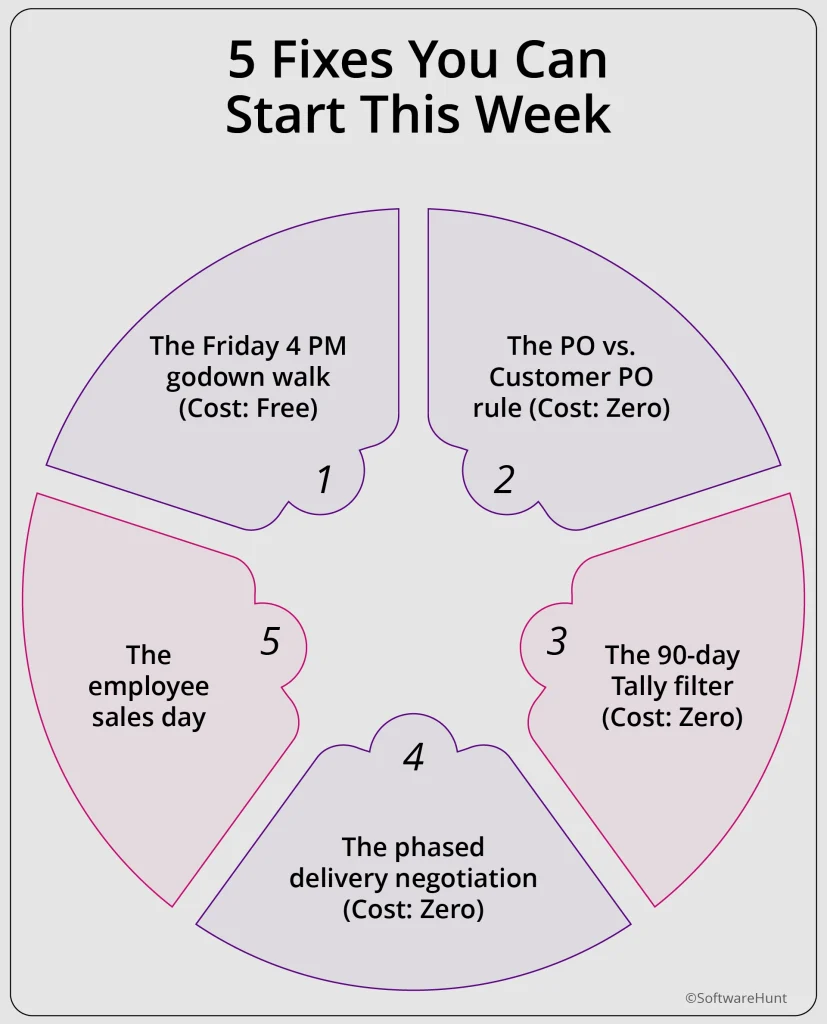
Fix 1: The Friday 4 PM godown walk (Cost: Free)
Every Friday at 4 PM, walk your godown with your phone camera. Touch 10 random items. If 3+ are dusty, you have a problem. Take a photo. Send it to your purchase manager with “Explain why we have this.” The shame alone will change behavior.
Time: 20 minutes.
Impact: The purchase manager starts thinking twice before ordering “just in case.”
Fix 2: The PO vs. Customer PO rule (Cost: Zero)
Before you sign any PO over ₹50,000, ask your sales head: “Show me the customer PO that justifies this.” If there is no customer PO, the sales head must sign a personal guarantee that this will sell in 30 days. You’ll be amazed how many “emergency” orders disappear.
Time: 5 minutes per PO.
Impact: Purchase managers begin questioning every ‘just in case’ order, creating accountability that reduces impulse bulk buying. Companies implementing PO approval workflows report significant reductions in excess inventory within 60-90 days.
Fix 3: The 90-day Tally filter (Cost: Zero)
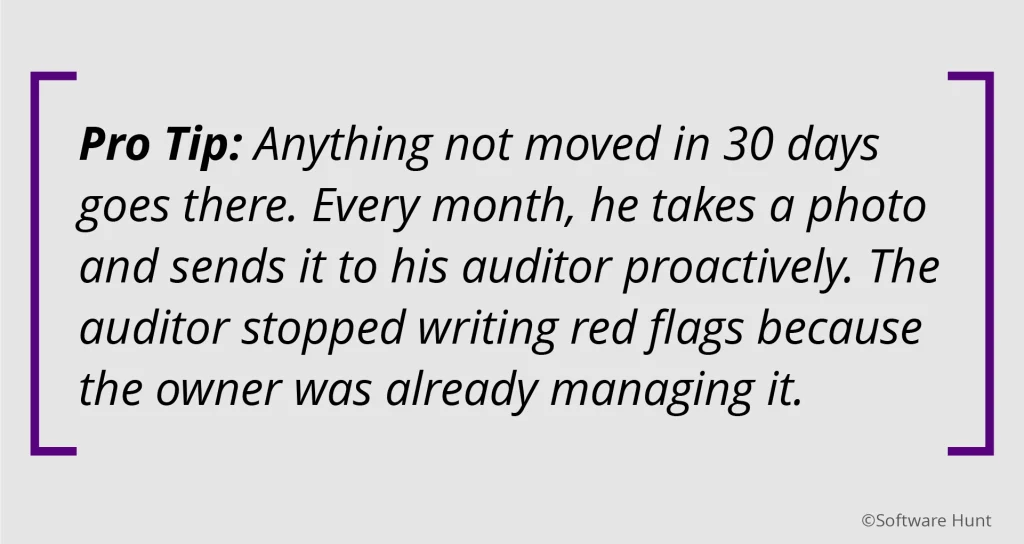
Run a Tally report: Items with zero consumption in 90 days. That’s your dead stock. Take a screenshot. Send it to your auditor proactively. Say, “I’m managing this. Here’s my clearance plan.” The auditor becomes your ally, not your critic.
Time: 10 minutes weekly.
Impact: Reduces auditor’s red flags and builds trust.
Fix 4: The phased delivery negotiation (Cost: Zero)
Call your top 3 suppliers. Say, “I’ll commit to ₹2 lakh quarterly, but I need ₹50,000 monthly deliveries.” Most will agree because they get predictable revenue. You avoid ₹1.5 lakh in dead stock. Both win.
Time: 1 hour of calls.
Impact: Frees ₹1.5 lakh working capital immediately.
Fix 5: The employee sales day
Once a quarter, have an “employee sales day.” Put dead stock in the canteen. Sell at cost. Employees buy for their side businesses, home projects, family needs. You clear space, build morale, and recover cash. The ₹5,000 you spend on snacks is less than the interest on ₹2 lakh dead stock.
Time: 4 hours.
Impact: Clears ₹50,000-2 lakh in dead stock and boosts morale.
Still trying to “figure it out” on your own?
Our team is happy to connect with you, understand your personal pain points, operational leaks and growth challenges and go beyond platform listings/information to help find the right solution for you at no cost to you.
To email an advisor for a quick fit-check write to us at connect@softwarehunt.com
Why Your Tally Alone Can’t Stop Overstocking (And What You Actually Need)
Tally is brilliant at tracking what you bought. It’s terrible at telling you what you shouldn’t have bought. Here’s why:
Tally tells you what you have, not what you need
Tally’s stock summary shows 500 kg of steel. It doesn’t show that you only need 50 kg for confirmed orders. The gap (450 kg) is invisible. It’s not Tally’s fault. It’s not designed to link inventory to customer POs in real-time.
What you need: A tool that shows Tally stock data next to open customer orders. The gap becomes visible. The overstocking becomes obvious.
Tally can’t calculate dynamic reorder points
Your reorder point in Tally is a static number: 100 kg, but your supplier’s lead time isn’t static. It’s 7 days in summer, 14 days in monsoon, 21 days during Diwali. Tally doesn’t adjust. You keep ordering 100 kg, and you keep stockpiling during stable periods.
What you need: A tool that adjusts reorder points based on actual supplier performance data from the last 6 months. Not a static number.
Tally doesn’t flag dead stock automatically
You have to run a manual “stock ageing” report. You have to remember to do it. You have to interpret it. In busy weeks, you skip it. The dead stock becomes deader.
What you need: A tool that auto-flags items not consumed in 90 days and sends you a WhatsApp alert. You can’t ignore what you see daily.
The ₹1.5 Lakh Mistake That Makes Owners Say “Software Doesn’t Work for SMEs”
Anil’s friend in the same industrial area bought a “business management software” for ₹1.5 lakh. It promised to “optimize inventory.” Six months later, the software is unused. The dead stock is still there. The owner tells everyone, “Software doesn’t work for SMEs like us.”
What went wrong:
The enterprise trap
The tool was designed for companies with 500+ workers and dedicated IT teams. It required 3 days of training. Anil’s shopfloor supervisor attended for 2 hours and went back to WhatsApp. The tool died because it was built for someone else’s reality.
The data desert problem
The tool asked for 3 years of historical data. Anil had 6 months of messy Excel sheets. The tool couldn’t function. It assumed clean data. Tier 2/3 SMEs have real data, not clean data.
The Tally disconnect
The tool didn’t integrate with Tally. Anil’s finance head refused to use it. The data lived in two worlds. The tool became a parallel system that nobody trusted. It died from lack of integration.
The lesson: Software fails because vendors build for enterprises and label it “SME-friendly.”
How to Bury Your Dead Stock Without Burying Your Margins
Clearing dead stock isn’t about discounting. It’s about strategy.
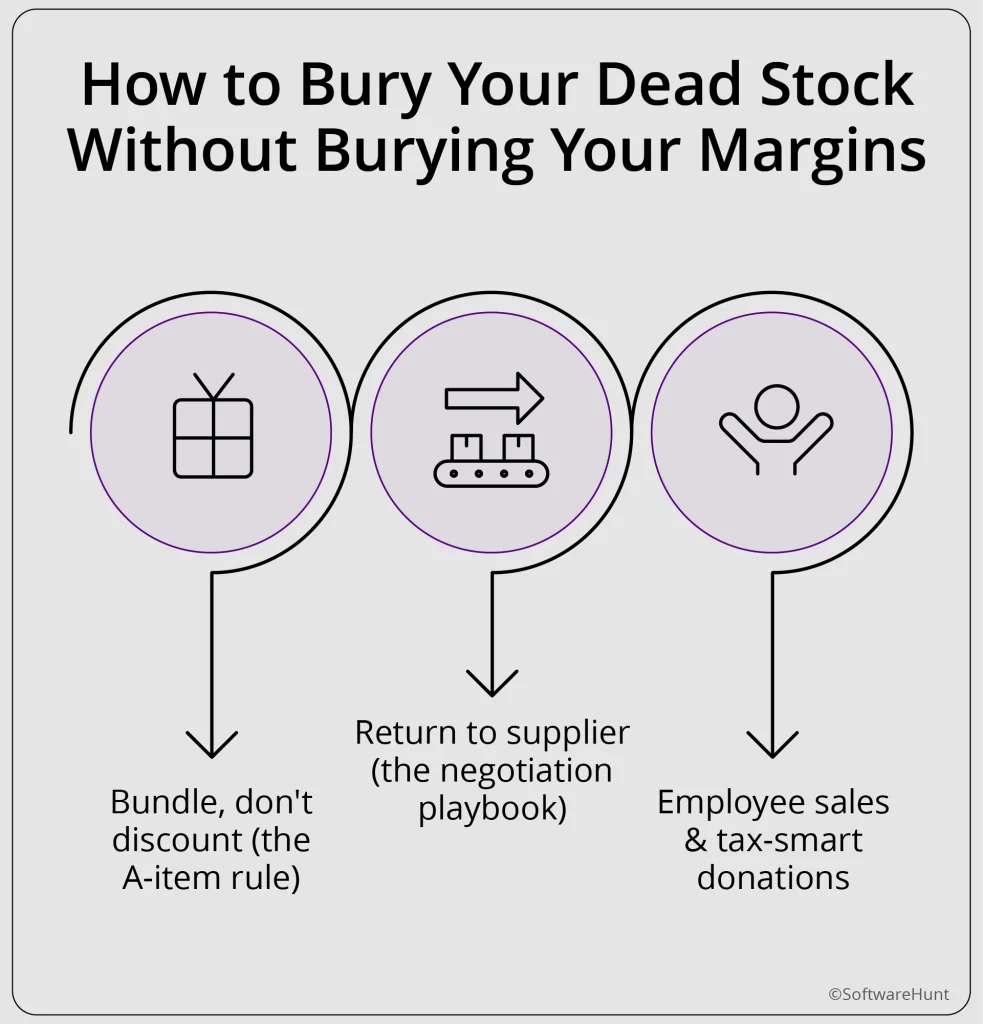
Bundle, don’t discount (the A-item rule)
Never discount your A-items (fast movers). It kills their perceived value. Instead, bundle dead C-items with A-items. “Buy 500 bearings, get 50 bolts free.” The customer feels they’re getting value. You clear space without killing margins.
Return to supplier (the negotiation playbook)
Call your top 3 suppliers. Show them the dead stock list. Say, “We have ₹1.8 lakh of your material that’s slow-moving. Can you take 70% back as credit for next order?” Most will agree to preserve the relationship. It works for A-items only (suppliers care about A-items).
Employee sales & tax-smart donations
Sell dead stock to employees at cost. They use it for side businesses, home projects, family needs. You clear space, build morale, recover cash. The ₹5,000 you spend on snacks for the sales day is less than the interest on ₹2 lakh dead stock.
The tax angle: Donate expired items to NGOs. Get tax benefits under Section 80G.
Last resort: Liquidation companies (they pay 10-20% of value).
From Graveyard to Growth Engine: Your 30-Day Overstock Elimination Plan
Anil Mehta didn’t clear his ₹4.2 lakh dead stock in a day. He did it in 30 days, one weekly ritual at a time.
Week 1: The autopsy report (find the dead stock)
Run Tally’s “Stock Summary” filter: Items with zero consumption in 90 days. That’s your dead stock. Photograph it. Calculate its value. Share it with your auditor proactively. Say, “I’m managing this. Here’s my clearance plan.” The shock value of seeing ₹4.2 lakh of rust is more powerful than any report.
Week 2: The ABC surgery (classify ruthlessly)**
Tag your top 20 SKUs in Tally as “A.” Everything else is B or C. Set reorder points for A-items based on max lead time. Rule: No PO for B/C items without approval from you + finance head. The double signature slows down panic buying.
Week 3: The supplier summit (negotiate returns)**
Call top 3 suppliers, show them the dead stock list, and negotiate return terms.
Goal: Get 50% credit on ₹1.8 lakh dead stock.
Result: ₹90,000 freed + supplier trust built.
Week 4: The mobile pilot (track A-items live)
Pilot mobile tracking for 5 A-items. Supervisor logs daily consumption. Syncs to Tally.
Outcome: Real-time consumption data shows you’re ordering 30% more than needed on average.
The proof: By Day 30, Anil walked into his bank manager’s office with: “Dead stock reduced from ₹4.2 lakh to ₹90,000. Inventory turnover improved from 5x to 8.3x. My loan covenant is safe. Can we discuss increasing my limit for that export order?”
The bank manager approved the limit increase immediately because now Anil wasn’t a risk. He was a businessman who managed his inventory like a professional.
Why SoftwareHunt Is Your Financial Lifeline
We’re SoftwareHunt. We work with manufacturing owners running on Tally, Excel, and lean teams to understand your operational leaks and growth challenges. We go beyond platform listings to help you find the right solution at no cost to you.
Anil’s problem wasn’t software. It was understanding where cash was actually leaking. Our team sits with owners like you, maps the specific challenges – whether it’s MOQ traps, bank covenant stress, or audit red flags – and helps you find the right fix. Sometimes it’s a process change. Sometimes it’s the right tool. Always, it starts with diagnosis.
We’ll help you translate symptoms into clear financial insight and show you where to focus first – at no cost to you.
Email an advisor for a quick fit-check write to us at connect@softwarehunt.com