TL;DR
- Process comes before technology – Lock warehouse + standardize items fixes 80% of tracking problems without software
- Five daily/weekly checks catch majority of errors – Zero-movement reports, negative stock alerts, cycle counting
- Self-diagnosis first – Answer 5 questions to know if you’re at 30% maturity or 90%
- ₹0 investment for first 8 weeks
Anjali’s warehouse had 920 kg of MS rods. Her system showed “out of stock.” She placed an emergency order at 18% markup. ₹4.8 lakh locked in duplicate inventory. Six days of production delays. One very awkward PO cancellation.
Her insight: We weren’t tracking inventory. We were just documenting it.
And there’s a massive difference between the two. This guide shows you what it is and how to fix it this week, with zero technology investment.
Before You Read Further: Is This You?
Answer these 8 questions. If you say “yes” to more than 3, your warehouse is documenting, not tracking.
1. Material arrives now, is it in your system within 10 minutes or 10 hours?
2. How often do you hear “System shows X but we have Y”? Daily? Weekly? Or rare?
3. When production urgently needs material, do they check the system first or call the warehouse?
4. How many hours do you spend reconciling inventory every month? 2 hours? 8 hours? More?
5. Would you place a ₹5 lakh purchase order based purely on your current stock data, without physically checking the warehouse?
6. How many different names does the same material have in your system? (Example: MS Rod 12mm vs. 12mm rod vs. Round 12 vs. MS-12-R)
7. If your warehouse in-charge left tomorrow, would the next person know where anything is stored?
8. In the last month, how many times did you discover missing inventory or duplicate orders during month-end reconciliation instead of before?
Scoring Guide:
0-2 yeses: Your tracking is solid. (Skip to FAQs for edge cases.)
3-5 yeses: You have a process leak. Fix this month.
6+ yeses: Your system is lying to you. Start with Section 3.
What Stock In and Stock Out Mean
Stock In means material entering your inventory system.
Stock Out means material leaving your inventory system.
Sounds obvious. But here’s what Anjali discovered the expensive way: obvious transactions get recorded, invisible transactions don’t.
The Transactions Everyone Records
Stock In:
- Vendor delivery against purchase order
Stock Out:
- Material issued to production against work order
If these are the only two movements you track, you’re missing roughly 40% of what’s actually happening in your warehouse.
The Transactions That Vanish
Stock In (often missed):
- Production returns – unused material from completed batch
- QC-rejected goods from supplier sitting in inspection limbo
- Customer sample returns
- Material returned from subcontractors after job work
Stock Out (rarely recorded immediately):
- Samples sent to prospective clients
- Scrap, damage, or pilferage
- Material transferred to subcontractor for processing
- Shop floor emergency pulls without requisition slips
Every unrecorded transaction creates phantom stock (system shows inventory you don’t have) or phantom shortages (warehouse has material your system doesn’t know about).
The business impact: Finance calculates working capital on ₹28 lakh inventory. Actual inventory: ₹22 lakh. Your credit line applications are based on inflated numbers.
Production plans a batch needing 400 kg raw material. System shows 450 kg available. Warehouse has 180 kg. Emergency purchase at 18% markup delays delivery by five days.
This isn’t an inventory problem. It’s a definition problem.
Solving this requires inventory control systems that enforce recording discipline whether through paper slips (₹0) or warehouse management software (₹2,300+/month) but process design comes first.
Why Standardizing Item Names Is Your First Battle
Before you track anything, you need to know what you’re tracking.
Anjali’s warehouse had the same 12mm MS rod listed five different ways:
- MS Rod 12mm
- 12mm rod
- Round 12
- MS-12-R
- Steel rod 12
The system thought these were five different items. When MS-12-R hit zero, nobody knew 200 kg sat under Round 12.
The fix: Item Master Standardization
One item, one code, one name. Everywhere. Forever.
Every material gets:
- Unique Item ID (alphanumeric, never reused)
- Standard description (decided once, used by everyone)
- Unit of measure (kg, pieces, meters – pick one, stick with it)
- Location code (more on this in a moment)
Time investment: 20 hours of owner time, or hire a consultant for ₹12,000.
Immediate payoff: Warehouse search time drops from 15 minutes per item to under 2 minutes.
Location Coding
Where’s the 10mm bearing stock?
Near Raju’s side, bottom shelf.
What happens when Raju leaves? Or shelves get reorganized? Information vanishes.
Location coding structure:
- Warehouse ID – Rack – Shelf – Bin
- Example: WH-01-A2-03
- Printed labels on every location
- Every item record shows: Item | Location | Quantity
Material moves? Update the location. No exceptions.
Indian manufacturers implementing location coding report 35% faster order fulfillment because warehouse staff aren’t hunting for material.
This isn’t glamorous work. But every minute spent here saves 10 hours of reconciliation chaos later.
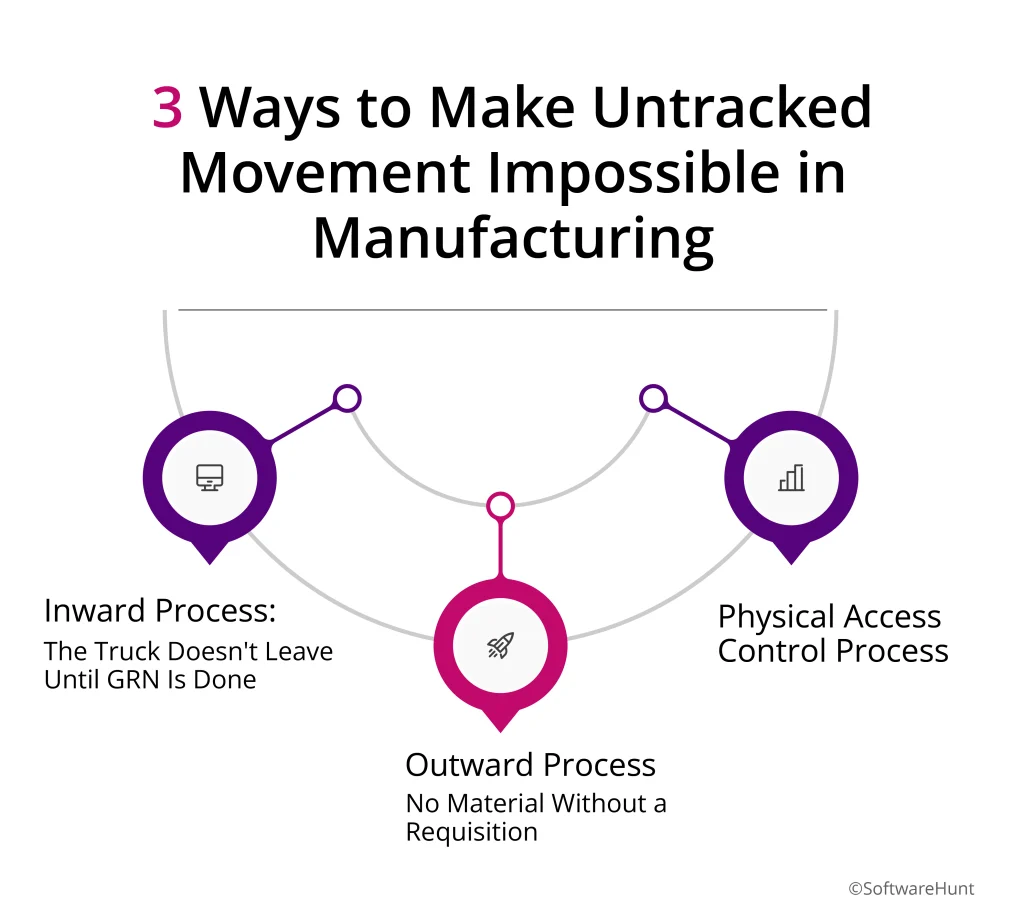
The Enforcement Principle: Make Untracked Movement Impossible
Here’s the shift that changes everything:
Nothing moves without a record doesn’t mean Remember to track movements.
It means making untracked movement physically impossible through process design.
Inward Process: The Truck Doesn’t Leave Until GRN Is Done
Rule: Receiving supervisor completes Goods Receipt Note before the delivery driver gets a gate pass.
The driver waits. Eight minutes on average.
Anjali’s 32-person sheet metal fabrication shop in Pimpri-Chinchwad resisted this for one week. Why are we delaying suppliers?
Then they calculated the real math:
- 8 minutes truck waiting time
- vs. 6 hours per week in reconciliation meetings trying to figure out what arrived when
The following month, their inbound variance dropped from 12% to 3%.
Outward Process: No Material Without a Requisition
Production can’t walk into the warehouse and take material. Full stop.
Material gets issued only against a requisition (paper slip or digital entry, method doesn’t matter yet, but the rule does).
Real resistance, real resolution: Anjali’s floor supervisor threatened to quit when this rule started. Too much paperwork, slowing down production.
He came back two days later, competitor didn’t hire him. Now he’s the biggest enforcer: No chit, no material. I don’t care if the MD is calling.
Why did he change? Because urgent material pulls without records meant he was blamed when inventory didn’t match. The requisition slip became his protection, not his burden.
Physical Access Control
Lock the warehouse. Literally.
Only two people have keys: stores in-charge and backup.
Material enters or exits? One of those two people must be present and record it.
Cost breakdown:
- ₹3,500 for good padlocks
- One day to reorganize key access
- Two weeks of arguments about trust
- Then it becomes normal
Zero technology. Maximum enforcement.
We’re SoftwareHunt. We work with manufacturing owners running on Tally, Excel, and lean teams to understand your operational leaks and growth challenges. Our team is happy to connect with you, understand your personal pain points, operational leaks and growth challenges and go beyond platform listings/information to help find the right solution for you.
We’ll help you translate symptoms into clear financial insight and show you where to focus first – at no cost to you.
To email an advisor for a quick fit-check write to us at connect@softwarehunt.com
What “Automatic” Actually Means
Automatic inventory tracking means recorded once, at the moment of movement, by the person moving it whether through mobile inventory apps, barcode scanners, or even disciplined paper slips synced to Excel.
Here’s the progression most manufacturers follow—not because it’s the only way, but because it’s what works with your constraints of budget, team skill, and risk tolerance:
Week 1-2:
Paper discipline. Pre-printed Stock In/Out slips (₹800 for 500), filled at point of movement, entered into Excel daily by your accountant. Accuracy jumps from 82% to 94%. Cost: ₹0 beyond the slips.
Week 3-4:
Faster capture. WhatsApp photos of slips + Google Forms (both free). Your warehouse sends a photo, accountant enters from phone. Accuracy: 96%. Time: 18 minutes daily instead of 25.
Month 2-3:
Simple mobile entry. Your 23-year-old warehouse assistant (or whoever you have) uses a free cloud inventory app on their phone. Direct entry syncs automatically. Accuracy: 98%. Time: 8 minutes daily.
Month 4+:
Scanning (optional). If you’re handling 100+ items daily, barcode scanning saves time. Thermal printer (₹8,500) + handheld scanner (₹12,000) + basic software (₹2,400/month). Worth it only after process is locked.
Which stage makes sense for you? That’s a conversation with someone who knows your operation. That’s why we’re here.
The Three Daily Checks That Catch Majority of Errors Before They Compound
You can’t manage what you don’t measure. But most SME manufacturers only discover inventory problems during month-end reconciliation.
By then, errors have compounded for 30 days. That’s too late.
Check #1: Zero-Movement Report (3 Minutes Every Morning)
Which items had no inbound or outbound transactions in the last 7 days?
This simple query reveals two critical issues:
- Dead stock: Why is this material sitting unused?
- Missed entries: Did someone forget to record a transaction?
Anjali’s team catches 2-3 missed entries per week with this check.
Even in Excel: Add a column =TODAY()-[@LastTransaction], filter for anything over 7 days.
Check #2: Negative Stock Report (Instant Investigation)
Negative stock is physically impossible. Which means it’s a guaranteed data error.
Usually indicates: Material was issued but receipt wasn’t recorded (or vice versa).
Check #3: Weekly Physical Count of Top 10 High-Value Items (15 Minutes)
ABC analysis: 20% of your inventory items typically represent 70% of inventory value.
Count those top items weekly. Physical quantity vs. system quantity. Variance greater than 5%? Deep investigation.
This approach, called cycle counting, means you’re auditing your highest-risk inventory constantly without shutting down the warehouse for annual stocktaking.
Time investment: 15 minutes every morning with chai.
Not when you have time. Scheduled discipline.
Manufacturers who implement daily error checks report 60% reduction in month-end reconciliation time.
Where to Start (The ₹0 Technology Roadmap)
Vikram asks the question every manufacturer eventually asks: Where do I actually start? I can’t fix everything at once.
Anjali’s answer: You don’t need to. Start with two things this week. Nothing else.
Week 1 Action Items
1. Standardize your item master (20 hours owner time)
Sit with your warehouse team. Create one name per item. Assign unique codes. Print and laminate the item list for the warehouse wall.
Don’t delegate this to a junior person. The owner or ops head must be involved, decisions about is this the same item or different? require business judgment.
2. Lock the warehouse
Physically install good padlocks. Only two people get keys. Material moves only when one of them records it.
Yes, your team will complain about trust issues. The lock isn’t about trust. It’s about making the process impossible to bypass.
Weeks 2-4: Prove the Process Works Before Buying Software
3. Implement paper slip system
Pre-printed forms (₹800 for 500 slips printed locally).
Stock In slip captures: Date, Time, Item, Quantity, PO Number, Supplier, Received By.
Stock Out slip captures: Date, Time, Item, Quantity, Work Order Number, Issued To, Approved By.
Office person enters daily into Excel.
4. Start daily zero-movement check
Every morning, 10 minutes. Owner does it personally for the first month to build discipline.
Months 2-3: Measure Results, Then Decide on Technology
Track three metrics:
- Variance percentage (should drop from 15% to under 5%)
- Time saved (reconciliation should go from 8 hours to 3 hours monthly)
- Prevented errors (document every would have ordered but system showed stock instance)
If you see these improvements, your process works. Now technology investment makes sense because you’re amplifying a working system, not digitizing chaos.
What Happens Next
Vikram walks to his car. Opens Excel on his phone. Looks at his inventory sheet differently now.
Not just wrong numbers. He sees the missing process underneath. The unrecorded returns. The urgent pulls without requisition slips. The phantom stock and phantom shortages.
Tomorrow morning, 8 AM. He’s not blaming his warehouse manager. He’s going to rebuild with him.
Because the crisis isn’t coming. It’s already here, he just couldn’t see it because his data was lying to him.
The fix starts with two simple actions this week: standardizing item names and locking the warehouse.
Zero software. Maximum discipline.
Everything else builds from there.
Most Manufacturers We Talk to Score 5-7 on That Checklist
If that’s you and you’re tired of guessing whether the problem is process, people, or software, don’t DIY the seven-month roadmap above. Our team works with 50+ Tally-and-Excel shops like yours every month. We help you figure out where you actually are, what’s the highest-ROI fix, and what to do first.
We’re not here to sell you software. We’re here to help you avoid the ₹4.8 lakh mistake. Email us at [connect@softwarehunt.com ]. First conversation is always free. We’ll listen, diagnose, and tell you exactly what you should do even if it’s “just lock your warehouse and use paper slips for three months.