TL;DR
- Your inventory accuracy is probably 85-90%. That ₹15L discrepancy destroys cash flow.
- The fix is systematic. Start with barcode scanning. Add cycle counting (monthly Class A, bi-monthly Class B, quarterly Class C). Capture lot numbers even in spreadsheets.
- Migration timeline: Spreadsheet to cloud spreadsheet + barcode to low-cost software.
- Choose based on revenue scale and SKU count.
A warehouse manager in 2024 discovered something that should have been impossible.
His inventory system showed 10,000 units of high-grade aluminum sitting in the warehouse but when he sent the team to actually find those units, they found 8,500. On paper, the shortage didn’t exist. In reality, it had been costing the company ₹50+ lakhs in production delays every single month.
The numbers just didn’t match the physical world anymore. The gap happened slowly – a picking error here, a delayed receipt update there, a misplaced pallet somewhere else. Each tiny mistake compounded silently until suddenly, he had a ₹15+ lakh inventory discrepancy on his hands.
Research shows that most warehouses achieve only 85-90% inventory accuracy. That tiny 10-15% gap translates to millions in hidden costs. Production delays. Dead cash tied up in inventory you can’t find. Customers waiting for orders that should exist but don’t. Labor teams wasting hours searching for materials.
Why Tracking Fails (And It’s Not What You Think)
Most people think inventory discrepancies come from one place: human error. Someone counts wrong. Someone picks the wrong box. Someone forgets to scan.
The truth is more interesting and more fixable.
The gap between what your system says you have and what’s actually in your warehouse comes from system misalignment.
Here’s how it really breaks down.
Your warehouse team receives materials. The receipt gets logged. But the production team doesn’t know those materials are available yet. So they schedule production based on yesterday’s inventory. Meanwhile, materials sit in receiving, unstaged for production. When production finally starts, they can’t find what they need because nothing was marked as ready. They pull from somewhere else. The records still show the original location. Discrepancy created.
Or this: A production order calls for 500 units of raw material. The warehouse picks 500 units from Lot A (received last week). But your system shows consumption from Lot B (received last month). Why? Because the picking wasn’t linked to the actual lot pulled. Now you have a lot tracking failure that creates phantom inventory problems downstream.
Or simpler: Materials are moved from receiving to a staging area. Nobody updates the location in the system. Not because someone is careless. Because they’re moving fast. They’ll update it later. But later never comes because three more priority tasks hit. Two weeks later, someone is searching for that material and can’t find it anywhere.
Research indicates that Inventory Record Inaccuracy (IRI), the mismatch between recorded inventory and actual physical stock, is a pervasive issue affecting over 65% of inventory records in retail and warehousing settings.
Cycle Counting: The Framework That Gets You to 97% Accuracy
The ABC Classification Framework Explained
Cycle counting works because it prioritizes your high-value items:
Class A items (20% of items, 80% of value): Count monthly
Example: Specialized steel alloys, imported components
These drive 80% of your production value
Class B items (30% of items, 15% of value): Count bi-monthly
Example: Standard fasteners, common raw materials
Class C items (50% of items, 5% of value): Count quarterly
Example: Consumables, low-cost supplies
Why this works: You’re continuously verifying high-risk inventory without shutting down for full physical counts.
Three Ways to Track Raw Materials for Manufacturing
Technology is supposed to make tracking easier. But different tracking technologies have vastly different costs, speeds, and accuracy profiles.
You need to understand what you’re actually paying for.
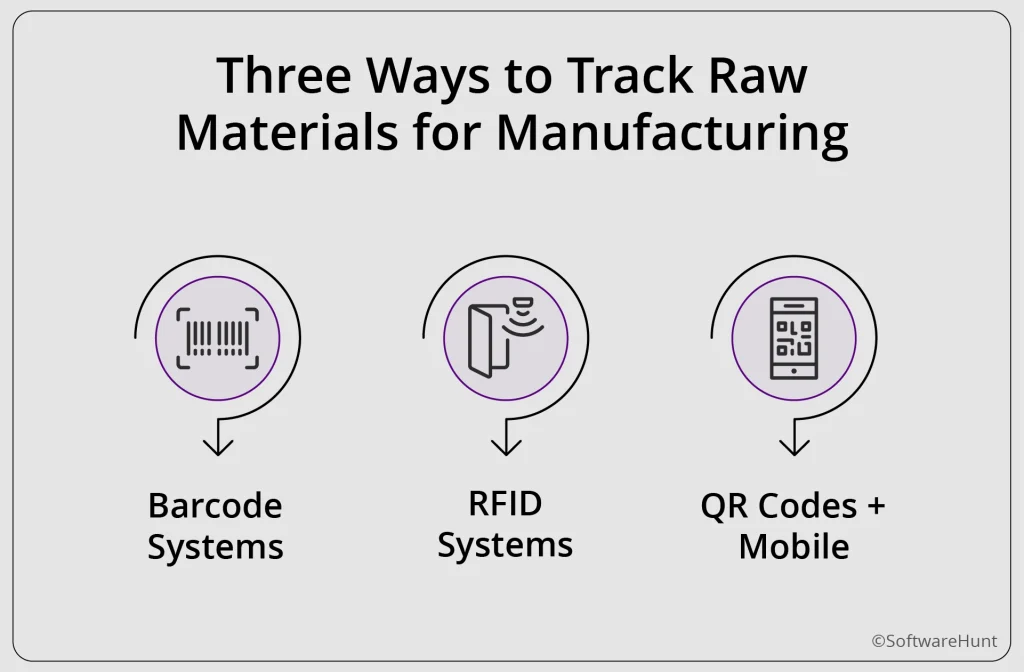
Barcode Systems
A barcode scanner costs ₹2,000-5,000 to set up. You print barcodes on everything. Whenever something moves, someone scans it. The scan updates your inventory.
What you get:
Barcode systems deliver 95%+ accuracy if scanning discipline is maintained. You can implement them in 2-3 weeks. They work well for 100-1,000 SKUs across single or dual locations.
What it costs:
Someone has to scan everything. Training is required. At scale, fatigue becomes an issue. If you’re scanning 600+ units daily, people get tired. Fatigue causes errors. Errors pile up.
When it works best: Small-to-medium manufacturers with under 100 SKUs, single or dual locations, and tight process discipline.
When it breaks: At scale, barcodes need scanning one item at a time. If you’re handling thousands of units daily, that scanning bottleneck becomes exhausting. Fatigue leads to errors. The system depends entirely on consistent human attention.
RFID Systems
An RFID system costs ₹5-50 lakhs to implement. Tags run ₹1-30 each. Readers are expensive. Infrastructure integration is complex. But an RFID reader can scan multiple items simultaneously, no line-of-sight required.
What you get:
RFID delivers 95-99% accuracy. Multiple items scan instantly. Hands-free operation. Walk past a reader with a pallet, the entire pallet inventories automatically. It’s 90% faster than barcode scanning. It works in harsh environments where barcode labels degrade.
What it costs:
Massive upfront investment. Implementation takes 2-6 months. Integration with existing systems is complex. Ongoing tag management is required as tags wear out.
When it works best: Manufacturers with 5,000+ SKUs, multiple locations, high-value assets, or heavy automation environments. Also critical for pharmaceuticals, food, electronics where traceability is non-negotiable.
When it’s overkill: A small manufacturer with 50 SKUs, one location, and ₹1 crore in inventory doesn’t need RFID. The ROI is terrible.
QR Codes + Mobile
Print QR codes on everything. Workers scan with smartphones. Cost: ₹2,000-5,000. Implementation: Less than one week.
What you get:
Simple setup. Mobile flexibility. Higher data capacity than barcodes. Low cost.
What it doesn’t give:
Scalability. Still one scan at a time. No hands-free operation. Integration only works for basic workflows.
When it works best: Returns management, field logistics, small operations where flexibility matters more than speed.
The Real ROI of Real-Time Tracking
Most manufacturers avoid real-time tracking because they think it’s expensive and complicated. But when you look at actual case studies, the ROI is stunning.
A large manufacturing facility implemented real-time tracking because employees were spending 30+ minutes daily searching for equipment.
The math was simple. If an employee makes ₹1 lakh per month, and 5 employees are collectively wasting 30 minutes daily on searches, that’s ₹2.5+ lakhs monthly in lost productivity. Annually, ₹30 lakhs of pure waste.
After implementing RFID tracking, search time dropped 90%. Savings: ₹27 lakhs annually. The system paid for itself in less than one year.
But here’s the bigger insight: That ₹27 lakh savings was just from reducing search time. The actual benefits of real-time tracking are larger.
Real-time data enables better forecasting. You stop overbuying materials because you can see actual consumption patterns. You catch slow-moving inventory before it becomes dead stock. You reduce safety stock because you have confidence in your numbers.
In a food and beverage operation, just a 2% reduction in inventory cost (through better accuracy and demand forecasting) on ₹20 crore in annual sales generates ₹40+ lakhs in additional profit.
Here’s the ROI timeline:
Year 1 breaks even as software costs, setup, and training eat profits. Year 2 and beyond deliver 100%+ ROI as benefits exceed ongoing costs. Typical payback is 12-18 months.
The payback is fast because inventory problems are expensive. A ₹15+ lakh discrepancy isn’t unusual. That’s one month of operational losses recovered by implementing better tracking.
The Production-Warehouse Disconnect (The Hidden Problem)
Here’s a problem most manufacturers don’t even realize they have.
Your warehouse tracks raw materials. Your production team schedules production. But these two systems don’t talk to each other in real-time.
Production says: “We need 500 units of material X for tomorrow’s shift.”
Warehouse says: “Yes, we have 500 units available.”
But what they don’t say: “Are those units actually staged and ready? Are they at the right location? Do they match the quality specifications for this production run?”
The result: Material is available but not accessible. Production delays. Labor waste. Frustration.
Here’s how the problem manifests:
Materials arrive at receiving. They’re scanned in. But production isn’t notified. Materials sit in receiving for hours. When production needs them, they’ve been marked “in stock” but are nowhere near the production line. Workers waste time tracking them down. Production doesn’t start on time. Downstream orders get delayed.
Or: Production pulls materials for a batch. But the system doesn’t know which lot they pulled. Later, when quality discovers a defect in that batch, you can’t trace it back to the supplier. Lot tracking fails. You can’t recall the specific shipment. You’re stuck recalling everything.
Or: Multiple production lines need the same material. The system shows availability, but doesn’t allocate it. Two production schedulers both think they can use the same inventory. One line gets shortchanged. Production delays.
The fix requires integration: Bill of Materials (BOM) connected to real-time inventory, mobile picking apps that link consumption to specific lots, automated updates when materials are consumed, and real-time visibility across warehouse and production planning systems.
We’re SoftwareHunt. Our team sits with manufacturing owners to understand your operational leaks and growth challenges. We go beyond platform listings to help you find the right solution at no cost to you.
Email an advisor for a quick fit-check write to us at connect@softwarehunt.com
Lot Tracking: When It Matters and How to Scale It
Lot tracking means knowing which specific shipment from your supplier went into which finished product. It matters for recalls. It matters for compliance. It matters for quality traceability.
When lot tracking is non-negotiable:
Food and beverage, pharmaceuticals, cosmetics, medical devices, electronics. These industries require traceability for regulatory compliance and recall management.
When it’s optional:
General manufacturing, textiles, non-regulated goods. Lot tracking adds complexity here without proportional benefit.
Here’s how it scales:
Small Scale (Spreadsheet-Based)
Add columns to your inventory tracking spreadsheet: Lot Number, Supplier, Received Date, Expiration Date. Manually enter lot numbers from supplier invoices when materials arrive. Track which lot goes into which production batch.
Cost: ₹0
Limitations: Works for fewer than 100 lots per month. Beyond that, manual entry becomes error-prone.
Time to implement: Less than one week.
Medium Scale (Software-Assisted)
Barcode lot numbers at receiving. Your inventory software automatically links lots to production batches. When a finished product is completed, the system knows which supplier lots are embedded in it. Traceability reports generate automatically.
Cost: ₹5-10,000
Limitations: Requires software integration; works for 100-1,000 lots per month.
Time to implement: 2-4 weeks
Large Scale (ERP-Integrated)
Lot numbers tracked through entire production. Forward traceability (where did this lot end up?) and backward traceability (which suppliers are in this finished product?) both automated. Recall management becomes automatic.
Cost: ₹50,000+
Limitations: Requires full ERP integration; needs training and disciplined processes.
Time to implement: 3-6 months
The ROI of lot tracking is dramatic for regulated industries. Without it, a recall means pulling everything. With it, you pull only affected batches.
A food manufacturer recalls an entire ₹5 crore product line due to a contamination issue in one supplier lot. With lot tracking, they would have recalled ₹50 lakhs only. Difference: ₹4.5 crore loss prevented.
Where Discrepancies Actually Come From (And How to Prevent Them)
Inventory discrepancies don’t happen randomly. They come from specific, preventable sources.
Understanding the root causes lets you design systems that prevent them.
Receiving Stage
Materials arrive. Lot numbers aren’t captured from supplier documents. Cost per unit isn’t recorded properly. Prevention: Barcode scan at receiving. Capture lot number automatically from supplier invoice. Match received quantity to purchase order before materials move. Cost: ₹2-5K (barcode setup).
Storage Stage
Materials get moved to a different location without location updates. Expired stock gets mixed with fresh stock. Prevention: Mobile location tracking. FIFO discipline audits. Temperature/humidity monitoring for sensitive materials. Cost: Low (process discipline) to ₹5K (mobile system).
Production Stage
Which lot went into which batch isn’t documented. Scrap isn’t recorded. Prevention: Mobile picking app that links lot selection to batch. Scrap tracking integrated into consumption process. Cost: ₹5-10K (software integration).
Usage/Consumption Stage
Manual counting creates errors. Materials get “borrowed” and not returned. Shrinkage (theft, spillage) isn’t tracked. Prevention: Real-time consumption posting (not batched updates). Mobile issue/return process. Regular audits for missing materials. Cost: ₹5K+ (system integration).
Reconciliation Stage
Discrepancies get discovered but root cause isn’t investigated. Records get adjusted without understanding why. Prevention: Monthly cycle count analysis. Mandatory root cause investigation before adjusting records. Tracking which locations/items have recurring issues. Cost: Process discipline (no software cost).
Discipline + simple system beats complex system with poor discipline. You can have the most advanced technology, but if your processes aren’t designed to prevent errors, they will happen.
When to Migrate from Spreadsheet to Software
Most small manufacturers start with spreadsheets. They work fine initially. But they hit a scaling wall.
Spreadsheets work when:
You have fewer than 50 SKUs. You operate from a single location. You process fewer than 10 transactions daily. Lot tracking isn’t needed. Real-time visibility isn’t critical.
Spreadsheets break when:
You have more than 100 SKUs. You have multiple locations. You have more than 500 SKUs. Lot tracking is needed. Production integration is needed. Multiple team members need to update simultaneously.
The migration path:
Stage 1 (0-₹2 crore revenue): Spreadsheet plus barcode scanner
Use a free or cheap cloud spreadsheet (Google Sheets). Pair it with a barcode scanner app on a smartphone. This hybrid gives you 80% of software benefits at 10% of software cost.
Implement cycle counting manually. Discipline matters more than technology at this stage.
Stage 2 (₹2-10 crore revenue): Low-cost inventory software
Consider Katana MRP, Fishbowl (entry-level), or Unleashed. Cost runs ₹500-2,000 per month. You get cloud-based inventory, some production planning, supplier integration.
Cycle counting becomes semi-automated. Alerts for low stock trigger automatically. Lot tracking becomes feasible.
Stage 3 (₹10 crore+ revenue): ERP or advanced WMS
NetSuite, Dynamics 365, or industry-specific ERPs. Cost runs ₹50,000-500,000+ depending on implementation.
You get full integration: production planning, quality management, advanced lot tracking, supplier management, costing, all linked in real-time.
The decision rule: If you’re losing more than ₹10+ lakhs annually to inventory discrepancies, you’re past the spreadsheet stage. Software investment pays for itself.
The Supplier Performance Connection
Most manufacturers track inventory inside their warehouse. Few track what’s happening with suppliers.
But supplier performance directly affects inventory accuracy.
If Supplier A delivers on time 70% of the time, you need extra safety stock to protect against delays. That safety stock is extra cash tied up.
If Supplier A has a 5% defect rate, you need to inspect more heavily and hold buffer stock for rework. That’s extra cost hidden in your inventory numbers.
If Supplier A’s lead time keeps changing (promised 14 days, actually delivering 21 days), your reorder points are constantly wrong.
Tracking supplier performance means measuring:
On-time delivery %age. Quality (defect rate, rejection %age). Cost variance month-to-month. Lead time consistency.
This information should feed back into your inventory management. If a supplier is unreliable, you adjust safety stock upward. Your inventory investment increases, but you prevent production disruptions.
If a supplier improves (on-time delivery jumps from 70% to 95%), you can reduce safety stock and free up cash.
Most manufacturers don’t capture this. They treat suppliers in isolation from inventory. This is a missed opportunity for cash optimization.
Your Path Forward: Start Simple, Scale Smart
You don’t need to transform everything at once.
If you’re on spreadsheet tracking:
Step 1 is adding a barcode scanner (₹2-5K). This single investment eliminates 80% of manual entry errors.
Step 2 is implementing cycle counting for Class A materials (high-value items). Monthly counts. No software needed, just discipline.
Step 3 is capturing lot numbers for any item that requires traceability. Even in a spreadsheet, this takes 5 minutes per receipt.
These three steps cost less than ₹10K and improve accuracy from 85% to 93%+ within three months.
If you’re at ₹5-10 crore revenue:
You’ve likely outgrown spreadsheets. Low-cost inventory software (₹500-2,000 per month) becomes cost-justified. You’re losing more than that monthly to discrepancies.
Pick a tool that integrates with your existing systems. Phased implementation is smarter than big-bang. Start with basic inventory tracking. Add production integration next.
If you’re at ₹10 crore+ revenue:
A proper ERP system pays for itself through inventory accuracy alone. The secondary benefits (production optimization, quality tracking, costing) are bonuses.
The universal principle that works at every scale: Real-time visibility beats periodic counts. Cycle counting beats annual counts. Discipline beats technology.
We’re SoftwareHunt. We work with manufacturing owners running on Tally, Excel, and lean teams to understand your operational leaks and growth challenges. Our team is happy to connect with you, understand your personal pain points, operational leaks and growth challenges and go beyond platform listings/information to help find the right solution for you.
We’ll help you translate symptoms into clear financial insight and show you where to focus first – at no cost to you.
To email an advisor for a quick fit-check write to us at connect@softwarehunt.com.