TL;DR
- Poor inventory management costs manufacturing SMEs ₹50-60 lakhs annually, nearly 2.75x net profit, through carrying costs, stockouts, obsolescence, and operational inefficiency.
- Work-in-progress (WIP) inventory has 6-9x more profitability impact than finished goods. Reducing WIP from 30 to 20 days frees ₹5-10 lakhs in cash and improves ROA by 1%.
- The root cause is process. Most companies digitize broken processes instead of fixing them. 80% of problems are solvable with standardization, cycle counting, and clear ownership.
- 13 warning signs reveal if you have this problem: stockouts 2+ times/month, DIO above 90 days, inventory accuracy below 85%, ghost stock, rising obsolescence, month-end close delays, suppliers complaining about erratic orders.
- Fix with a 30/90/365-day roadmap: Measure baseline metrics (week 1-4), implement process fixes like barcode scanning & cycle counting (month 2-4), add technology only if needed (months 5-12).
It’s 7:45 AM on a Tuesday. Your production manager walks into your office with a look you’ve come to recognize which is stress mixed with helplessness.
“We have a problem,” he says. “We’re out of the bearing for Assembly Line 2. The system says we have 47 units in stock, but the warehouse just confirmed we only have 3. The line was supposed to run all week. Now it’s sitting idle.”
You pull up your inventory dashboard. The numbers say 47. The warehouse says 3. Someone made an error during last week’s physical count, or materials were consumed and never recorded, or they got damaged and nobody logged it. It doesn’t matter which. What matters is right now: 12 workers standing around with nothing to do. The machines worth ₹2 crore sitting silent. And a customer order promised for Friday that now won’t ship.
You do what you always do. Call the supplier. “Can you overnight the bearings?” you ask, already knowing the answer will cost you three times the normal price. They can. But now your margin on this job just shrunk by ₹50,000. And you’re still not sure you’ll make the customer delivery date.
By 2 PM, the line is back running. But the damage is done. The day’s lost production is gone. Three of your best workers are now doing double shifts to catch up. And somewhere in your finance system, this day is going to show up as variance and cost overrun that nobody will fully understand.
This happens once a month in your plant. Maybe more.
What Is Poor Inventory Management (And Why It’s Actually a Business Problem)
Most companies think inventory management means having a good warehouse system. Maybe investing in barcode scanners or upgrading to better software.
They’re wrong.
Poor inventory management is when your records don’t match reality, your processes aren’t documented, and you can’t optimize between having too much and too little. It’s when your finance team spends three weeks of the month reconciling numbers that should reconcile automatically. It’s when your production team can’t find parts that your system says are in stock. It’s when you have ₹50 lakhs sitting in inventory but still miss customer delivery dates.
Poor inventory management is a margin problem. It signals something much deeper. Your supplier data is messy. Your teams don’t talk to each other. Nobody owns the accuracy of the numbers. When you digitize a broken process instead of fixing it first, you just automate the same mistakes faster.
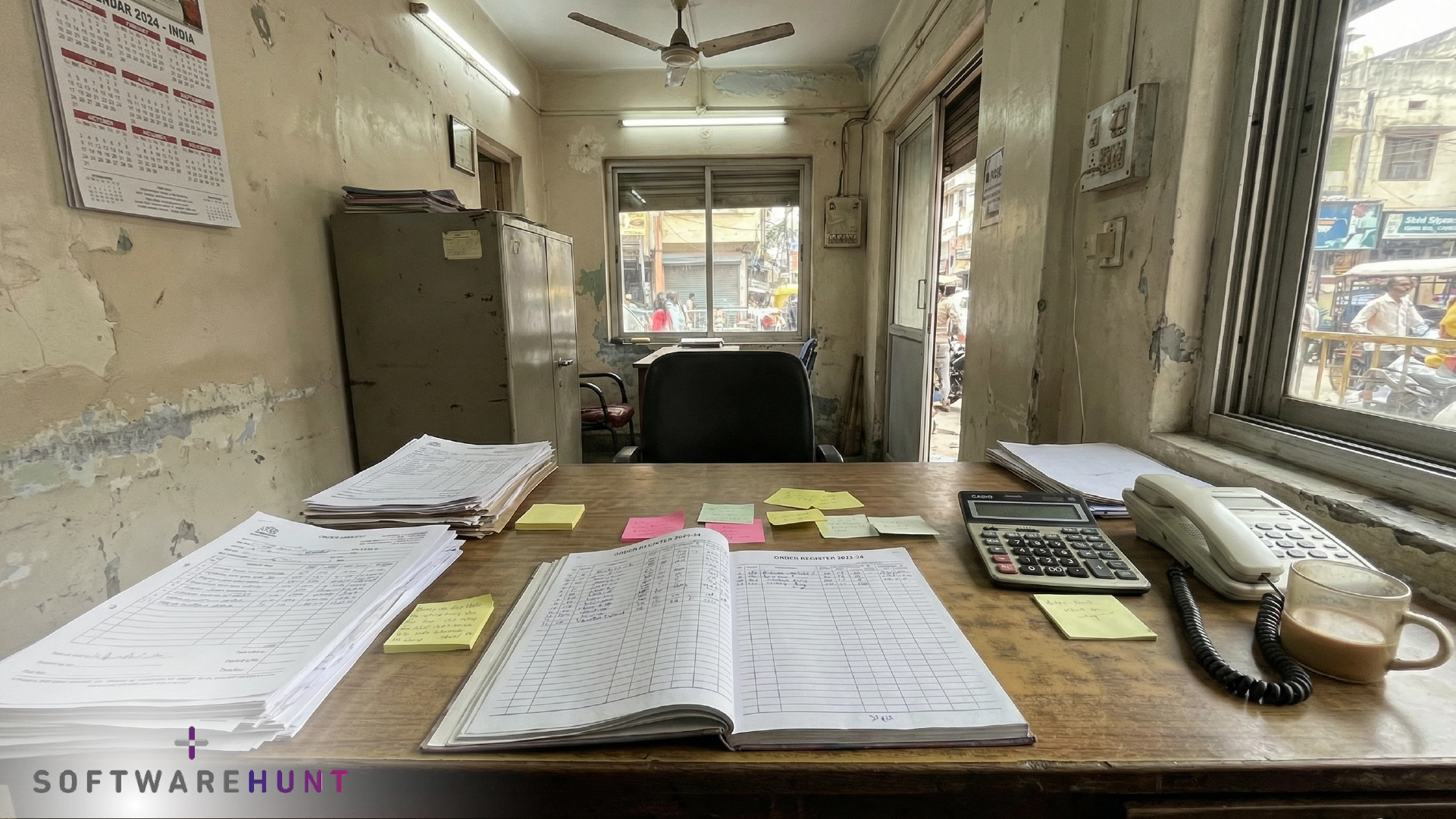
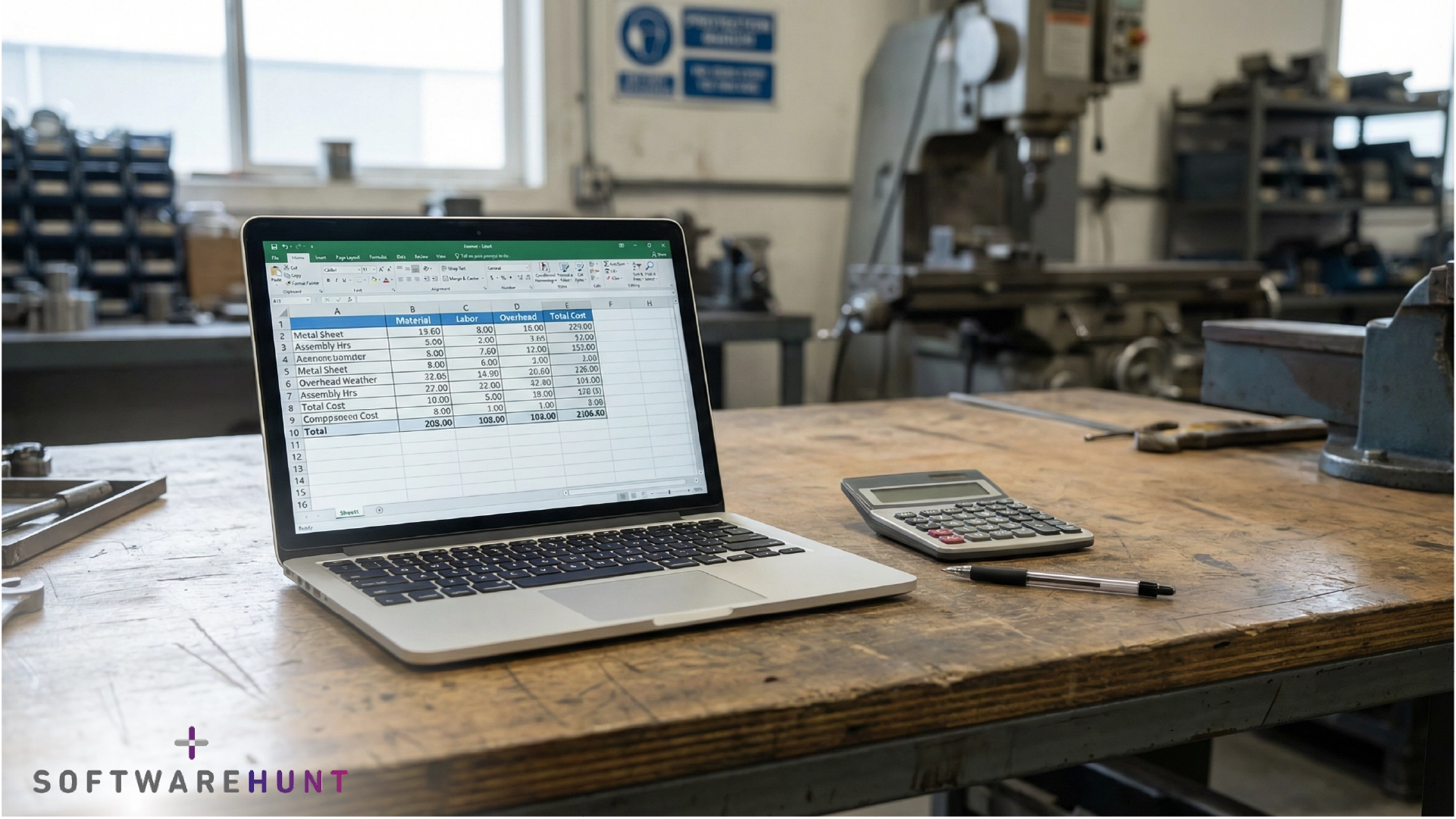
In tier 2 and tier 3 manufacturing in India, this problem is amplified. You’re running on spreadsheets and Tally. Demand is forecast based on gut feeling, not data. Suppliers call when deliveries are late, not before. And by then, it’s too late.
The real cost? It’s invisible until it hits your profit and loss statement.
How Poor Inventory Management Hurts Manufacturers
Let’s say you run a mid-sized manufacturing business. ₹2 crore in annual sales. ₹50 lakhs sitting in inventory. You think you’ve got it under control.
You don’t.
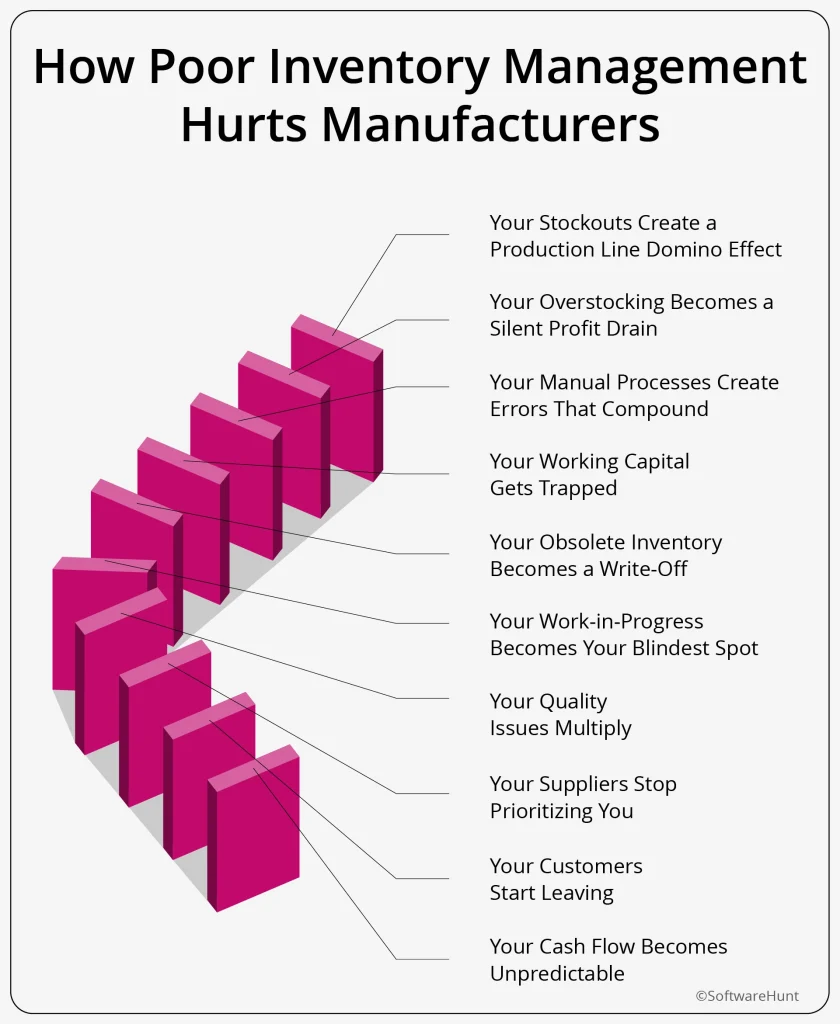
Poor inventory management cascades through your business in ten different ways. Each one feeds into the next. Fix one without understanding the others, and you’re just moving the problem around.
Your Stockouts Create a Production Line Domino Effect
Your system shows raw materials are available. Your production team starts their shifts expecting materials that aren’t actually there. By the time they realize it, the line is down. A ₹100 part shortage can idle a ₹2 crore production line in minutes. Workers sit around. Materials spoil during restart. Quality checks need repeating. You have to expedite replacement materials at triple the normal cost. Your customer misses the delivery date. The relationship takes a hit.
Your Overstocking Becomes a Silent Profit Drain
Twenty to thirty percent of inventory in a well-managed company just sits there unsold. For electronics or automotive components, it’s 50 percent or more. This isn’t just warehouse space being used inefficiently. This is cash locked up that could be funding growth, paying down debt, or reinvesting in equipment. And while it sits, you’re bleeding carrying costs. Storage fees. Handling labor. Insurance. Utilities. Depreciation.
The annual cost to hold inventory? It’s typically 25% of the inventory value itself.
For your ₹50 lakh inventory, that’s ₹12.5 lakhs a year. Every single year. That’s a daily cost of ₹34,000. Just sitting there.
Your Manual Processes Create Errors That Compound
Your team updates inventory from a spreadsheet. A number gets transposed. Or they do a physical count, but the person updating the system forgets to flag the discrepancy. Three weeks later, when you’re doing month-end close, you discover ₹5 lakhs in variance. Now someone spends three days investigating. The finance team has to stay late.
And here’s the part that costs money nobody talks about: every ₹1 in inventory error equals ₹1 in direct profit impact.
Your Working Capital Gets Trapped
You pay suppliers in 30 days. Your customers pay you in 60 days. And your inventory? It sits for 152 days on average. That’s a cash conversion cycle of over six months. For a ₹2 crore business, that means you need ₹100 lakhs sitting in working capital at any given time. That capital has a cost. At a 12% cost of capital, that’s ₹12 lakhs a year you’re spending just to keep the money locked up.
Your Obsolete Inventory Becomes a Write-Off
When demand didn’t show up in late 2023 and into 2024, manufacturers discovered they’d over-ordered. Twenty to thirty percent of their inventory became unsellable. Some products became truly obsolete as newer models launched. Others just couldn’t move because demand had shifted. Large retailers like Shoppers Stop had to write off ₹9 crores. Smaller companies face proportional losses. This isn’t accounting fiction. It’s real money gone.
Your Work-in-Progress Becomes Your Blindest Spot
Here’s a number that should shock you: work-in-progress inventory has six to nine times more impact on your profitability than finished goods inventory. Each day of WIP sitting in production costs you 0.113 percent in return on assets. That same day of finished goods costs you 0.013 percent.
If you’re holding 30 days of WIP, cutting it to 20 days would improve your ROA by nearly one percent and free up ₹5-10 lakhs in cash. But most manufacturers don’t track WIP at all. They just hope it’s moving.
Your Quality Issues Multiply
You discover defects after 80 percent of a batch is complete. The cost to fix it? Twenty to forty percent of the original production labor. The scrap material? Another 30-50 percent of the material cost gone. And your schedule? Now completely disrupted because rework takes priority. If your defect rate creeps from 2 to 5 percent, your rework costs double.
Your Suppliers Stop Prioritizing You
They see erratic orders. One week you’re ordering 100 units, the next week 50, the next week 300. They can’t plan. You’re creating what supply chain experts call the bullwhip effect: a 5 percent drop in actual customer demand can create a 40 percent swing in upstream orders. Your suppliers get frustrated. You move to their lower priority queue. Lead times get longer. Quality suffers. Your negotiating power disappears.
Your Customers Start Leaving
Sixty-nine percent of customers express dissatisfaction when stockouts happen. Eighty-two percent of them won’t come back. You could be losing 20 percent of potential revenue to inventory-related issues.
Your Cash Flow Becomes Unpredictable
Customers delay payment. Suppliers demand faster payment. You’re caught in the middle, needing more working capital to fund operations because so much cash is tied up in inventory. You take a loan at 15 percent interest. Now you’re paying ₹15 lakhs per year just to finance excess inventory you don’t need.
These ten problems don’t exist in isolation. One causes another. Fix the stockout by ordering more safety stock, and you create overstocking. Try to cut overstock quickly, and you get hit with a stockout. Miss a customer delivery because of inventory issues, and you lose the relationship. Now you have lower revenue, which means lower utilization of your plant, which means higher cost per unit produced, which means lower margins.
The spiral gets worse, not better, until you address the root cause.
The Cost of Poor Inventory Management
Let’s quantify this.
For your ₹2 crore manufacturing business with ₹50 lakhs in inventory and a 10 percent net profit margin (₹20 lakhs profit), poor inventory management costs you approximately ₹55.5 lakhs annually. That’s nearly three times your actual net profit.
Here’s the breakdown:
Carrying costs account for ₹12.5 lakhs every year. That’s 62 percent of your net profit going just to store and maintain inventory you’re not selling fast enough.
Stockout losses cost you ₹10 lakhs in lost margin from missed sales. Production downtime from material shortages? Another ₹6 lakhs. Unplanned stops are 15 times costlier than planned maintenance, and inventory shortages are one of the biggest causes.
Obsolescence and write-offs cost ₹10 lakhs. That’s 50 percent of your entire annual profit, wiped out because forecast accuracy wasn’t good enough.
Operational inefficiency – your team spending 25-30 percent of their time fixing inventory issues instead of growing the business – costs ₹8 lakhs in lost productivity.
Quality rework from late defect detection, emergency freight charges from expedited shipping, data errors during month-end close that require manual corrections. All together, another ₹9 lakhs.
That’s ₹55.5 lakhs. In hidden costs.
Most companies don’t measure these costs separately, so they stay invisible. They’re buried in COGS, overhead, and variance explanations. But they’re real. And they’re eating your profit.
The Working Capital Perspective
Now consider this from a working capital angle. Your Days Inventory Outstanding (DIO)—the number of days inventory sits before being sold is currently 152 days.
The formula is simple:
(Average Inventory ÷ Cost of Goods Sold) × 365 days.
If you could reduce that to 60 days (which is healthy for manufacturing), you’d free up ₹30-40 lakhs in cash. At 12-15 percent cost of capital, that’s ₹4-6 lakhs in carrying cost savings alone.
Put these together, and poor inventory management is costing you somewhere between ₹50-60 lakhs annually. For some of you, it’s more.
But here’s what most people miss: this cost is optional. It’s not inevitable. It’s what happens when you don’t manage inventory well. And it’s completely fixable.
13 Warning Signs You’re Dealing With This (And How to Know)
Most companies don’t realize they have an inventory problem until it shows up in numbers they can’t ignore. But the signs start showing up much earlier. Here are the ones to watch for:
You’re expediting orders more than you used to. If 10-15 percent of your orders now require express shipping, your demand forecast is broken or your inventory levels are too low. That ₹3-5 lakh monthly freight bill? It’s a symptom, not a solution. The real problem is upstream.
Your inventory accuracy is lower than you think. You assume you have 95 percent accuracy because you haven’t actually measured it. Run a proper cycle count. Compare physical stock to system records. Most companies discover they’re at 65-95%, not 95-99%.
Production stops for materials 2+ times per month. Not delays. Complete stops. If your team regularly can’t find materials that your system says are in stock, you have a ghost stock problem. Your data isn’t matching reality.
Your Days Inventory Outstanding is creeping up. Calculate it: (Average Inventory ÷ COGS) × 365. If it’s above 90 days and rising, cash is getting trapped. If it’s over 120 days, you have a serious problem. Healthy manufacturing sits between 45-70 days.
You’re writing off more inventory than last year. If your annual obsolescence reserve has grown, demand forecasting isn’t working. Either you’re over-ordering or demand is shifting faster than you can react.
Month-end close is getting delayed. If your finance team needs 1-2 extra weeks to reconcile inventory, your consumption isn’t being recorded in real-time. You’re relying on manual counts and journal entries instead of system records.
Slow-moving inventory is piling up. More than 10 percent of your inventory hasn’t moved in 90 days? That’s inventory you should have either sold, discounted, or written off already. Thirty percent or more slow-moving? You’re in crisis mode.
Your inventory turnover is declining year-over-year. Calculate it: COGS ÷ Average Inventory. If the ratio is getting smaller, inventory is stagnating. Slow movers are accumulating.
Your team blames “the system.” You hear “the system shows we have 100 units but we only have 50” more than once a month. When team members don’t trust system data, they work around it instead of from it. That means processes are broken, not just the software.
Nobody can tell you how much inventory you have in five minutes. If answering “how much do we have of SKU X across all locations” takes hours, you don’t have real-time visibility. You’re making decisions on outdated information.
Suppliers are complaining about inconsistent orders. If they’re saying “your orders are all over the place,” they can’t plan their own production. You’re creating the bullwhip effect unintentionally.
Your cash flow is tight despite growing sales. If revenue is up but working capital needs keep increasing, inventory is your problem. You need more cash to fund more inventory, not because you’re selling more necessarily, but because things are sitting longer.[
Your safety stock keeps growing. Each time you hit a stockout, someone orders more safety stock “to prevent this next time.” But nobody removes safety stock when demand forecast actually improves. So it just keeps growing, cash gets trapped, and carrying costs increase.
If you recognize 5-8 of these signs, measure your key metrics right now. What you’re about to discover will probably surprise you. Most companies are bleeding profit in ways they don’t measure.
We’re SoftwareHunt. Our team sits with manufacturing owners to understand your operational leaks and growth challenges. We go beyond platform listings to help you find the right solution at no cost to you.
Email an advisor for a quick fit-check write to us at connect@softwarehunt.com
How to Actually Fix Poor Inventory Management
Here’s what works and what doesn’t.
Most companies buy new software hoping it fixes their inventory problems. Then they discover the software doesn’t actually help because they’ve digitized a broken process. The mistakes just happen faster now. This is the cardinal error of inventory management: assuming technology solves process problems.
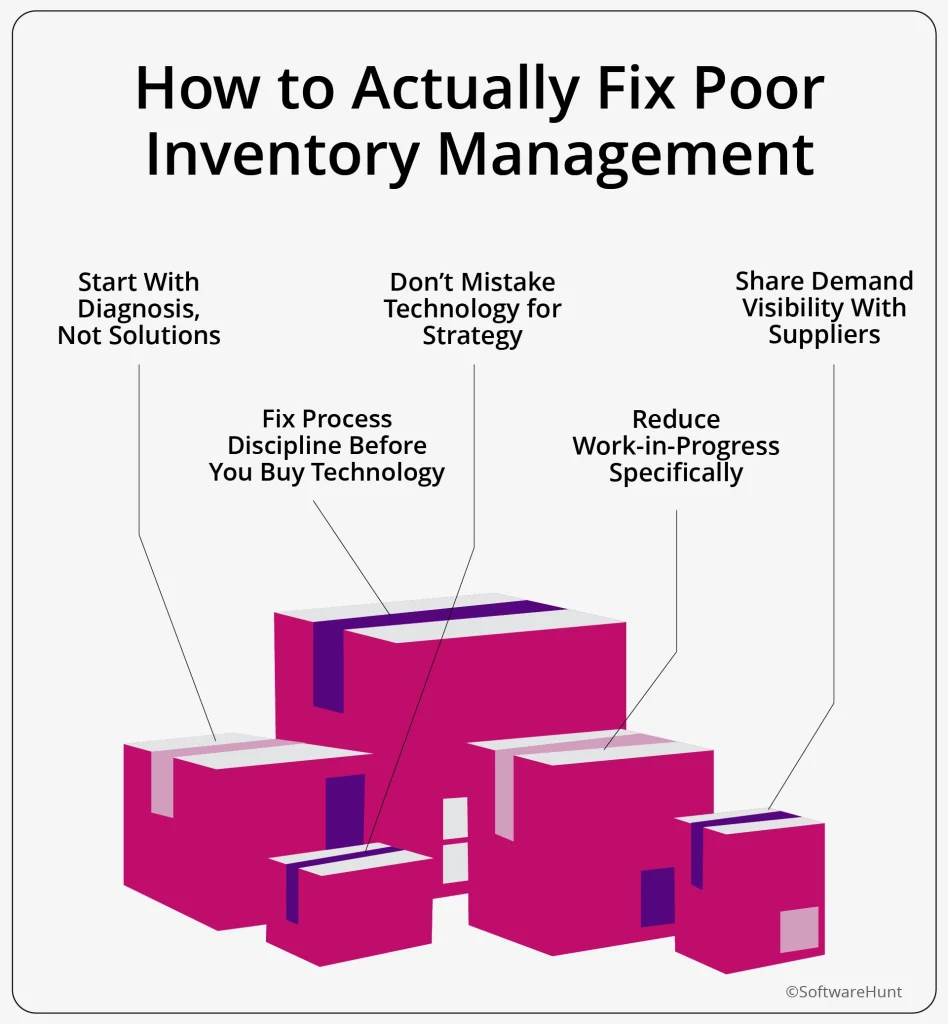
Start With Diagnosis, Not Solutions
Measure six baseline metrics. Inventory accuracy: do a full count and compare to system records. Inventory turnover:
COGS ÷ Average Inventory. Days Inventory Outstanding: (Avg Inventory ÷ COGS) × 365.
Stockout frequency: how often is material requested but unavailable? Dead stock percentage: inventory with zero movement in 90 days.
Carrying cost: total annual carrying cost ÷ average inventory value.
Don’t assume you know these numbers. Measure them. You’ll be surprised.
Then ask diagnostic questions.
- Who owns inventory accuracy? If nobody, you’ve found your first problem.
- How do materials get updated in the system – real-time or batch entry?
- How is demand forecasted – data-driven or gut feeling?
- Do your sales, production, and finance systems talk to each other?
The answers will tell you exactly what’s broken.
Fix Process Discipline Before You Buy Technology
Most problems resolve with better procedures, not better software.
Standardize your receiving process: all items scanned against purchase orders with immediate system updates.
Implement cycle counting: count high-value items weekly, medium-value items monthly, low-value items quarterly.
Compare physical to system immediately and investigate discrepancies the same day.
Create monthly aging analysis: identify slow-movers and decide whether to discount, reposition, or write off.
Establish clear ownership: one person owns overall inventory accuracy, one owns warehouse procedures, one owns demand forecasting, one owns supplier performance. Meet weekly on accuracy metrics. Monthly on Inventory forecasting. Quarterly on obsolescence.
Don’t Mistake Technology for Strategy
Most companies assume software will fix their inventory problem. It won’t, if your processes are broken, technology just automates mistakes faster.
Fix procedures first. Measure results. Then (and only then) evaluate whether technology is needed.
That’s where our diagnosis helps: identifying whether your problem is a process, people, or systems. Most of the time, it’s a process.
Reduce Work-in-Progress Specifically
Remember how WIP has six to nine times more impact on profitability than finished goods? Focus there first. Order-to-batch cycle instead of forecast-to-batch. Faster QC—add in-process inspection instead of end-of-batch. Reduce changeover time through standardized setups. Target: if you’re at 30 days WIP, get to 20. That single move frees ₹5-10 lakhs in cash and improves ROA by up to one percent.
Share Demand Visibility With Suppliers
If suppliers can’t see your actual demand, they default to safety stock buffering, which creates the bullwhip effect. Start simple: send them your monthly forecast. Update it weekly. Even a spreadsheet shared via email reduces the demand uncertainty they’re operating with. Result: more stable orders, better lead times, better quality, stronger relationships.
The 30-Day, 90-Day, and 12-Month Roadmap
You don’t have to fix everything at once.
Week 1-4: The 30-Day Diagnostic
Measure baseline metrics. Do a full physical inventory count. Investigate the biggest discrepancies. Document current procedures. Define ownership. Cost: ₹0-₹50,000 (mostly labor).
Expected result: You’ll discover accuracy is probably lower than you thought. You’ll find 5-10 quick wins that don’t cost money. Most importantly, you’ll know exactly what your problem is—not a guess, but measured fact.
Month 2-4: The 90-Day Fix
If it’s manual tracking errors, standardize your receiving/dispatch procedures and implement daily reconciliation. If it’s demand planning, analyze 12 months of historical sales. If it’s WIP buildup, reduce batch sizes.
Cost: ₹0-5 lakhs (mostly labor time, not technology).
Month 5-12: The 12-Month Transformation
Months 1-3 focused on process. Months 4-6 add technology if needed. Months 7-12 integrate everything and build continuous improvement. Cost: Depends on technology tier. ₹0-50 lakhs if process-only. ₹20-100 lakhs if you add software.
Expected end state: Inventory accuracy at 96 percent. DIO cut from 152 days to 70 days. Dead stock from 25 percent to 8 percent.
And here’s the payoff: annual profit improvement of ₹20-30 lakhs. Working capital freed up: ₹30-50 lakhs.
Your Next Step
You probably recognize some of these problems in your own business right now.
The question isn’t whether you have an inventory problem. It’s which inventory problem is costing you the most. Is it accuracy? WIP buildup? Demand forecasting? Supplier coordination? They need different fixes. A diagnostic conversation identifies exactly what’s happening in your situation, what it’s costing you in real terms, and what the realistic path forward looks like.
No product pitch. No software demo. Just a genuine conversation about where your inventory chaos is and how to fix it.
If you’re serious about unlocking ₹20-50 lakhs in profit improvement and cash, book a 20-minute diagnostic call. We’ll walk through your numbers, identify your specific bottleneck, and outline what fixing it actually takes.
The cost of poor inventory management isn’t hypothetical. It’s real. It’s in your margins right now. And it’s completely fixable.
The question is whether you’ll fix it or keep bleeding profit silently.
We’re SoftwareHunt. We work with manufacturing owners running on Tally, Excel, and lean teams to understand your operational leaks and growth challenges. Our team is happy to connect with you, understand your personal pain points, operational leaks and growth challenges and go beyond platform listings/information to help find the right solution for you.
We’ll help you translate symptoms into clear financial insight and show you where to focus first – at no cost to you.
To email an advisor for a quick fit-check write to us at connect@softwarehunt.com.